Spiff vs CaptivateIQ: Feature-by-Feature Comparison (2026)
Salesforce Spiff vs CaptivateIQ compared on pricing, CRM integration, plan complexity, implementation time, and G2 reviews. Includes who each tool is best for.
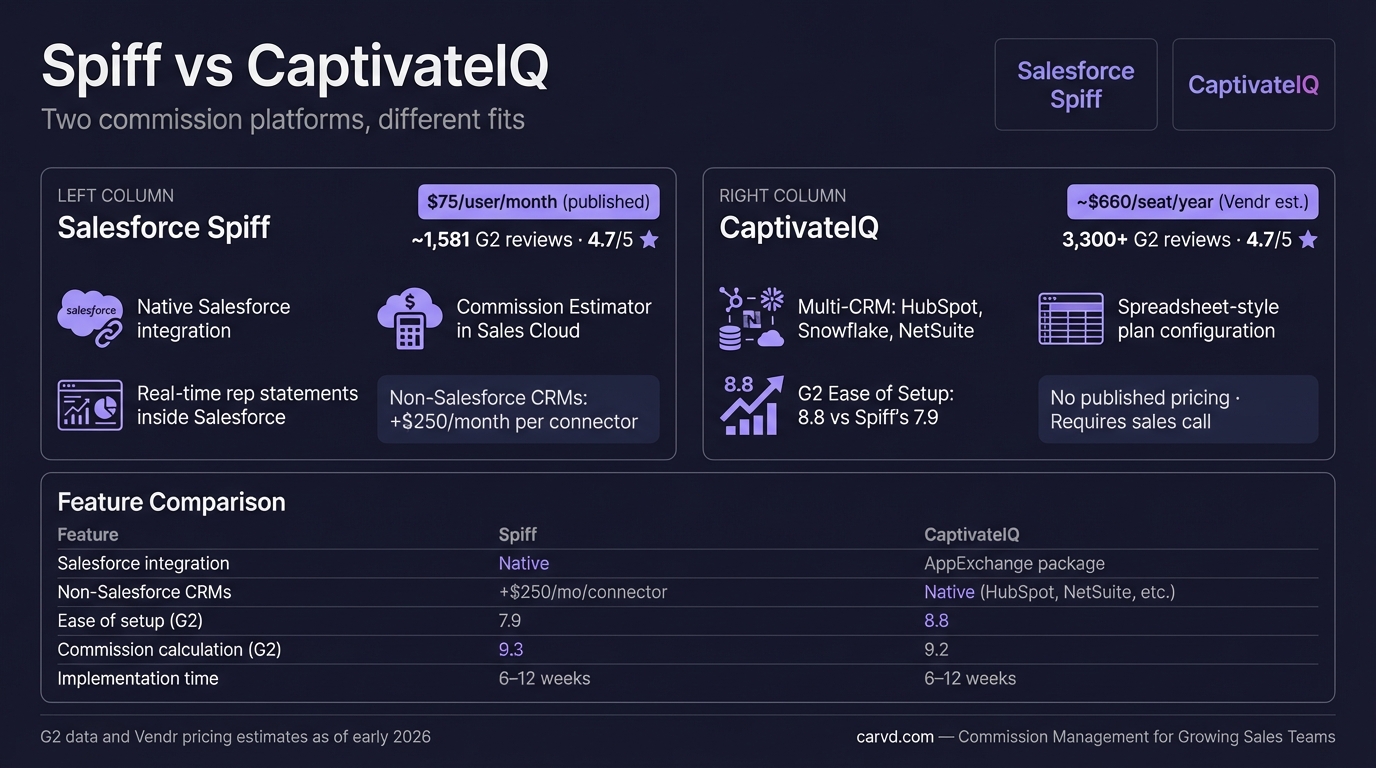
Salesforce Spiff is $75/user/month and runs natively inside Salesforce CRM. CaptivateIQ doesn't publish pricing — according to Vendr's procurement data (as of early 2026), it runs approximately $660/seat/year before integration and professional services costs. Both carry a 4.7/5 rating on G2. Both target mid-market and enterprise sales teams. And both require weeks of implementation before you're running live commission calculations.
The real question isn't which is better in the abstract — it's which fits the specific shape of your team: your CRM, your plan complexity, your implementation budget.
This post covers the verified differences between Spiff and CaptivateIQ across pricing, CRM integration, plan complexity support, and implementation, so you can make that call without a sales call first.
Where they're similar
Both tools are commission management platforms serving mid-market to enterprise sales organizations. Before getting into the differences, it's worth naming what they share:
- 4.7/5 on G2, with CaptivateIQ at 3,300+ reviews and Spiff at around 1,581 reviews
- Real-time rep visibility into commission earnings
- Dispute management workflows
- Audit trail for commission calculations
- Support for tiered plans, accelerators, SPIFFs, and multi-component comp structures
- Salesforce integration (though implemented differently — more on that below)
- Professional services requirements for complex implementations
If your evaluation criteria is "can it handle our current commission plan," both tools can almost certainly answer yes for most mid-market use cases. The differences emerge in total cost, CRM fit, and what happens when your plans need to change.
Key differences
CRM integration
This is the most practical differentiator for most buyers.
Spiff is built inside Salesforce. It's a native Salesforce product (acquired February 2024 for $419 million), which means commission data lives in the Salesforce data model, reps view their statements inside Salesforce, and the integration requires no separate setup for Salesforce CRM customers. For teams that live in Salesforce, this is a genuine advantage: the data flow is seamless and reps never leave the platform they're already in.
The constraint is what happens outside Salesforce. Each non-Salesforce connector — HubSpot, NetSuite, or any other data source — costs $250/month. A team pulling data from Salesforce plus a secondary system adds $3,000/year in connector fees before counting implementation.
CaptivateIQ integrates with Salesforce but isn't native to it. The connection runs as a Salesforce AppExchange package, with commission data calculated in CaptivateIQ and surfaced inside Salesforce via a Lightning component. The integration is primarily one-way: Salesforce pushes deal data into CaptivateIQ for calculation.
What CaptivateIQ does better here is breadth. Native integrations cover HubSpot, Snowflake, Amazon Redshift, MySQL, and NetSuite without a per-connector surcharge. For teams with heterogeneous tech stacks — a CRM, a data warehouse, and an ERP all feeding commission data — CaptivateIQ's architecture handles that without connector penalties. The Integration Platform add-on ($11,000/year) manages those connections at scale.
Bottom line: Spiff wins on Salesforce depth. CaptivateIQ wins on multi-system breadth.
Plan complexity
Both tools handle standard commission plans: flat rate, tiered structures, accelerators, draws, SPIFFs. For most teams running 2-4 plan variants, either works.
The difference shows up at the complex end.
CaptivateIQ's spreadsheet-inspired interface is designed for finance and ops teams that need to read and modify comp logic without learning a proprietary configuration language. Users consistently cite this as a strength in G2 reviews — the ability to understand, audit, and change plan logic without depending on vendor support for every modification. CaptivateIQ scores 8.8 for ease of setup on G2, higher than Spiff's 7.9, which is notable given that CaptivateIQ targets more complex plan types.
Spiff uses a drag-and-drop plan builder with a low-code approach. It handles a wide range of plan types including event-based payouts, territory splits, MBOs, and trailing commissions. Where it scores higher is commission calculation itself — 9.3 on G2 vs CaptivateIQ's 9.2.
For teams with frequently changing plans — headcount growth, quarterly plan adjustments, territory changes — CaptivateIQ's configuration model is designed to support ongoing modifications without professional services involvement for each change. Whether Spiff requires similar support for ongoing complex changes depends on plan structure and is worth confirming with the vendor during evaluation.
Pricing
| Salesforce Spiff | CaptivateIQ | |
|---|---|---|
| Published pricing | $75/user/month | None |
| Estimated cost (Vendr, early 2026) | $900/seat/year | ~$660/seat/year before discounts |
| Integration costs | $250/month per non-Salesforce connector | $11,000/year (Integration Platform add-on) |
| Professional services | ~$5,000 baseline implementation fee | Silver: $8,000 (50 hrs); Gold: $18,000 (100 hrs) |
| Premium support | 30% of net license cost | Custom |
Spiff's published pricing makes budget modeling easier. CaptivateIQ's list rate from Vendr data ($660/seat/year) runs below Spiff's $900/seat/year, but Vendr's data also shows typical contracts include integration platform costs and professional services that add significantly to the base rate.
For a 50-rep team:
- Spiff (Salesforce only): 50 reps × $900/seat = $45,000/year + implementation
- CaptivateIQ (estimated): 50 reps × $660 = $33,000/year + integration platform ($11,000) + professional services ($8,000–$18,000) = $52,000–$62,000/year at typical contract structure
These are estimates. Both vendors negotiate — CaptivateIQ's Vendr data shows 26–49% discounts based on team size and contract length. The actual number requires a sales conversation.
Implementation
Both tools typically take 6–12 weeks for standard deployments. Enterprise implementations with complex plan logic or multi-system integrations can run 4–6 months.
Spiff's stated implementation fee is ~$5,000. CaptivateIQ's baseline implementation starts at ~$7,500, with managed services at Silver ($8,000) or Gold ($18,000) tiers for teams requiring ongoing configuration support.
Multiple G2 and TrustRadius reviewers for both tools note that actual enterprise timelines frequently exceed stated timelines, particularly when implementation involves customized territory crediting rules or data from multiple source systems.
Rep experience
Both tools provide real-time rep dashboards showing commission earnings by deal. Reps can see how payouts were calculated, which reduces shadow accounting and commission disputes.
Spiff's rep experience is tightly embedded in Salesforce — reps see their statements directly inside the CRM they work in daily, including Commission Estimator for projecting earnings while building quotes. This is a genuine advantage for Salesforce-native teams.
CaptivateIQ provides a standalone rep portal alongside the Salesforce Lightning component. Reps have access to the same real-time calculation transparency; the interface is just external to Salesforce rather than embedded in it.
On G2, Dispute Management scores: Spiff 8.5, CaptivateIQ 8.8. Custom Reports: Spiff 8.5, CaptivateIQ 8.8. For smaller teams, Carvd offers a built-in dispute resolution workflow at a fraction of the cost.
Side-by-side comparison
| Salesforce Spiff | CaptivateIQ | |
|---|---|---|
| Published pricing | $75/user/month | None (~$660/seat/year per Vendr) |
| Salesforce integration | Native (built-in Salesforce) | AppExchange package + Lightning component |
| Non-Salesforce CRMs | $250/month per connector | Native (HubSpot, Snowflake, NetSuite, etc.) |
| G2 rating | 4.7 / 5 (~1,581 reviews) | 4.7 / 5 (3,300+ reviews) |
| Ease of setup (G2) | 7.9 | 8.8 |
| Commission calculation (G2) | 9.3 | 9.2 |
| Dispute management (G2) | 8.5 | 8.8 |
| Typical implementation | 6–12 weeks | 6–12 weeks |
| Best for | Salesforce-native mid-market teams | Multi-CRM, complex plans, mid-market to enterprise |
| Multi-currency | Yes | Yes |
| ASC-606 support | Yes | Yes |
| Rep portal | Salesforce-embedded + mobile | Standalone portal + Salesforce Lightning |
How to choose
Choose Spiff if:
- Your entire sales operation runs on Salesforce CRM and you want commission data native to that environment
- Your commission plans are standard — tiered accelerators, quota attainment, event-based payouts — and you don't anticipate frequent plan changes
- You want the tightest possible integration between pipeline and commission visibility (Commission Estimator inside Sales Cloud)
- Your team is already buying Salesforce licenses and can absorb commission software as an add-on
Choose CaptivateIQ if:
- You're on HubSpot, a data warehouse, a non-Salesforce CRM, or a mix of systems
- Your compensation plans change frequently or have complexity — territory overlays, multi-component plans, frequent plan revisions — that requires ongoing self-service configuration
- You need multi-currency support across international sales teams
- Plan complexity is increasing and you need a tool your ops team can modify without vendor involvement
Ask both vendors:
- "Show me my most complex plan type configured in your system — not described." A live demo of your actual plan structure reveals far more than a feature list.
- "What does the all-in annual cost look like, including integrations, professional services, and support?" The gap between headline price and total cost of ownership is significant for both.
- "Who handles ongoing plan changes — your team or ours?" This matters most when quarterly plan adjustments are routine.
When neither fits
Spiff and CaptivateIQ are both built for mid-market to enterprise teams with dedicated sales ops resources. If your team is under 75 reps on standard commission structures, the all-in cost of either tool — including implementation, integrations, and professional services — typically exceeds what the plan complexity warrants.
For teams at that scale, alternatives that fit better:
QuotaPath ($25–$50/user/month, published pricing): native HubSpot and Salesforce integration at every tier, ASC-606 support at the Growth tier, and earnings forecasting for reps. See QuotaPath alternative for more detail.
Carvd (flat-rate from $49/month): handles flat, tiered, and standard commission plans with no per-seat pricing, no implementation services required, and CRM integration on the Scale plan ($199/month). Carvd's comp plan builder and rep dashboards cover the core workflow most teams need. The limitation is plan complexity — multi-currency, territory overlays, and MBO components aren't supported. If those aren't requirements, Carvd gets teams live in days rather than months. For detailed comparisons, see Carvd vs Spiff and Carvd vs CaptivateIQ.
For a full comparison across seven commission platforms — including Spiff, CaptivateIQ, Everstage, QuotaPath, and Carvd — see best commission management software: 2026 comparison.
Related reading
- CaptivateIQ alternative — where CaptivateIQ fits and which tools work for teams outside its target profile
- Spiff alternative — Salesforce dependency, post-acquisition trade-offs, and which tools work without the connector surcharges
- Commission tracking software: buyer's guide (2026) — evaluation criteria and tool comparisons
- Commission errors: the most common mistakes — the six error types that manual commission processes consistently produce
- ASC 606 and sales commissions — capitalized commission expense and revenue recognition for finance teams
Last updated: March 22, 2026