Commission Software for Small Business: What Actually Works
Compare commission software built for small businesses. Covers pricing, CRM integrations, plan complexity, and which tools are worth evaluating for teams under 50 reps.
Enterprise commission software is not built for small sales teams. Salesforce Spiff starts at $75/user/month with a separate $250/month charge per non-Salesforce CRM connector. CaptivateIQ has no published pricing; based on Vendr procurement data (as of early 2026), the Incentives product runs approximately $660 per seat annually before volume discounts, with additional costs for integrations and professional services — and a 4–12 week implementation timeline. Xactly Incent requires professional services and typically takes several months to configure.
For a 10-rep team on a tiered commission plan, none of those are the right tool. The question isn't which enterprise platform to pick — it's which software was built for teams your size.
This post covers what actually works for small businesses, when a spreadsheet is still the right answer, and how to choose based on your rep count and plan complexity.
When a spreadsheet is still the right answer
Before buying software, it's worth being honest: spreadsheets work for very small, simple setups.
If you have 5 or fewer reps on a flat commission rate with no exceptions, no tiered accelerators, no splits, and no disputes — a Google Sheet can calculate commissions in minutes. The overhead of learning and maintaining commission software may not pay off at that scale.
The signals that you've outgrown a spreadsheet:
- 6+ reps — more rows means more opportunity for input errors
- Multiple plan types — different rates for different products, roles, or regions
- Tiered structures — any calculation where the rate changes based on quota attainment
- Rep disputes — when reps are tracking their own commissions separately because they don't trust the numbers (shadow accounting)
- Time cost — reconciling commissions manually takes more than 2–3 hours per pay period
If two or more of these apply, dedicated software will save time and reduce errors. See commission spreadsheet: when it works and when it doesn't for a fuller breakdown of when the switch makes sense.
What small businesses actually need
Enterprise commission software solves enterprise problems: multi-currency plans, territory overlays, MBO components, and custom crediting rules across hundreds of reps. Most small businesses don't have those problems.
For a team of 5–50 reps, the practical requirements are:
Speed to live. You need software running in days or a couple of weeks, not months. Multi-month implementations with professional services aren't practical for a team without dedicated sales ops.
Transparent pricing. You should be able to calculate your annual cost before a sales call. Per-seat pricing that scales linearly with headcount can also create unpredictable costs for growing teams.
Basic plan support. Flat-rate commissions, tiered accelerators, quota-based attainment, and splits cover the vast majority of small business comp plans. You don't need a proprietary scripting language to implement these.
Rep visibility. Reps should be able to see how their commission was calculated. Without this, shadow accounting — reps building parallel tracking spreadsheets — is common. Disputes follow.
CRM or CSV integration. The software needs to pull deal data without manual re-entry. A native Salesforce or HubSpot sync is ideal; a clean CSV deal import is an acceptable alternative for smaller teams.
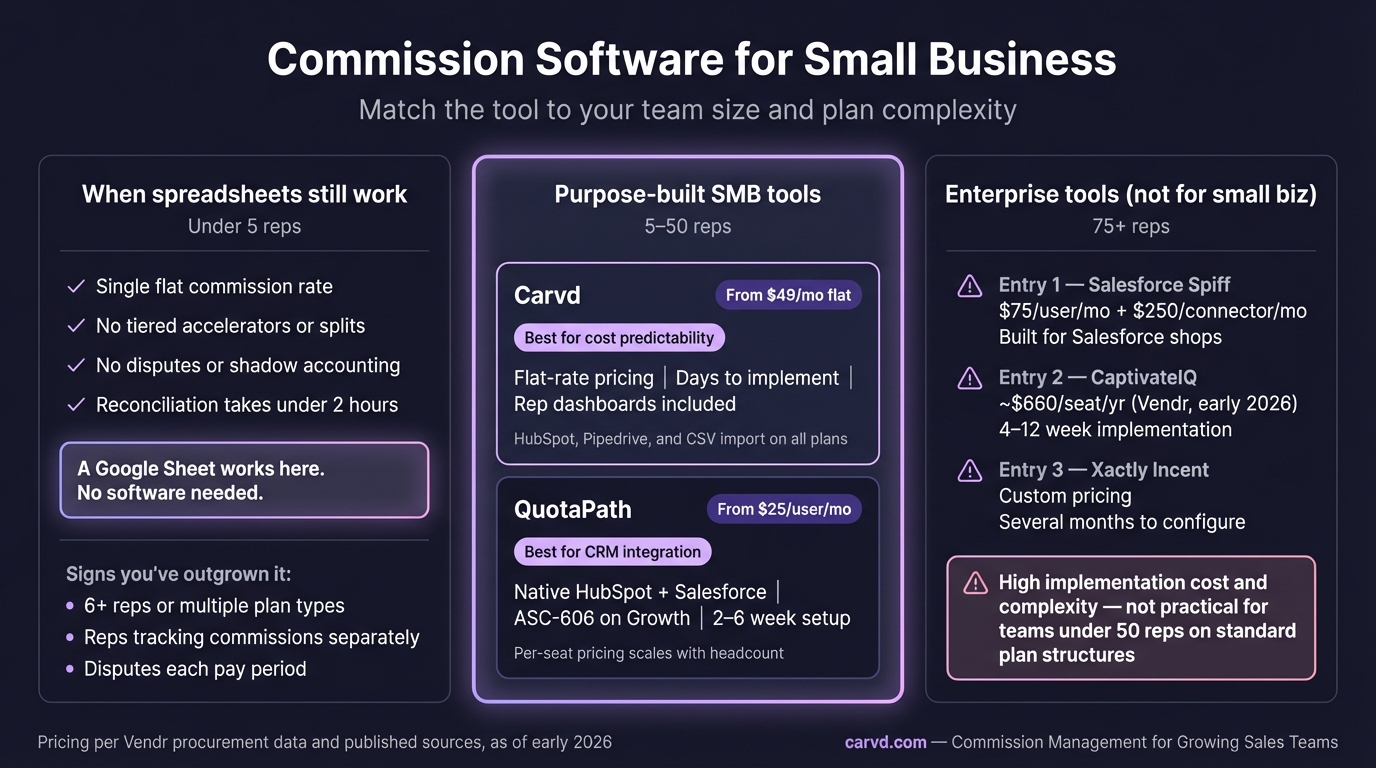
Commission software that works for small businesses
Carvd
Pricing: $49/month (Starter, up to 10 reps), $99/month (Growth, up to 25 reps), $199/month (Scale, unlimited reps). Flat-rate — no per-seat charges.
How it works: Starter and Growth plans accept a CSV export of closed-won deals. Scale connects to Salesforce or HubSpot. Commission rules are configured by the ops team or manager, and reps get a dashboard showing earnings broken down by deal. Dispute workflows are included on Growth and above.
What it does well:
- Flat-rate pricing removes the per-seat scaling math. A 5-rep team and a 40-rep team on Scale pay the same $199/month.
- Implementation is days, not months. No professional services required.
- Rep-facing dashboards and PDF payout statements at every tier.
- Dispute workflow on Growth ($99/month) — not locked to an enterprise tier.
Honest limitations:
- CRM integration requires the Scale plan ($199/month). Starter and Growth use CSV upload, which means a manual export step remains.
- No multi-currency support. International teams with different-currency commissions need a different tool.
- No ASC-606 compliance tooling. If capitalized commission expense reporting is a requirement, QuotaPath or CaptivateIQ handle this; Carvd doesn't.
- Fewer third-party reviews than established competitors — it's a newer product.
Best for: Teams of 5–50 reps with flat, tiered, or standard commission plans who want real-time rep visibility without per-seat pricing. Also the best fit for managers who need software running before next month's close.
QuotaPath
Pricing: $25–$50/user/month, billed annually. Three published tiers: Essential, Growth, Premium.
How it works: QuotaPath connects natively to Salesforce and HubSpot at all paid tiers — no connector surcharge. The earnings forecasting feature lets reps model their pipeline to project quarterly earnings. The Growth tier adds ASC-606 compliance; Premium adds payroll integration via Rippling.
What it does well:
- The most transparent per-seat pricing among mid-market tools — you can calculate your annual cost before the first sales call.
- Native Salesforce and HubSpot integration at every paid tier, no add-on fees.
- Earnings forecasting for reps reduces shadow accounting.
- ASC-606 compliance at the Growth tier, which covers a requirement that typically costs far more in enterprise tools.
- Implementation typically runs 2–6 weeks depending on plan complexity.
Honest limitations:
- Per-seat pricing scales with headcount. A 30-rep team at $35/user/month is $1,050/month, or $12,600/year.
- Less suited to highly complex plan types — territory overlays, multi-currency, custom crediting rules.
- More configuration time than Carvd for the same plan complexity, since CRM sync requires setup.
Best for: Growing SMB and mid-market teams (10–75 reps) that want transparent per-seat pricing, native CRM integration without surcharges, and rep-facing earnings forecasting. Also the practical choice if ASC-606 compliance is a near-term requirement.
What small businesses should avoid
Enterprise ICM platforms (Xactly, CaptivateIQ). These are built for 75–500 rep organizations with complex, multi-plan programs and dedicated sales ops teams. CaptivateIQ has no published pricing; based on Vendr procurement data (as of early 2026), the Incentives product runs approximately $660 per seat annually before volume discounts, with additional costs for integrations ($11,000/year) and professional services (Silver tier: $8,000; Gold: $18,000). Implementation typically runs 4–12 weeks. Xactly Incent's scope is similar — custom pricing, several months to implement, professional services required. At under 50 reps with standard plan structures, neither is the right tool — though both are worth evaluating when plan complexity genuinely demands it.
Salesforce Spiff. $75/user/month, with an additional $250/month per non-Salesforce CRM connector. A 15-rep team on HubSpot pays $13,500/year in user licenses plus $3,000/year in connector fees before implementation or support. Spiff's value proposition is rooted in deep Salesforce-native integration — teams on other CRMs get a weaker integration at a high price.
CRM native features. Salesforce, HubSpot, and Pipedrive have some form of commission or incentive tracking, but none are purpose-built for calculating and displaying commissions to reps. They lack rep-facing dashboards, dispute workflows, and the plan logic flexibility needed for tiered structures or multiple plan types.
Side-by-side comparison
| Tool | Starting price | Pricing model | CRM integration | Implementation | ASC-606 | Best for |
|---|---|---|---|---|---|---|
| Carvd | $49/mo flat | Flat-rate | Scale plan ($199/mo) | Days | No | Teams of 5–50 reps, cost predictability |
| QuotaPath | $25/user/mo | Per seat | All tiers (no surcharge) | 2–6 weeks | Growth tier | SMB–mid-market, CRM-heavy workflows |
| Salesforce Spiff | $75/user/mo | Per seat | Native Salesforce; +$250/connector/mo | 2 weeks–6 months | Yes | Salesforce enterprise shops |
| CaptivateIQ | ~$660/seat/yr* | Per seat | Yes | 4–12 weeks | Yes | Complex plans, 75+ reps |
| Xactly Incent | Custom | Per seat | Yes | ~6 months | Yes | Enterprise, large teams |
*CaptivateIQ pricing per Vendr procurement data, as of early 2026. Excludes integration and professional services costs.
How to choose by team size
Under 10 reps: If your plan is a flat rate and disputes haven't been a problem, a spreadsheet is still a reasonable choice. To move off spreadsheets, Carvd's Starter plan ($49/month flat) is the lowest-friction option — no per-seat charges and no implementation services required.
10–25 reps: This is the range where commission software consistently pays for itself. Manual reconciliation gets error-prone, and rep disputes start eating into management time. Carvd Growth ($99/month flat) or QuotaPath Essential ($25/user/month, so $250–$625/month depending on rep count) are the practical options. QuotaPath has native CRM sync at base tier; Carvd uses CSV at Growth but costs less at the higher end of this range.
25–50 reps: QuotaPath Growth handles ASC-606 and native CRM integration. Carvd Scale ($199/month flat) is cheaper at 25+ reps — a 30-rep team on QuotaPath at $35/user/month costs $1,050/month versus $199/month flat on Carvd Scale. The trade-off is whether native per-rep CRM sync at every tier matters more than cost predictability.
50+ reps: Both Carvd and QuotaPath remain viable depending on plan complexity. If plan types are getting complex — territory-based crediting, multi-currency, MBO components — start evaluating Everstage, which targets growing mid-market teams with faster implementation than legacy enterprise tools.
Questions to ask before buying
"Show me my plan type configured — not described." Ask every vendor to demonstrate your actual commission structure live during the demo, not a simplified version of it. The gap between "we support that" and "here it is running" tells you more than any feature checklist.
"What's the total cost for my team size in year one?" Include implementation, integration costs, and surcharges. For Spiff, add the connector fee. For CaptivateIQ, add professional services. For per-seat tools, calculate at your expected rep count 12 months out, not today.
"How long before reps see their first payout in the tool?" For a 10–20 rep team on a flat or tiered plan, any answer longer than two weeks is worth probing.
"What does a typical dispute look like in the tool?" This reveals how rep-facing the software actually is. Tools built for ops teams often have weak rep interfaces — commissions are calculated correctly, but reps can't see the derivation. Carvd's rep dashboards show deal-level breakdowns so reps can verify their own numbers.
Small businesses don't need enterprise commission software. The complexity, cost, and implementation time of Xactly, CaptivateIQ, and Salesforce Spiff exist because they're solving enterprise problems at enterprise scale.
For a 10–40 rep team on standard commission structures, Carvd starts at $49/month flat — no implementation services, no per-seat charges, rep-facing dashboards included. QuotaPath's Essential tier ($25/user/month) is the alternative if native CRM integration at base price is the priority.
Not sure what your reps should be earning? The OTE calculator can help you benchmark before selecting a tool. For a broader comparison across seven commission platforms — pricing, feature matrices, and best-for summaries — see best commission management software: 2026 comparison.
Related reading
- CaptivateIQ alternative — where CaptivateIQ fits and which tools work for teams outside its target profile
- Spiff alternative — Salesforce Spiff pricing, post-acquisition trade-offs, and which teams it fits
- Commission tracking software: buyer's guide (2026) — evaluation criteria and tool comparisons across seven platforms
- Commission spreadsheet: free template + why you'll outgrow it — when a spreadsheet is enough and when it isn't
- Commission errors: the most common mistakes — the six error types that manual commission processes consistently produce
Last updated: March 22, 2026