Best Commission Software in 2026: 9 Tools Compared Honestly
Compare the 9 best commission software tools of 2026. Real pricing, honest pros/cons, and best-for guidance for CaptivateIQ, QuotaPath, Spiff, Xactly, Everstage, Carvd, and more.
Most commission software is built for enterprise buyers. The marketing says otherwise—every vendor claims to serve "growing sales teams"—but the pricing, implementation timelines, and feature scope tell a different story.
The best commission software for your team depends on one thing: how complex your commission plans actually are. A 12-rep SaaS company with a flat 10% rate and an occasional accelerator doesn't need the same tool as a 400-rep insurance carrier with territory overlays, draw programs, and multi-step approval workflows.
This guide covers 9 commission software tools—with real pricing where available, honest assessments of where each tool works well, and clear guidance on which segment each serves. We've organized them by the team size they're genuinely built for.
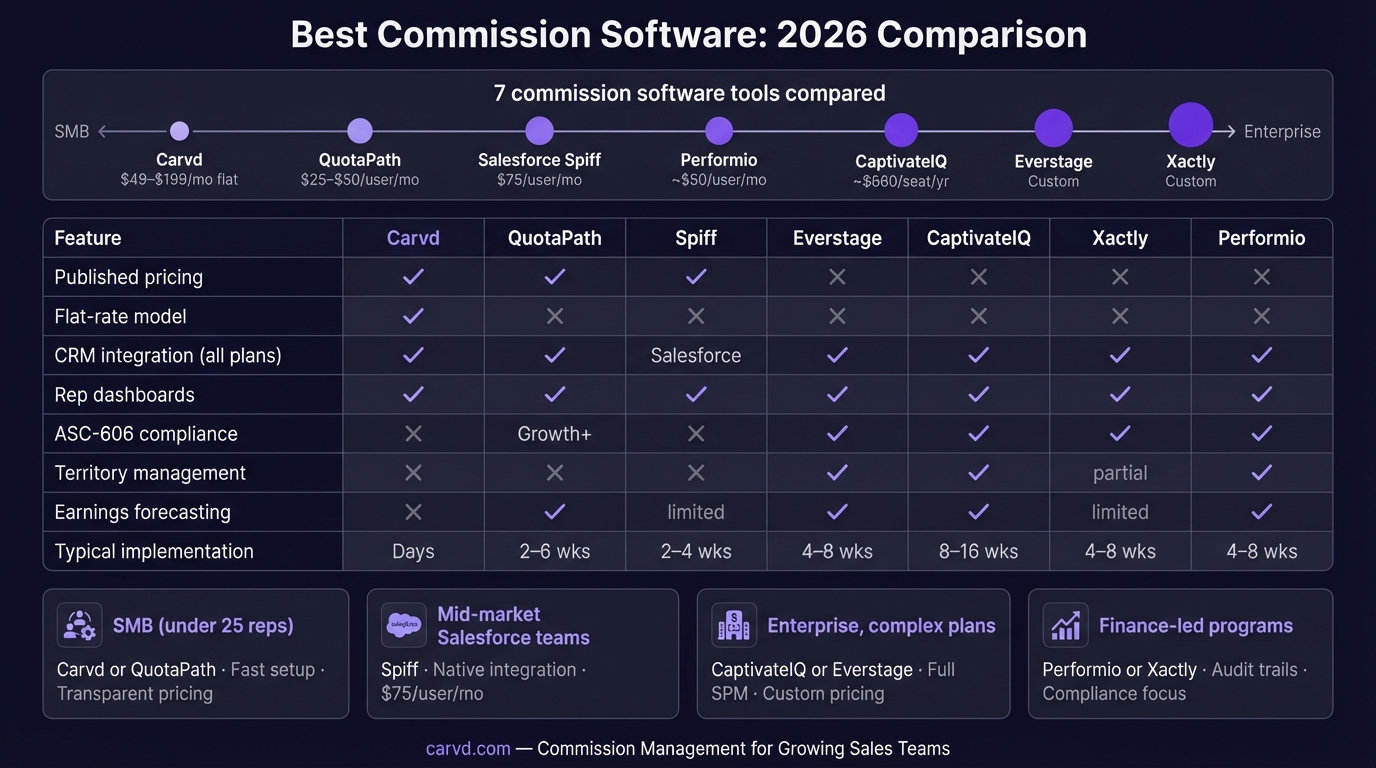
Who this guide is for
This comparison is most useful if you're:
- A Sales Manager, RevOps lead, or VP of Sales managing commissions for a team of 5-500 reps
- Running commission calculations in spreadsheets and hitting the limits (errors, disputes, hours-per-cycle)
- Evaluating software and finding that most review sites are either G2 category pages or competitor-funded listicles
If you're a 1,000-rep enterprise with territory overlays and MBO components, CaptivateIQ, Xactly, or Performio are your realistic options. This guide will tell you that clearly instead of pretending otherwise.
How we evaluated
We assessed each tool on:
- Pricing transparency: Published pricing vs. "contact sales" opacity
- Setup time: Hours/days vs. weeks/months to first commission run
- Plan type support: Flat, tiered, per-product, draws, SPIFs, territory overlays
- Rep transparency: Whether reps can see deal-level breakdowns of their payout
- Integrations: CRM connections and data import options
- Payroll readiness: Export formats for finance/payroll teams
- Scalability ceiling: Where the tool breaks down
The 9 tools at a glance
| Tool | Starting price | Best for | Setup time | Pricing model |
|---|---|---|---|---|
| Carvd | $49/month | 5-200 reps, fast setup | Under 1 hour | Flat monthly, no per-seat |
| QuotaPath | ~$375/month | 10-50 reps on HubSpot/Salesforce | Days | Platform fee + per user |
| Sales Cookie | $400/month | 10-50 reps, no-contract flexibility | Days | Per user, 10-user minimum |
| Core Commissions | $120/month | 10-100 reps, complex rules | Days–weeks | Per payee |
| Everstage | Custom (~$15K+/year) | 50-150 reps, mid-market | 4-8 weeks | Custom quote |
| CaptivateIQ | Custom (~$20K+/year) | 30-300 reps, complex plans | 8-12 weeks | Custom quote, per seat |
| Salesforce Spiff | $75/user/month | 150-500 reps in Salesforce | Weeks | Per user, annual |
| Xactly Incent | Custom (~$60/user/month floor) | 200-1,000+ reps | 3-6 months | Custom enterprise |
| Performio | Custom (~$50/user/month floor) | 50-200 reps, audit compliance | 8-12 weeks | Custom quote |
Pricing as of March 2026. Enterprise tools without published pricing use third-party procurement data (Vendr, Coefficient.io, G2 buyer reports).
SMB tools (under 50 reps)
Carvd
Carvd is commission tracking software built for sales teams that have outgrown spreadsheets but don't need the complexity—or cost—of enterprise ICM platforms.
What it does: Import deals from HubSpot, Pipedrive, or CSV. Build flat, tiered, or per-product commission plans using the comp plan builder. Run commission calculations with a one-click audit that shows reps exactly how each deal contributed to their payout. Export to payroll-ready CSV or PDF statements.
Pricing (as of March 2026):
- Starter: $49/month — up to 10 reps, 2 plans
- Growth: $99/month — up to 25 reps, unlimited plans, disputes and payroll export
- Scale: $199/month — unlimited reps, API access, custom branding, dedicated onboarding
No per-seat fees. No implementation costs. No contract required.
Where it works well:
- Teams of 5-200 reps on flat, tiered, or product-based plans
- RevOps teams running monthly commission cycles who need to close the books fast
- Companies where reps are shadow accounting (recalculating payouts in personal spreadsheets) — the deal-by-deal breakdown eliminates the trust problem
- Finance teams who need payroll-ready exports without manual reconciliation
Honest limitations:
- Doesn't support draws, SPIFs, or complex multi-step approval workflows
- No territory management or quota modeling
- Multi-currency not yet supported — international teams with commissions in multiple currencies should evaluate CaptivateIQ or Xactly
- Carvd connects to HubSpot and Pipedrive. Salesforce shops need to export CSV until a native sync ships
Bottom line for Carvd: The fastest path from "commission chaos" to "first run done" for teams with standard plan structures. Not the right fit if your plans need draws, territory overlays, or enterprise workflow automation.
QuotaPath
QuotaPath is commission software with a strong HubSpot and Salesforce integration layer and a plan builder that handles most SMB plan types. It targets sales teams that want something between "spreadsheet" and "enterprise ICM."
Pricing (as of March 2026):
- Essential: $250/month platform fee + $25/user/month (minimum ~$375/month for 5 users)
- Growth: $525/month platform fee + higher per-user rate — adds ASC 606 compliance, dispute resolution
- Premium: $800/month platform fee
Where it works well:
- Teams already on HubSpot or Salesforce who want native CRM sync without manual CSV exports
- Companies that need ASC 606 commission amortization tracking (Growth tier)
- RevOps teams building multiple plan types for different rep roles
Honest limitations:
- The platform fee structure makes QuotaPath expensive for very small teams. At 5 reps on Essential, you're paying $375/month before you've added a single plan.
- Dispute resolution and ASC 606 are Growth-tier features, which adds a meaningful cost step
- Some G2 reviewers note that complex accelerator logic requires workarounds compared to enterprise tools
Best for: 10-50 rep teams on HubSpot or Salesforce who want CRM-native commission sync and plan to grow into the platform's capabilities.
See our QuotaPath alternative comparison for a deeper head-to-head.
Sales Cookie
Sales Cookie is one of the few commission software vendors with fully transparent, published pricing and no annual contract requirement. It targets teams that want flexibility without a long-term commitment.
Pricing (as of March 2026):
- Business: $40/user/month — AI-assisted configuration, dashboards, reporting. Caps: 100K transactions, 25 plans, 1,000 calculations per run.
- Business+: $60/user/month — removes caps, adds API access and custom authentication
- 10-user minimum on both plans (~$400/month minimum)
- 14-day free trial, no credit card required
Where it works well:
- Small teams that want month-to-month flexibility without a long-term contract
- Companies integrating with HubSpot, Salesforce, QuickBooks, Stripe, or Dynamics 365 — Sales Cookie has broad connector support
- Teams that want to self-configure without relying on a vendor's implementation team
Honest limitations:
- The 10-user minimum is a real constraint. A 6-rep team is paying for 10 seats.
- Business tier transaction and calculation caps may bind high-volume teams
- Less sophisticated modeling for complex plan types compared to enterprise tools
Best for: Teams of 10-50 reps that want published pricing, no annual contract, and broad integration support.
Core Commissions
Core Commissions is a per-payee-priced platform with a rules engine that punches above its price point—particularly for insurance, channel sales, and recruitment industries with non-standard commission structures.
Pricing (as of March 2026):
- Launch: $12/payee/month, 10-payee minimum ($120/month minimum) — 5 commission rules, 2 support tickets, dispute management, rep portal
- Enterprise: $25-$35/payee/month — unlimited rules, full interactive features
- $500 Quick Start onboarding package (10 hours setup + 30-day trial)
Where it works well:
- Companies with specialized commission structures common in insurance, recruitment, or channel sales
- Teams needing automated auditing and dispute management at a low per-payee cost
- Mid-size companies (20-100+ reps) that want per-payee pricing that scales linearly
Honest limitations:
- Only 5 commission rules on the Launch plan — many teams will outgrow this quickly and need the Enterprise tier
- Support tickets are rationed on lower tiers
- The $500 onboarding fee is an upfront cost not visible in the monthly rate
- Interface receives mixed reviews compared to more polished tools
Best for: Teams with unconventional commission structures in insurance, channel sales, or recruitment who need an affordable rules engine.
Mid-market tools (50-200 reps)
Everstage
Everstage is a full SPM (sales performance management) platform that has gained significant traction in the 50-150 rep mid-market segment. It's rated 4.9/5 on G2 across 1,400+ reviews—the highest customer satisfaction score in the category.
Pricing (as of March 2026):
Everstage doesn't publish pricing. Based on third-party procurement data (Coefficient.io, G2 buyer reports), typical contract ranges:
- 20-50 reps: $10,000-$30,000/year
- 50-100 reps: $30,000-$60,000/year
- 100-250 reps: $60,000-$100,000+/year
- Implementation: $5,000-$15,000 (often negotiated down)
Where it works well:
- Mid-market companies that need complex accelerators, SPIFs, draws, and multi-currency support
- SOC 2 and GDPR compliance requirements
- Teams that want strong rep-facing dashboards—Everstage's rep UX is frequently cited as a differentiator
- Organizations integrating with Salesforce, HubSpot, SAP, or NetSuite
Honest limitations:
- Rarely cost-effective for teams under 30-40 reps — the pricing doesn't scale down well
- Some G2 reviewers report daily sync delays during month-end close, which matters if reps monitor earnings in real time
- Custom reporting requires professional services involvement
Best for: 50-150 rep mid-market teams that need complex plan support, high rep satisfaction scores, and compliance credentials.
See our Everstage alternative comparison for more detail.
CaptivateIQ
CaptivateIQ is the market leader in the mid-market commission software category—4.8/5 on Capterra from 840+ reviews, ranked #1 in Sales Compensation on G2 with 3,300+ reviews. It handles everything from simple tiered plans to complex multi-component compensation with territory overlays, SPIFs, multi-step approvals, and ML-powered quota forecasting.
Pricing (as of March 2026):
CaptivateIQ doesn't publish pricing. Third-party procurement benchmarks (Vendr, Coefficient.io):
- 30-50 reps: $20,000-$35,000/year
- 50-100 reps: $35,000-$65,000/year
- 100-200 reps: $60,000-$120,000/year
- Implementation: $5,000-$40,000+ (one-time)
- Managed services: $8,000-$18,000 for 50-100 hours
- Total first-year cost (30-rep team): typically $25,000-$70,000
Where it works well:
- Companies with genuinely complex commission structures—SPIFs, draws, multi-step approval workflows, territory overlays, eligibility rules across multiple plan types
- Organizations that need the full ICM suite: commission automation (CaptivateIQ Incentives), sales capacity planning (CaptivateIQ Planning), and ML quota forecasting (Catalyst)
- Enterprise integrations: Salesforce, HubSpot, NetSuite, Snowflake, BigQuery, Workday, ADP, and 15+ others
- Reference customers at scale: Datadog, 6sense, Boston Scientific
Honest limitations:
- 8-12 week typical implementation—not for teams that need commissions calculated this month
- Most plan changes require professional services engagement
- Not cost-effective for teams under 30 reps
- G2 reviewers consistently flag formula/calculation debugging as time-consuming without PS support
Best for: 30-300 rep mid-market companies with complex compensation structures who can absorb a multi-month implementation and have dedicated RevOps resources to manage the platform.
See our CaptivateIQ alternative comparison for a deeper analysis.
Enterprise tools (200+ reps)
Salesforce Spiff
Salesforce acquired Spiff in 2023 and rebranded it as Salesforce Spiff—a commission management layer inside the Salesforce ecosystem. If your sales team runs on Salesforce, Spiff offers native CRM integration that eliminates the data sync overhead of third-party connectors.
Pricing (as of March 2026):
- $75/user/month, billed annually (published on Salesforce's pricing page)
- Integration connectors: $250/connector/month for any system outside native Salesforce
- Premium support: 30% of net contract price for 24/7 coverage
- No free trial or self-serve signup
Where it works well:
- Salesforce-native organizations (Salesforce CRM + CPQ + Revenue Cloud) that want commission data in the same workspace as their pipeline
- Teams of 150-500 reps that need real-time commission visibility without CSV exports
- Organizations that have already standardized on Salesforce's Revenue Cloud ecosystem
Honest limitations:
- Tightly coupled to Salesforce. Limited value if you're not on Salesforce.
- $250/connector/month for non-Salesforce integrations adds up fast for mixed-stack organizations
- No trial means you're committing to an implementation before seeing the product
- At $75/user/month, a 100-rep team is paying $90,000/year before connectors and support
Best for: Salesforce-native organizations with 150+ reps who want commission management as part of their existing Salesforce investment.
Xactly Incent
Xactly is the legacy enterprise leader in sales performance management—founded in 2005, publicly traded until 2017, and the platform that most large-enterprise commission operations were built on. It's the reference point that mid-market alternatives define themselves against.
Pricing (as of March 2026):
Xactly doesn't publish pricing. Based on G2 buyer data and procurement intelligence (TrustRadius, Vendr):
- Published floor: ~$60/user/month
- Real-world average contract: ~$175,000/year across the full Xactly platform
- Large enterprise deals: $100,000-$300,000+/year
- Implementation: typically 3-6 months with a dedicated implementation partner
Where it works well:
- Global enterprises with 500+ reps across multiple currencies, geographies, and regulatory environments
- SAP or Oracle ERP environments—Xactly's enterprise integrations are built for legacy systems
- Organizations that need maximum compensation plan complexity: draw programs, SPIFs, territory overlays, multi-level manager compensation, quota modeling
- Regulated industries requiring audit trails and compliance documentation
Honest limitations:
- Widely considered overkill for teams under 200 reps—the pricing and complexity rarely justify it below that threshold
- Legacy architecture draws complaints from G2 and TrustRadius reviewers about inflexibility
- Heavy reliance on professional services for plan changes and reporting
- Implementation timelines of 3-6+ months with a dedicated SI partner
Best for: Large enterprises (500-1,000+ reps) with global operations, complex plan structures, and existing SAP/Oracle infrastructure.
Performio
Performio is an enterprise-grade ICM platform with a particularly strong footprint in Australian and US mid-to-large organizations. It differentiates on audit trail depth and compliance documentation—useful for regulated industries.
Pricing (as of March 2026):
Performio doesn't publish pricing. Based on Coefficient.io and Capterra data:
- Starting floor: ~$50/user/month
- 20-40 reps: $40,000-$60,000/year
- 100+ reps: $80,000-$150,000+/year
- First-year total (including implementation): $50,000-$220,000
- Implementation: $10,000-$40,000+ (8-12 weeks)
Where it works well:
- Mid-to-large companies (50-200+ reps) that need deep audit trails and compliance documentation
- Organizations in regulated industries (financial services, insurance, healthcare) where commission audit history matters
- Teams that need complex commission modeling with strong reporting and analytics
Honest limitations:
- Implementation timelines and costs comparable to CaptivateIQ without the same brand recognition or review volume
- G2 reviewers cite a steep learning curve for plan administrators
- Limited to 2-3 primary integrations on standard plans; additional connectors carry additional cost
- Less well-known than CaptivateIQ or Xactly in most buyer shortlists
Best for: 50-200 rep organizations in regulated industries where audit trail depth and compliance documentation are priority requirements.
Feature comparison matrix
| Feature | Carvd | QuotaPath | Sales Cookie | Core Commissions | Everstage | CaptivateIQ | Spiff | Xactly | Performio |
|---|---|---|---|---|---|---|---|---|---|
| Published pricing | ✓ | ✓ | ✓ | ✓ | — | — | ✓ | — | — |
| Free trial | ✓ | ✓ | ✓ | ✓ | — | — | — | — | — |
| No annual contract | ✓ | — | ✓ | — | — | — | — | — | — |
| Flat-rate plans | ✓ | ✓ | ✓ | ✓ | ✓ | ✓ | ✓ | ✓ | ✓ |
| Tiered plans | ✓ | ✓ | ✓ | ✓ | ✓ | ✓ | ✓ | ✓ | ✓ |
| Per-product plans | ✓ | ✓ | ✓ | ✓ | ✓ | ✓ | ✓ | ✓ | ✓ |
| Draw programs | — | ✓ | ✓ | ✓ | ✓ | ✓ | ✓ | ✓ | ✓ |
| SPIFs | — | ✓ | ✓ | ✓ | ✓ | ✓ | ✓ | ✓ | ✓ |
| Territory overlays | — | — | — | — | ✓ | ✓ | ✓ | ✓ | ✓ |
| Rep dashboards | ✓ | ✓ | ✓ | ✓ | ✓ | ✓ | ✓ | ✓ | ✓ |
| Dispute workflow | ✓ | ✓ | — | ✓ | ✓ | ✓ | ✓ | ✓ | ✓ |
| ASC 606 compliance | — | ✓ (Growth) | — | — | ✓ | ✓ | ✓ | ✓ | ✓ |
| Multi-currency | — | — | ✓ | — | ✓ | ✓ | ✓ | ✓ | ✓ |
| Payroll export | ✓ | ✓ | ✓ | ✓ | ✓ | ✓ | ✓ | ✓ | ✓ |
| HubSpot integration | ✓ | ✓ | ✓ | — | ✓ | ✓ | — | — | — |
| Pipedrive integration | ✓ | — | ✓ | — | ✓ | — | — | — | — |
| Salesforce integration | — (CSV) | ✓ | ✓ | — | ✓ | ✓ | Native | ✓ | ✓ |
| CSV import | ✓ | ✓ | ✓ | ✓ | ✓ | ✓ | — | — | — |
| Setup under 1 week | ✓ | ✓ | ✓ | Partial | — | — | — | — | — |
Feature availability verified against vendor documentation and G2 profiles as of March 2026. Check current documentation before purchasing.
How to choose
The clearest signal for choosing commission software is plan complexity, not team size.
If your plans are flat, tiered, or per-product
Most teams at this complexity level don't need enterprise ICM. A flat percentage, a tiered structure with 2-3 brackets, or different rates by product are all solvable with SMB tools.
Best options: Carvd, QuotaPath, Sales Cookie, Core Commissions
The decision between them usually comes down to:
- CRM: HubSpot or Pipedrive → Carvd or QuotaPath. Salesforce → QuotaPath or Sales Cookie. No CRM or CSV-first → Carvd or Core Commissions.
- Budget sensitivity: Under $500/month → Carvd or Core Commissions. Platform fee is acceptable → QuotaPath or Sales Cookie.
- Contract flexibility: Month-to-month needed → Carvd or Sales Cookie.
If you need draws, SPIFs, or multiple overlapping plan types
You're in mid-market territory. The SMB tools won't cover this without workarounds.
Best options: Everstage, CaptivateIQ
- Teams under 50 reps with these requirements: consider Everstage first—it's priced lower than CaptivateIQ and has strong G2 satisfaction scores.
- Teams of 50-300 reps: evaluate both. CaptivateIQ's plan complexity ceiling is higher; Everstage's rep UX consistently scores better.
If you're on Salesforce and want zero CRM friction
Best option: Salesforce Spiff
The $75/user/month rate is expensive at small scale. At 150+ reps in a Salesforce-native organization, paying the connector fees and support costs may be worth eliminating data sync entirely.
If your team is 200+ reps with global or enterprise complexity
Best options: Xactly Incent, Performio, CaptivateIQ Enterprise
You're buying a full SPM platform, not just commission software. Expect a 3-6 month implementation, a dedicated SI partner, and $100,000-$300,000+/year in total cost. Budget for it and evaluate all three.
If audit trails and compliance documentation are non-negotiable
Best option: Performio
If you're in financial services, insurance, or healthcare where commission audit history is a compliance requirement, Performio's documentation depth is a real differentiator over other mid-market tools.
The "best for" summary
| Use case | Best option |
|---|---|
| Fastest setup, under 25 reps | Carvd |
| HubSpot or Pipedrive shop, standard plans | Carvd or QuotaPath |
| Salesforce shop, standard plans | QuotaPath or Sales Cookie |
| No annual contract required | Carvd or Sales Cookie |
| Complex plans, 50-150 reps | Everstage |
| Full ICM suite, 30-300 reps | CaptivateIQ |
| Salesforce-native, 150+ reps | Salesforce Spiff |
| Enterprise, 200+ reps, SAP/Oracle | Xactly Incent |
| Regulated industry, audit compliance | Performio |
| Insurance/channel commission structures | Core Commissions |
What most review sites get wrong
Three problems with most "best commission software" lists:
They don't show pricing. Most editorial round-ups mention 6 tools and note that pricing is "available on request." That's not useful when you're building a business case. The table above shows what you'll actually pay, sourced from procurement intelligence where vendors don't publish rates.
They rank by G2 score, not fit. CaptivateIQ and Everstage consistently rank at the top of G2 lists—and they're genuinely excellent tools for the mid-market. They're also wrong for a 12-rep team that needs commissions done by Friday. High G2 scores don't mean right-for-you.
They include everything. Some lists include 15+ tools. At that point, the comparison isn't useful—it's padding. The 9 tools above cover the real decision space for companies with 5-500 reps.
Before you buy: three questions to answer
1. What plan types do you actually run?
List every plan type in your current comp plan: flat rate, tiered, per-product, draw, SPIF, territory-based. If it's just flat or tiered, you don't need enterprise ICM software. If it's draws plus multi-step approvals plus territory overlays, you do.
2. How many reps, and how fast are you growing?
A 15-rep team that will be 80 reps in 18 months needs to either: (a) buy for where you'll be, or (b) accept that you'll switch tools. Both are valid. Switching mid-growth is disruptive but doable. Buying enterprise software 18 months too early is expensive.
3. What does a commission dispute cost you today?
If your current process involves a rep emailing "I think my number is wrong" and a 3-hour investigation with no clear resolution, that's a measurable cost. Commission software with a dispute resolution workflow eliminates most of that. Quantifying it helps build the internal ROI case for any tool on this list.
Bottom line
The best commission software is the one that matches your plan complexity, fits your budget, and gets you to first commission run without a 3-month implementation.
For most teams under 50 reps: start with the SMB tools. Carvd, QuotaPath, and Sales Cookie all have free trials. Run your actual comp plan through one of them before committing — or use the commission calculator to model your payout structure first.
For 50-200 rep teams with complex plans: Everstage and CaptivateIQ are the realistic options. Both require a vendor conversation; use the pricing ranges above to set expectations before you get on the call.
For 200+ rep enterprise teams: Xactly, Performio, and CaptivateIQ Enterprise are the shortlist. You're buying a multi-year platform relationship, not just software—evaluate implementation support and professional services as carefully as features.
For more help navigating the landscape, see our commission software for small business guide, our commission tracking software buyer's guide, or the individual alternative comparisons for CaptivateIQ, QuotaPath, Spiff, Everstage, and Xactly.
Last updated: March 22, 2026