Spiff Alternative: Commission Software Without the Enterprise Complexity
Looking for a Salesforce Spiff alternative? Compare 5 commission management tools on pricing, Salesforce dependency, setup time, and plan complexity.
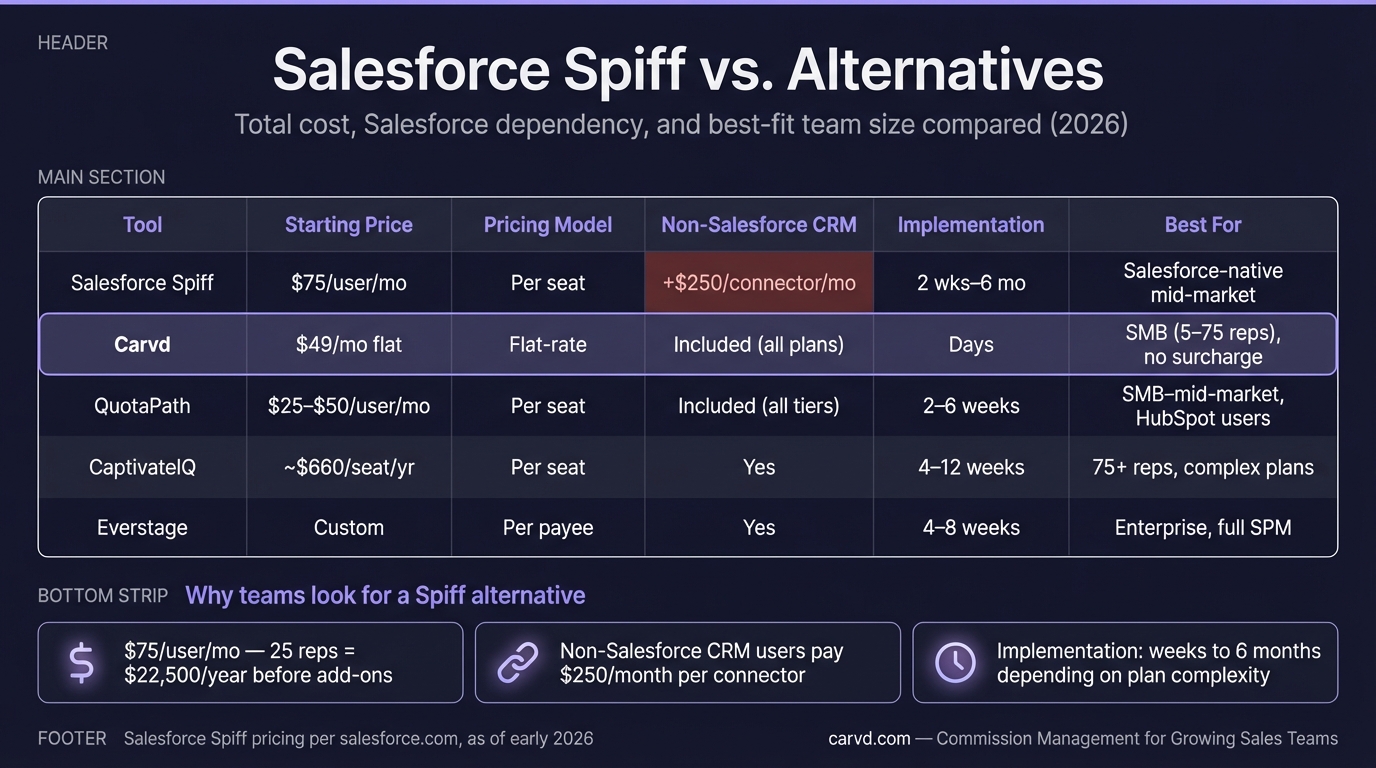
Salesforce Spiff costs $75/user/month and is natively built for Salesforce shops. Teams on other CRMs pay an additional $250/month per connector. Salesforce acquired Spiff in February 2024 for $419 million. Multiple G2 and TrustRadius reviewers (as of early 2026) report that pricing increased after the acquisition and that post-acquisition support quality declined.
That's the honest starting point. For the buyer Spiff was originally designed for — a mid-market company already on Salesforce, with a dedicated sales ops team and complex compensation plans — it's a capable tool. For a different buyer profile, the total cost of ownership and the Salesforce lock-in are real constraints.
This post covers where Spiff excels, why teams look for alternatives, and which tools actually fit outside its target profile.
Where Spiff excels
Start here, because any credible comparison has to.
Spiff's automation engine handles a wide range of plan types: tiered accelerators, event-based payouts, splits, MBOs, and trailing commissions. Calculations update in real time, and the audit trail is strong — every number is traceable back to the source data. The rep statement experience is clean and accessible via web, mobile, or directly inside Salesforce.
The Salesforce-native integration is genuinely deep. If your sales team lives in Salesforce CRM, Spiff's data flow is seamless. Commission Estimator lets reps see projected earnings directly while building quotes in Sales Cloud — a capability that requires heavier configuration in non-native tools.
Spiff has around 3,065 reviews on G2 with high scores on ease of use. For a Salesforce-heavy enterprise team that needs tight CRM integration and plan complexity handled reliably, the platform earns its price.
The alternatives below exist for buyers who fall outside that profile.
Why teams look for alternatives
Most Spiff evaluation cycles start when one of these four conditions is true.
You're not on Salesforce. Spiff's value proposition is rooted in Salesforce-native integration. Teams on HubSpot, Pipedrive, or another CRM can still use Spiff, but each non-Salesforce connector costs $250/month on top of the $75/user base price. A 20-rep HubSpot team's true annual cost: $18,000 in user licenses + $3,000 in connector fees = $21,000/year before implementation or support.
The per-seat cost doesn't fit. At $75/user/month, per-seat pricing scales directly with headcount. A 25-rep team pays $22,500/year. A 50-rep team pays $45,000/year. For teams on standard plan structures — flat rate, a tiered plan, and an occasional SPIFF — that's a significant spend for software running well-understood commission math.
Implementation complexity is a constraint. Spiff implementations range from weeks to six months depending on plan complexity. Teams that need commission software running before next month's payroll cycle — not next quarter — often look for faster-go-live alternatives.
Post-acquisition support concerns. Salesforce completed the Spiff acquisition in February 2024. Multiple verified reviewers on G2 and TrustRadius document that support response times slowed and issue resolution became less reliable after the acquisition. One reviewer described "the same issues recurring month after month." Another noted that the rapid influx of Salesforce customers post-acquisition "very quickly overwhelmed them and the cracks start to form in implementation and ongoing support." These reviews are from specific users and not universal — but they show up consistently enough to warrant asking about support SLAs in any Spiff evaluation.
The alternatives
Carvd
Pricing: $49/month (Starter, up to 10 reps), $99/month (Growth, up to 25 reps), $199/month (Scale, unlimited reps). Flat-rate — no per-seat charges.
How it works: Carvd accepts a CSV export of closed-won deals on Starter and Growth plans, and connects to Salesforce or HubSpot on the Scale plan. Commission plan rules are configured by the ops team, and reps get a dashboard showing earnings broken down by deal. Dispute workflows are included on Growth and above.
What it does well:
- Flat-rate pricing at every tier means cost is predictable regardless of headcount. A 10-rep team and a 60-rep team on Scale pay the same $199/month.
- Implementation is typically days, not months. No sandbox testing or professional services required.
- Published pricing at every tier — you can evaluate the full cost without a sales call.
- Rep dashboards and PDF payout statements are included at every tier.
Honest limitations:
- CRM integration (Salesforce and HubSpot) is available only on the Scale plan ($199/month). Starter and Growth rely on CSV exports.
- No multi-currency support. International teams with currency-denominated commissions need a different solution.
- No ASC-606 compliance tooling. If revenue recognition compliance is a requirement, Carvd isn't the right fit.
- No in-CRM forecasting or mobile app. These are features Spiff users often rely on.
- Fewer third-party reviews than established competitors.
Best for: Teams of 5–75 reps on standard plan structures who want predictable flat-rate pricing and setup in under an hour.
QuotaPath
Pricing: Platform-fee model. Plans start at $250/month for Starter (includes first 5 users), $525/month for Growth, and $800/month for Premium. Per-user add-ons available beyond the base count.
How it works: QuotaPath connects to Salesforce and HubSpot natively on all paid plans. Reps can forecast their own commission earnings by modeling pipeline scenarios in real time. Growth tier includes ASC-606 compliance. Premium adds payroll integration via Rippling.
What it does well:
- Published pricing across all three tiers — completely transparent, no custom quotes required.
- Native Salesforce and HubSpot integration at the base tier (not locked to a higher plan).
- Earnings forecasting allows reps to model their own pipeline against commission rates.
- ASC-606 compliance available at Growth tier ($525/month) without an enterprise contract.
Honest limitations:
- Not designed for enterprise-level plan complexity: territory overlays, multi-source crediting, and complex commission waterfalls hit configuration limits quickly.
- Per-user add-ons make total cost less predictable as teams grow.
- G2 reviewers cite occasional data sync lag from Salesforce and HubSpot.
Best for: Mid-market teams (10–100 reps) that want transparent pricing, native CRM integration at the base tier, and ASC-606 support — without enterprise complexity.
CaptivateIQ
Pricing: No published pricing. Third-party procurement benchmarks (Vendr, as of early 2026) suggest approximately $660 per seat annually, before integration costs and professional services engagements (typically $8,000–$18,000).
How it works: CaptivateIQ's SmartGrid calculation engine handles enterprise-grade plan complexity — territory overlays, multi-currency, MBO components, custom crediting rules — at scale. Integrations include Salesforce, HubSpot, Workday, NetSuite, and 15+ other enterprise systems. Implementations typically take 8–12 weeks.
What it does well:
- Built for plan complexity that exceeds most mid-market tools. Territory overlays, multi-source crediting, and complex MBO tracking are native capabilities.
- Strong G2 rating (4.7 across 3,300+ reviews) with consistent marks for calculation accuracy.
- Named customers include Datadog, Affirm, Gong, and Lattice.
- Multi-currency support and ASC-606 compliance included.
Honest limitations:
- No published pricing. Custom quote required.
- Implementations require professional services and typically take 8–12 weeks.
- All-in cost for smaller teams (under 25 reps) can exceed $40,000 in year one.
- Not a simpler or cheaper alternative to Spiff — it's a comparable-complexity option for organizations that want to avoid Salesforce vendor lock-in.
Best for: Mid-market to enterprise teams (50+ reps) with complex compensation structures that want to avoid Salesforce lock-in but need similar functionality to Spiff.
Everstage
Pricing: Custom per-payee quote. No published pricing.
How it works: Everstage is a broader sales performance management (SPM) platform that combines commission management with territory management, quota planning, and sales visibility. The Crystal feature allows reps to model commission impact before closing deals.
What it does well:
- Full SPM scope: territory management, quota planning, and commission management under one system.
- Highest-rated commission platform on G2 (4.9/5 across 1,900+ reviews) and Gartner Peer Insights (4.8/5).
- No-code configuration approach allows plan changes without professional services.
- Strong rep experience and earnings visibility features comparable to Spiff's Commission Estimator.
Honest limitations:
- No published pricing. Enterprise contract required, as with Spiff.
- The full SPM platform may be over-scoped for teams that only need commission tracking.
- Per-payee pricing scales with headcount.
Best for: Mid-market and enterprise teams that want modern UX, a full SPM platform, and analyst recognition — often as an alternative to Spiff for teams that also need quota and territory management.
Performio
Pricing: Not published publicly as of early 2026. Positioned between SMB tools and enterprise platforms.
How it works: Performio handles tiered plans, accelerators, overrides, draws, and complex reporting. Implementation is generally shorter than Spiff but longer than self-serve tools.
What it does well:
- G2 reviewers consistently cite customer support quality as a strength — a contrast to Spiff's post-acquisition reputation.
- Flexible reporting module praised for customization options.
- Mid-market positioning sits between QuotaPath's simplicity and CaptivateIQ's complexity.
Honest limitations:
- Pricing not published — requires a sales conversation.
- Implementation takes longer than SMB tools but shorter than Spiff.
- Smaller customer base compared to Spiff, Everstage, or CaptivateIQ means fewer reference customers and community resources.
Best for: Mid-market teams (50–300 reps) with complex compensation structures that want strong support and implementation guidance without the full enterprise overhead of CaptivateIQ or Spiff.
Side-by-side comparison
| Tool | Pricing model | Starting price | CRM integration | Implementation | Best for |
|---|---|---|---|---|---|
| Carvd | Flat-rate | $49/mo | Scale plan only | Days | 5–75 reps, standard plans |
| QuotaPath | Platform fee | $250/mo + per-user | All plans | 2–6 weeks | 10–100 reps, published pricing |
| CaptivateIQ | Per seat (custom) | ~$660/seat/yr | Yes | 8–12 weeks | 50+ reps, complex plans |
| Everstage | Per payee (custom) | Custom quote | Yes | 6–8 weeks | Mid-market to enterprise, full SPM |
| Salesforce Spiff | Per seat | $75/user/mo | Native Salesforce | 4–8 weeks (or longer) | Salesforce-native mid-market |
How to choose
Your primary CRM is Salesforce and you have moderately complex plans (SPIFs, accelerators, MBOs): Spiff's native integration is a genuine advantage. The question is whether that advantage justifies $75/user/month. For a 20-rep team, you're paying $18,000/year. Compare that directly to QuotaPath ($8,400/year for 20 reps on Growth tier) or Everstage (estimate $12,000–$18,000/year based on similar team sizes in third-party benchmarks). If tight Salesforce integration is a must-have, the cost might be justified. If it's a nice-to-have, the alternatives are cheaper.
You're on HubSpot, Pipedrive, or another non-Salesforce CRM: Spiff's value disappears. The $250/month per non-Salesforce connector effectively raises total cost to $21,000/year+ for a 20-rep team. QuotaPath, Carvd, and Everstage all integrate natively with HubSpot at lower total cost. Unless you're also running Salesforce for data, Spiff doesn't make sense.
Your plans are simple (flat rate, tiered brackets, occasional SPIFFs): You're paying for complexity you don't use. Carvd ($1,188/year for Growth tier at 20 reps) handles standard plan types just as accurately as Spiff for a fraction of the cost — use the commission plan builder to test your structure.
Cost is the primary constraint: Run the numbers:
- Carvd Growth: $1,188/year (20 reps)
- QuotaPath Growth: $8,400/year (20 reps)
- Salesforce Spiff: $18,000/year (20 reps, before add-ons)
- CaptivateIQ: $20,000+/year (Vendr benchmark)
- Everstage: $12,000-$20,000/year (estimated per third-party data)
You have a go-live deadline before next payroll: Carvd and QuotaPath can go live in days to weeks — Carvd's CSV deal import means you can start calculating before a CRM integration is even connected. Spiff, CaptivateIQ, and Everstage typically take months.
For teams evaluating Spiff, the honest answer is: if you're on Salesforce and your plans are complex enough to justify the per-seat cost, Spiff is a strong option. If you're not on Salesforce, or if your plans are standard, the alternatives offer the same calculation accuracy at lower cost and faster setup.
Carvd offers a 14-day free trial. No sales call required. Connect your HubSpot or Pipedrive account or upload a CSV of your closed deals, and you'll have commission calculations running in under an hour.
Related reading
Last updated: March 22, 2026