Xactly Alternative: Modern Commission Management vs Legacy ICM
Looking for a Xactly alternative? Compare 6 commission management tools on pricing, setup time, and plan complexity. Honest review of who should switch and who should stay.
Xactly has been in the commission software market since 2005. It has Gartner Magic Quadrant recognition, processes billions of commission transactions, and is trained on over 20 years of proprietary compensation data. It's also expensive, complex to implement, and built for enterprises with 200–500+ commissioned reps and dedicated teams to manage them.
That profile works for some buyers. For everyone else — mid-market teams, companies that need to go live in weeks rather than months, or anyone without a full-time sales ops function — the search for an Xactly alternative starts here.
This post covers where Xactly excels, where it doesn't fit, and which alternatives are worth evaluating for teams outside its target profile.
Where Xactly excels
Any honest comparison starts with what the platform actually does well.
Xactly Incent is built for enterprise-scale incentive compensation management. Its calculation engine handles plan complexity that most mid-market tools can't configure: territory overlays, multi-currency commissions, MBO components, complex crediting hierarchies, and compensation plans that span dozens of roles and exceptions. The platform processes billions of commission transactions monthly and surfaces analytics across earnings, attainment, and rep performance at scale.
Two operational requirements that matter to large teams: Xactly includes ASC 606 and IFRS 15 compliance tooling for capitalizing commission expense — a hard requirement for public companies and many late-stage private ones. And its "Xactly Next" modernization (launched 2024) updated the platform's calculation architecture with AI-assisted plan analysis drawing on its proprietary dataset of 20+ years of compensation benchmarks.
Xactly has been named a Leader in the Gartner Magic Quadrant for Sales Performance Management across multiple consecutive cycles, which carries weight in enterprise procurement processes.
If you have 300+ reps, multi-overlay comp plans, an ASC 606 compliance requirement, and the internal resources to manage an enterprise ICM implementation, Xactly is a legitimate contender. The alternatives below exist for different buyers.
Where teams look for alternatives
Teams typically start looking for an Xactly alternative when one of three things is true.
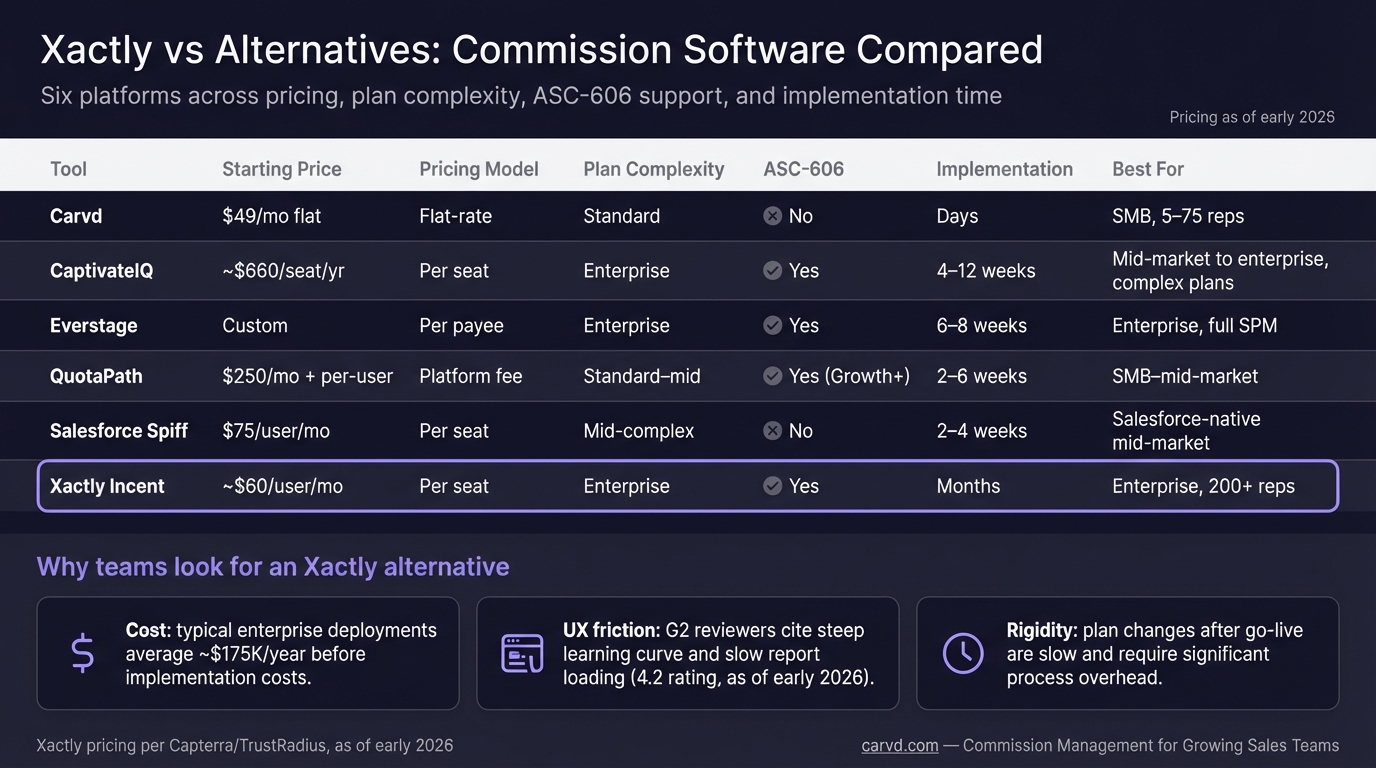
The cost and implementation model doesn't fit. Xactly doesn't publish pricing. According to Capterra and TrustRadius data (as of early 2026), Xactly Incent starts at approximately $60/user/month — and typical enterprise deployments run around $175,000/year before implementation costs. For a 50-rep team, the all-in cost is difficult to justify against what the platform delivers relative to lighter-weight alternatives.
The UI creates friction. Xactly's G2 rating is 4.2 across 1,049 reviews — lower than newer competitors like Everstage and CaptivateIQ. The most consistently cited issues in G2 reviews (as of early 2026): steep learning curve, confusing navigation, slow report loading with large Salesforce datasets, and limited dashboard drill-down. When the ops team spends significant time fighting the tool instead of managing the plans, that's a signal.
Plan changes are too slow. G2 reviewers (as of early 2026) consistently flag plan change rigidity as a pain point: adapting compensation structures after go-live is described as slow and complex, requiring more process overhead than newer no-code platforms. Teams that run frequent SPIFF promotions, rapid comp plan adjustments, or quarterly plan redesigns find this friction accumulates.
The alternatives
Carvd
Pricing: $49/month (Starter, up to 10 reps), $99/month (Growth, up to 25 reps), $199/month (Scale, unlimited reps). Flat-rate — no per-seat charges.
How it works: Carvd connects to Salesforce or HubSpot on the Scale plan and accepts CSV exports of closed-won deals on Starter and Growth. Commission plan rules are configured by the ops team; reps get a real-time earnings dashboard broken down by deal. Dispute workflows are included on Growth and above.
What it does well:
- Flat-rate pricing eliminates the per-seat math. A 10-rep team and a 60-rep team on Scale pay the same $199/month.
- No implementation engagement required. Most teams are live within a week.
- Rep dashboards and PDF payout statements at every tier.
- Dispute resolution workflow on Growth ($99/month), not locked to an enterprise tier.
Honest limitations:
- CRM integration requires Scale ($199/month). Starter and Growth use CSV upload — manual data exports remain.
- No multi-currency support. Teams with currency-denominated international commissions need a different tool.
- No ASC-606 compliance tooling. If capitalized commission expense reporting is a requirement, Carvd isn't the right fit.
- Not designed for enterprise plan complexity: territory overlays, multi-source crediting, and MBO components aren't supported.
- Fewer third-party reviews than established competitors — it's a newer product.
Best for: Growing teams (5–75 reps) on flat, tiered, or per-product plans that want predictable pricing and setup in under a week — not months.
QuotaPath
Pricing: Plans start at $250/month (Starter, includes first 5 users), $525/month (Growth), and $800/month (Premium). Per-user add-ons available beyond the base count.
How it works: QuotaPath connects natively to Salesforce and HubSpot on all plans. Reps can forecast their own commission earnings by modeling pipeline scenarios. Growth tier includes ASC-606 compliance. Premium adds payroll integration via Rippling.
What it does well:
- Published pricing across all three tiers — you can evaluate total cost without a sales call.
- Native Salesforce and HubSpot integration at the base tier.
- Earnings forecasting allows reps to model commission impact before deals close.
- ASC-606 compliance at Growth tier ($525/month) — a feature Xactly charges significantly more for.
Honest limitations:
- Not built for enterprise plan complexity: territory overlays, multi-source crediting, and complex MBO tracking hit limits quickly.
- Per-user add-ons make total cost less predictable as teams grow.
- G2 reviewers cite occasional data sync lag from CRM integrations.
Best for: Teams of 10–100 reps on straightforward plan structures that want published pricing and fast setup without enterprise overhead.
Everstage
Pricing: Custom per-payee quote. No published pricing.
How it works: Everstage is a broader sales performance management (SPM) platform that covers commission management, quota planning, territory management, and sales visibility. Crystal feature lets reps model commission impact in real time.
What it does well:
- Full SPM scope: commission, territory, quota, and sales planning under one system.
- Highest-rated commission platform on G2 (4.9/5 from 1,900+ reviews) and Gartner Peer Insights (4.8/5).
- No-code configuration approach allows plan changes without professional services engagements — a contrast to Xactly's approach.
- Strong rep experience and earnings visibility.
Honest limitations:
- No published pricing. Enterprise contract required.
- Full SPM platform may be over-scoped for teams that only need commission tracking.
- Per-payee pricing scales with headcount.
Best for: Mid-market teams (25–200 reps) that want modern UX, published analyst recognition, and quota management alongside commission tracking — without Xactly's complexity or implementation overhead.
CaptivateIQ
Pricing: No published pricing. Third-party procurement benchmarks (Vendr, as of early 2026) estimate $660 per seat annually before integration costs and professional services ($8,000–$18,000).
How it works: CaptivateIQ's SmartGrid calculation engine handles enterprise-grade plan complexity — territory overlays, multi-currency, MBO components, custom crediting rules — at scale. Integrations cover Salesforce, HubSpot, Workday, NetSuite, and 15+ other enterprise systems. Implementations typically run 8–12 weeks.
What it does well:
- Built for the kind of plan complexity that Xactly handles. Territory overlays, multi-source crediting, and complex MBO tracking are native capabilities.
- Strong G2 rating (4.7 across 3,300+ reviews) with consistent marks for calculation accuracy.
- Named customers include Datadog, Affirm, Gong, and Lattice.
- Multi-currency support and ASC-606 compliance included.
Honest limitations:
- No published pricing. Custom quote required.
- Implementations require professional services and typically take 8–12 weeks — not meaningfully faster than Xactly.
- All-in cost for smaller teams can exceed $40,000 in year one.
- For teams leaving Xactly specifically to avoid cost or complexity, CaptivateIQ is roughly in the same price range and complexity as Xactly itself.
Best for: Mid-market to enterprise teams (50–300 reps) with complex compensation structures that want a more modern platform than Xactly but aren't ready to simplify their comp program.
Salesforce Spiff
Pricing: $75/user/month, billed annually. Non-Salesforce CRM connectors add $250/month each.
How it works: Spiff (acquired by Salesforce in February 2024) runs natively on the Salesforce platform. Commission calculations happen inside the Salesforce data environment. Reps view statements directly in Salesforce or via mobile app.
What it does well:
- Deepest Salesforce-native integration available. If your team lives in Salesforce, data flow is seamless.
- Handles tiered accelerators, event-based payouts, MBOs, territory splits, and trailing commissions.
- Familiar interface for ops teams already working in Salesforce.
Honest limitations:
- $75/user/month pricing scales directly with headcount. A 50-rep team pays $45,000/year before add-ons.
- Non-Salesforce connectors each cost $250/month. Multi-CRM teams face materially higher true cost.
- The value proposition depends entirely on Salesforce. Teams on HubSpot or other CRMs lose the advantage.
Best for: Salesforce-native mid-market teams that want tight CRM integration and are willing to pay per-seat pricing.
Performio
Pricing: Not published publicly as of early 2026. Positioned between SMB tools and enterprise platforms.
How it works: Performio handles tiered plans, accelerators, overrides, draws, and complex reporting. Implementation is shorter than Xactly but longer than self-serve tools.
What it does well:
- G2 reviewers consistently cite customer support quality as a strength.
- Flexible reporting module praised for customization options.
- Mid-market positioning sits between QuotaPath's simplicity and CaptivateIQ's complexity.
Honest limitations:
- Pricing not published — requires a sales conversation.
- Implementation takes longer than SMB tools but shorter than Xactly.
- Smaller customer base than Xactly or CaptivateIQ.
Best for: Mid-market teams (50–300 reps) with complex compensation structures that want implementation support and strong customer success without the full enterprise overhead of Xactly or CaptivateIQ.
Side-by-side comparison
| Tool | Starting price | Pricing model | Plan complexity | ASC-606 | Implementation | Best for |
|---|---|---|---|---|---|---|
| Carvd | $49/mo flat | Flat-rate | Standard | No | Days | SMB (5–75 reps), flat-rate preference |
| CaptivateIQ | ~$660/seat/yr* | Per seat | Enterprise | Yes | 4–12 weeks | Mid-market to enterprise, complex plans |
| Everstage | Custom | Per payee | Enterprise | Yes | 6–8 weeks | Enterprise, full SPM, plan agility |
| QuotaPath | $250/mo + per-user | Platform fee | Standard–mid | Yes (Growth+) | 2–6 weeks | SMB–mid-market, HubSpot/Salesforce |
| Salesforce Spiff | $75/user/mo | Per seat | Mid-complex | No | 2–4 weeks | Salesforce-native mid-market |
| Xactly Incent | ~$60/user/mo† | Per seat | Enterprise | Yes | Months | Enterprise (200+ reps), legacy ICM |
*CaptivateIQ pricing per Vendr procurement data, as of early 2026. Excludes integration and professional services. †Xactly pricing per Capterra and TrustRadius, as of early 2026. Typical enterprise deployments average ~$175K/year before implementation.
How to choose
Start with plan complexity. The six tools above span a wide range:
- Complex enterprise plans (territory overlays, multi-variable crediting, multi-currency, ASC-606): Xactly, CaptivateIQ, Performio
- Mid-market plans (tiered, accelerators, draws, quota management): Everstage, QuotaPath, Performio
- Standard plans (flat, tiered, per-product): Carvd, QuotaPath, Spiff
If your comp plan involves structures beyond tiered rates and accelerators, Carvd and QuotaPath aren't viable replacements for Xactly. If your plan is flat rate, tiered brackets, or per-product — and those are working today — you're paying for capabilities you're not using.
Then look at cost against rep count. At 50 reps:
| Tool | Estimated annual cost (50 reps) |
|---|---|
| Xactly Incent | ~$36,000+ ($60/user/month estimate) |
| CaptivateIQ | ~$33,000+ (Vendr benchmark + integration costs) |
| Everstage | ~$18,000-$30,000 (estimated per third-party data) |
| QuotaPath | ~$15,750 ($25/user/month Growth tier) |
| Salesforce Spiff | ~$45,000/year |
| Carvd | $1,188/year (Scale, all 50 reps) |
Most growing sales teams don't need Xactly's compliance infrastructure, 20-year data history, or multi-variable crediting logic. They need to calculate commissions correctly, give reps visibility into their earnings, and export a clean payroll export before payroll goes out. Most of the tools above solve that problem at a fraction of Xactly's cost and implementation time.
If you're evaluating Xactly for the first time and your team is under 100 reps, run through the alternatives before committing to a 3–6 month implementation and a multi-year enterprise contract. The OTE calculator can help you benchmark compensation levels before choosing a platform. You may find that a lighter-weight tool fits your actual requirements.
Xactly processes billions in commission transactions and owns 20 years of compensation data. For organizations with 300+ reps, multi-overlay compensation programs, and the internal resources to manage an enterprise implementation, that investment in Xactly can pay off.
For everyone else — smaller teams, standard plan structures, or anyone who needs to be live before next month — the alternatives above offer a faster path to commission automation at lower cost.
Carvd offers a 14-day free trial. No sales call required. Connect your HubSpot or Salesforce account, or upload a CSV of your closed deals, and you'll have commission calculations running in under an hour.
Questions to ask in every demo
"Show me my most complex plan type configured — not described." This is the most important question in any commission software evaluation. A vendor who responds with "we can support that" instead of demonstrating it live is giving you a sales answer. The gap between described capability and demonstrated capability with your actual plan structure is where most implementation surprises originate.
"How long does it take to make a plan change after go-live?" Get a specific answer: who initiates the change, who configures it, who validates it, and what the typical turnaround time looks like. For Xactly specifically, this was a common operational bottleneck. Ask how the alternative handles the same scenario.
"What does implementation look like for a team our size, with our plan types?" Ask for the realistic range, not the best case. Ask who does the configuration work and what happens when something isn't configured correctly the first time.
"What's the all-in annual cost including integrations, implementation, and support?" Licensing rarely reflects the true total. For legacy platforms, professional services and integration fees can match or exceed the base license cost. Get the full number before comparing sticker prices.
"Can I talk to a customer with a similar team size and plan complexity?" Reference checks in this category matter more than analyst rankings. Ask for customers at your rep count, not their largest logo.
Related reading
Last updated: March 22, 2026