Everstage Alternative: Commission Software Compared (2026)
Looking for an Everstage alternative? Compare 5 commission management tools on pricing, setup time, and plan complexity to find the right fit for your team.
Everstage is the highest-rated commission management platform on G2 as of early 2026 — 4.9/5 across approximately 1,900 reviews, ahead of CaptivateIQ (4.7) and Xactly (4.2). It's also the top-rated platform on Gartner Peer Insights (4.8/5, 97% recommendation rate) and was named a Strong Performer in The Forrester Wave: Sales Performance Management Solutions For Incentive Compensation, Q1 2025.
That track record reflects a genuinely well-built product. It also costs enterprise money, requires 6–8 weeks to implement, and is built for companies with 50+ payees who need territory management, quota planning, and commission management under one platform.
For teams outside that profile — smaller teams, teams that only need commission tracking, or anyone who wants to evaluate tools without going through a full sales process — this post covers what Everstage does well, where it's typically not the right fit, and which alternatives are worth considering.
Where Everstage excels
Everstage covers a broader scope than most commission platforms: territory management, quota planning, and commission management in one product. The "Crystal" forecasting feature lets reps model deal scenarios — adjusting deal size, close date, or product mix — and see the payout impact before closing, directly inside Salesforce.
The platform uses a no-code configuration approach that allows plan changes without professional services involvement. Admins can set up sandbox environments to test new plan structures before pushing them live, which addresses a common pain point with legacy ICM tools where plan changes require consultant engagements.
Everstage raised a $30M Series B in October 2024, led by Eight Roads Ventures, bringing total funding to approximately $45M. Named customers include Diligent, Trimble, Paychex, Chargebee, and Postman.
If you have 50+ payees, multi-role commission structures, and want territory and quota management alongside commission tracking, Everstage is one of the strongest platforms in the category. The alternatives below exist for buyers with different requirements.
Where teams look for alternatives
Teams typically start evaluating Everstage alternatives when one of three things is true.
No published pricing creates evaluation friction. Everstage doesn't publish pricing tiers. Getting a number requires a formal sales process. Third-party analysis from Coefficient.io estimates typical annual costs at $10,000–$30,000 for 20–50 payees and $60,000–$100,000+ for 100–250 payees, before implementation and support fees — but these are estimates, not Everstage's own figures. For teams comparing three or four platforms, evaluating a tool without a published price is a friction point.
Full SPM scope is more than needed. Everstage's full platform covers territory management, quota planning, and commission management. For teams that only need commission calculations and rep-facing payout visibility, paying for and configuring three products instead of one adds scope that won't get used.
Team size is below the platform's target. Everstage's sweet spot is mid-market to enterprise (50+ payees). Smaller teams with standard commission plans — flat, tiered, or basic accelerators — often find lighter-weight tools easier to configure and less expensive to run. For a detailed feature-by-feature comparison, see how Carvd compares to Everstage.
The alternatives
Carvd
Pricing: $49/month (Starter, up to 10 reps), $99/month (Growth, up to 25 reps), $199/month (Scale, unlimited reps). Flat-rate — no per-seat charges.
How it works: Carvd connects to Salesforce or HubSpot on the Scale plan and accepts CSV exports of closed-won deals on Starter and Growth. Commission plan rules are configured by the ops team; reps get a real-time earnings dashboard broken down by deal. Dispute workflows are included on Growth and above.
What it does well:
- Flat-rate pricing means a 10-rep team and a 60-rep team on Scale pay the same $199/month. No per-seat surprises.
- Published pricing at every tier — you can calculate your full annual cost without a sales call.
- Implementation is typically days, not weeks. No professional services required.
- Rep dashboards and PDF payout statements with payroll export are included at every tier.
Honest limitations:
- CRM integration requires the Scale plan ($199/month). Starter and Growth use CSV upload — manual data exports still occur.
- No multi-currency support. International sales teams with currency-denominated commissions need a different tool.
- No ASC-606 compliance tooling. If capitalized commission expense reporting is a requirement, Carvd isn't the right fit.
- No territory management or quota planning. Carvd covers commission tracking only.
- Fewer third-party reviews than established competitors — it's a newer product.
Best for: Teams of 5–75 reps with flat, tiered, or standard incentive plans who want real-time rep visibility and predictable monthly cost without a per-seat model or an implementation engagement.
QuotaPath
Pricing: Platform-fee model. Essential tier starts at $250/month (includes first 5 users), Growth at $525/month, Premium at $800/month, with per-user add-ons beyond the base included count.
How it works: QuotaPath connects natively to Salesforce and HubSpot on all paid plans. Reps can model their own pipeline to forecast earnings in real time. The Growth tier includes ASC-606 compliant commission accounting, and the Premium tier adds payroll integration via Rippling. HubSpot Ventures made a strategic minority investment in QuotaPath in April 2021.
What it does well:
- Published pricing across all three tiers — the most transparent pricing model of the major alternatives.
- Native CRM integration (Salesforce and HubSpot) at the base tier, not locked to a higher plan.
- Earnings forecasting lets reps model pipeline scenarios against their own commission plan.
- ASC-606 compliance at the Growth tier, without an enterprise contract.
Honest limitations:
- Not designed for the plan complexity categories Everstage handles: territory overlays, multi-source crediting, and complex commission waterfalls hit configuration limits.
- Per-user add-ons make cost forecasting less straightforward for teams growing past the base included count.
- No territory management or quota planning — commission tracking only.
Best for: SMB and mid-market teams (10–100 reps) that need published pricing, CRM integration from day one, and ASC-606 support without an enterprise contract.
Salesforce Spiff
Pricing: $75/user/month, billed annually. Non-Salesforce CRM connectors add $250/month per connector.
How it works: Spiff was acquired by Salesforce in early 2024 and runs as a native Salesforce product. Commission calculations happen inside the Salesforce data environment, and reps view their statements directly in Salesforce or via a mobile app. The Commission Estimator lets reps project earnings on quotes inside Sales Cloud.
What it does well:
- The deepest Salesforce-native integration in the category. If your team lives in Salesforce, no sync lag and no export steps.
- Handles tiered accelerators, event-based payouts, MBOs, territory splits, and trailing commissions.
- Familiar interface for ops teams already working in Salesforce.
Honest limitations:
- $75/user/month adds up quickly. A 30-rep team pays $27,000/year before any add-ons.
- Non-Salesforce connectors each carry a $250/month surcharge. Multi-CRM teams face a materially higher true cost.
- The core value proposition depends on Salesforce. Teams on HubSpot or other CRMs get a weaker integration at the same price.
Best for: Mid-market teams already on Salesforce CRM that want native integration and are willing to pay the per-seat cost for it.
CaptivateIQ
Pricing: No published pricing. According to Vendr procurement data (as of early 2026), the Incentives product costs approximately $660 per seat annually before integration costs ($11,000/year) and professional services (Silver tier: $8,000 for 50 hours; Gold: $18,000 for 100 hours).
How it works: CaptivateIQ's SmartGrid calculation engine handles enterprise-grade plan complexity — territory overlays, multi-currency plans, MBO components, custom crediting rules, and complex tiered structures. Implementations involve professional services and typically run 4–12 weeks.
What it does well:
- The closest feature-level comparison to Everstage for enterprise plan complexity. Both handle the categories where legacy tools like Xactly also operate.
- G2 rating of 4.7 across 3,300+ reviews — strong across a large review base, though behind Everstage's 4.9.
- Named customers include Datadog, Affirm, Gong, and Lattice.
Honest limitations:
- Total cost for smaller teams can exceed $40,000 in year one after implementation and integration costs.
- Implementation still requires professional services — not meaningfully faster to deploy than Everstage for comparable plan complexity.
- No published pricing — requires the same formal sales process as Everstage.
Best for: Mid-market to enterprise teams (50+ reps) with complex comp programs that need enterprise plan logic and are choosing between the two highest-rated platforms in the category.
Side-by-side comparison
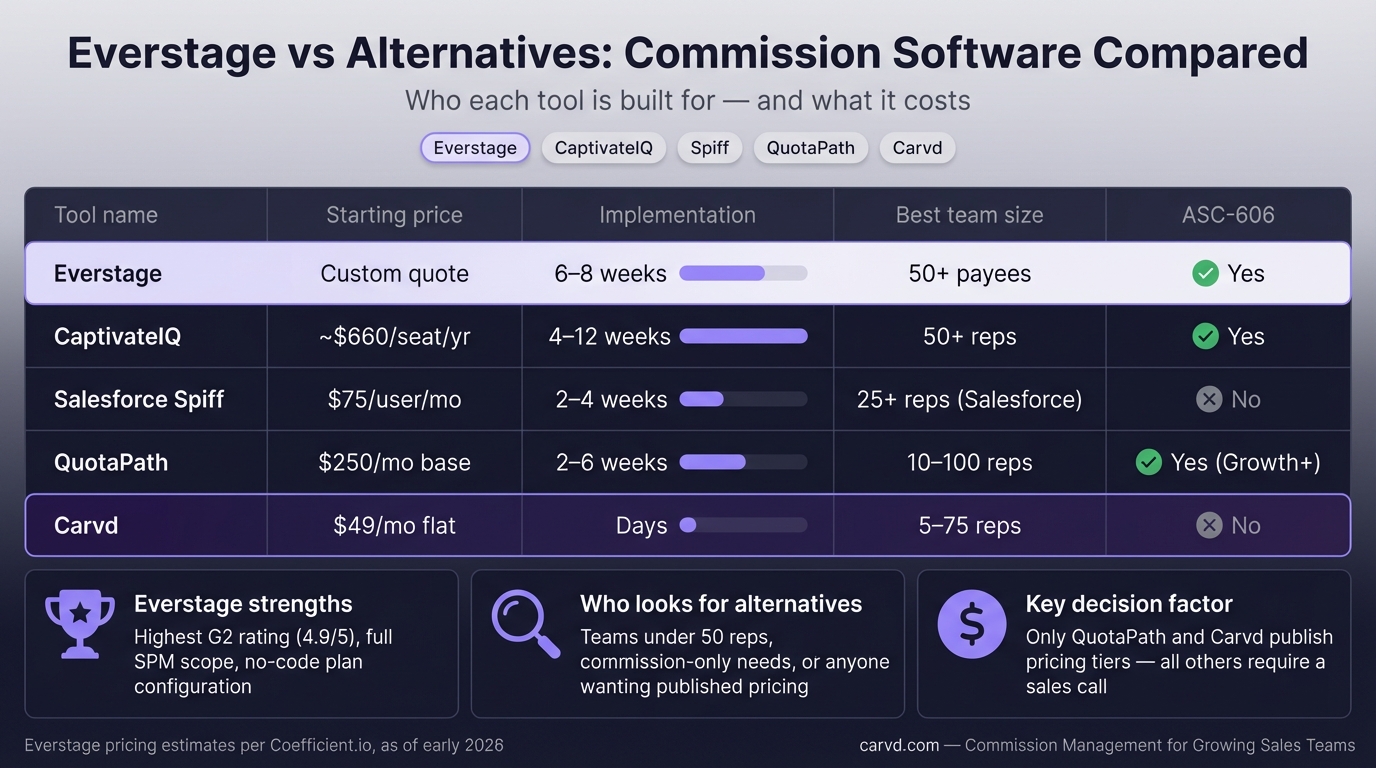
| Tool | Starting price | Pricing model | CRM integration | ASC-606 | Implementation | Best for |
|---|---|---|---|---|---|---|
| Carvd | $49/mo flat | Flat-rate | Scale plan ($199/mo) | No | Days | SMB (5–75 reps), flat-rate preference |
| QuotaPath | $250/mo + per-user | Platform fee | All plans | Yes (Growth+) | 2–6 weeks | SMB–mid-market, published pricing, HubSpot/Salesforce |
| Salesforce Spiff | $75/user/mo | Per seat | Native Salesforce | No | 2–4 weeks | Salesforce-native mid-market |
| CaptivateIQ | ~$660/seat/yr* | Per seat | Yes | Yes | 4–12 weeks | Mid-market to enterprise, complex plans |
| Everstage | Custom† | Per payee | Yes | Yes | 6–8 weeks | Mid-market to enterprise, full SPM |
*CaptivateIQ pricing per Vendr procurement data, as of early 2026. Excludes integration and professional services costs. †Everstage pricing estimates per Coefficient.io third-party analysis, as of early 2026. Contact Everstage directly for current pricing.
How to choose
Team under 50 reps, commission tracking only: Carvd's Growth or Scale plan and QuotaPath's Essential tier are the practical options at this size. Carvd's flat-rate model is more predictable at scale; QuotaPath's native CRM integration at the base tier is an advantage if you don't want to manage CSV exports. Neither platform covers territory management or quota planning, which is fine if those aren't requirements.
Team of 50–100 reps, needs CRM integration and ASC-606: QuotaPath's Growth tier ($525/month) covers both, with published pricing you can evaluate before a sales call. Carvd's Scale plan ($199/month flat) is the option if cost predictability matters more than ASC-606 compliance.
Salesforce-native team, moderate plan complexity: Spiff's native integration is the real differentiator here. Run the total cost math including non-Salesforce connector add-ons, then compare to QuotaPath's Growth tier.
Replacing Everstage because of scope, not cost: QuotaPath handles commission-only tracking without the territory and quota management modules. If you've been paying for full SPM and only using the commission piece, QuotaPath's focused scope may be the right size.
Team of 100+ reps, enterprise plan complexity: CaptivateIQ is the closest feature-level comparison to Everstage. Both handle territory overlays, multi-currency plans, and MBO components. CaptivateIQ requires a professional services engagement for implementation; Everstage uses a no-code configuration approach with sandbox testing. At this scale, a formal evaluation of both vendors is warranted.
ASC-606 compliance is a hard requirement: QuotaPath Growth tier and CaptivateIQ both cover this. Carvd and Spiff don't. See ASC 606 and sales commissions: what finance teams need to know for the accounting context.
Questions to ask in every demo
"Show me my most complex plan type configured — not described." This is the most important question in any commission software evaluation. A vendor who describes capability without demonstrating it live with your actual plan structure is giving you a sales answer. Ask to see your specific plan type — including any SPIFFs, accelerators, or territory splits — running in the tool before committing.
"What does implementation look like for a team our size, with our plan types?" Get a specific timeline and ask who does the configuration work — your team, their team, or a mix. Ask for the realistic range, not the best-case scenario. For Everstage specifically, 6–8 weeks is the standard range; ask what would push a deployment toward the longer end.
"Can I make plan changes after go-live without a support ticket?" Everstage's no-code approach addresses the plan-change rigidity complaint common with legacy platforms. Carvd's comp plan builder lets you edit rates and add tiers in minutes without vendor involvement. Ask any alternative vendor the same question: how many steps does it take to change a commission rate or add a new accelerator tier after you're live?
"What's the all-in annual cost including integrations, implementation, and support?" Licensing rarely reflects the true total. For both Everstage and CaptivateIQ, implementation and integration fees can add significantly to the base license cost. Get the full number before comparing sticker prices.
"Can I talk to a customer with a similar team size and plan type?" Reference checks in this category matter. Ask for customers at your rep count, not their largest enterprise logos.
Everstage is one of the best-rated commission platforms in the market. Its no-code configuration, Crystal forecasting, and full SPM scope are genuine differentiators — particularly for teams that need territory and quota management alongside commission tracking.
If you have 50+ payees and that full scope, Everstage deserves serious evaluation. If you're running a smaller team on standard commission structures and need something live in a week with published pricing, Carvd starts at $49/month flat with no per-seat charges and no implementation services required.
For a broader comparison across seven commission platforms — including a full feature matrix and best-for summaries — see best commission management software: 2026 comparison.
Related reading
- Commission tracking software: buyer's guide (2026) — evaluation criteria and comparisons across commission management tools
- CaptivateIQ alternative: simpler commission management for growing teams — where CaptivateIQ fits and where it doesn't
- Xactly alternative: modern commission management vs legacy ICM — how Everstage and other modern platforms compare to Xactly
- Incentive compensation management: the complete guide — what ICM software does, when you need it, and how to evaluate it
- ASC 606 and sales commissions — capitalized commission expense and revenue recognition for finance teams
Last updated: March 22, 2026