What Is a SPIFF in Sales? (And When to Use One)
A SPIFF (Sales Performance Incentive Fund) is a short-term cash bonus paid to reps for a specific behavior. Here's how they work, when to use them, and how to avoid common pitfalls.
A SPIFF — Sales Performance Incentive Fund — is a short-term cash bonus paid directly to a sales rep for completing a specific, defined action. Reps earn it on top of their regular commission, which is why SPIFFs are effective at changing sales behavior quickly: they add a second financial signal on top of the one already baked into the comp plan.
The canonical use case: you launch a new product. Reps default to selling what they know because their pipeline and relationships are built around it. A $150 per unit SPIFF on the new product changes that math. For a rep closing 10 deals per month, that's $1,500 in incremental earnings for doing something your regular comp plan wasn't moving them to do.
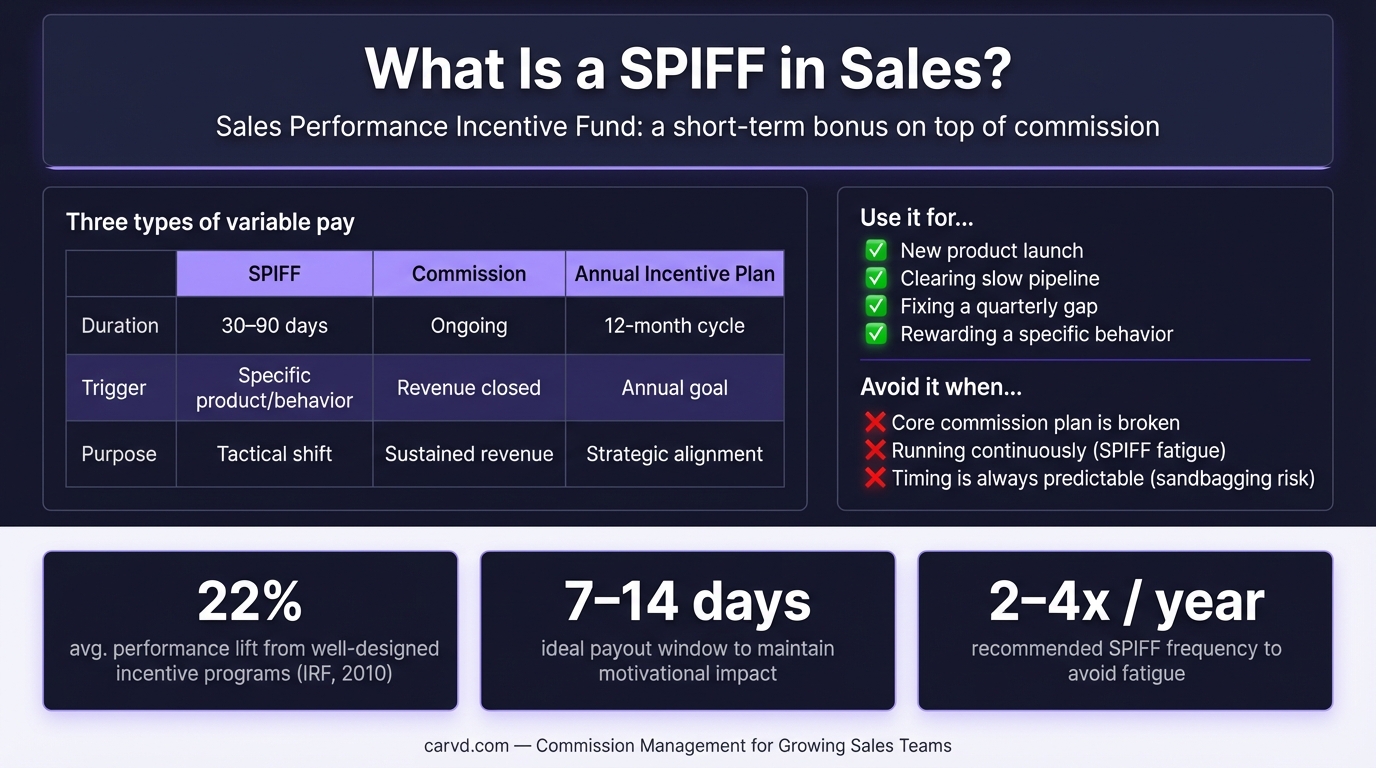
SPIFF vs commission vs bonus
These three terms describe different things, and conflating them leads to poorly designed comp plans.
Commission is the ongoing rate structure in a rep's plan — the percentage they earn on every deal they close. It's permanent and applies to all qualifying deals. Commission rates are built into the sales compensation plan and reset annually. For detail on structure types, see the sales commission structure guide.
SPIFF is temporary and targeted. It runs for a defined period, covers a defined set of actions or products, and then ends. SPIFFs sit on top of commission — a rep earning 10% commission on all deals might also earn $200 per unit of Product X for the next six weeks.
Bonus is an after-the-fact payment, typically tied to hitting a broader target — team revenue, annual quota attainment, or company performance. Bonuses are evaluated and paid after the measurement period. SPIFFs are paid quickly, often within days of the qualifying action. That immediacy is part of what makes them work.
| Commission | SPIFF | Bonus | |
|---|---|---|---|
| Duration | Ongoing | 2–8 weeks | Annual or quarterly |
| Trigger | Any closed deal | Specific product or action | Goal attainment |
| Payout timing | Monthly/quarterly | Fast (days to weeks) | After period closes |
| Plan layer | Core comp plan | Overlay incentive | Separate program |
SPIFFs are a component of the broader sales incentive plan, which also includes the base commission structure, accelerators, and team bonuses.
When SPIFFs work
Not every situation calls for a SPIFF. The specific contexts where they're consistently effective:
New product launches. Reps sell what they know. A SPIFF offsets the risk reps perceive in pitching something unfamiliar — if the new product doesn't close, they've invested time with nothing to show for it. Add financial upside and that calculus changes.
Inventory or pipeline clearance. Short-cycle products, renewal deals coming up for expiration, or promotional bundles that need velocity all respond well to a time-limited SPIFF. The deadline matters as much as the dollar amount — it forces prioritization.
Specific behavior adoption. If you want reps to run more product demos, book discovery calls with a particular segment, or add an upsell to standard deals, a SPIFF for those actions creates a direct feedback loop. Commission rewards outcomes; SPIFFs can reward the intermediate behaviors that lead to outcomes.
Competitive displacement. When a competitor is actively vulnerable (pricing change, service disruption, sales team in chaos), a short SPIFF on displacement deals can accelerate wins you'd eventually get anyway.
When SPIFFs don't work
SPIFFs fail — sometimes expensively — in a few predictable situations.
When the SPIFF product has no real demand. No financial incentive fixes a product-market fit problem. If reps aren't selling it now, it's worth understanding why before assuming money is the answer.
When they become permanent. If you run a SPIFF on the same product every quarter, reps start pricing it into their expectations. It's no longer a special incentive — it's just the comp plan with an extra layer of admin overhead.
When the underlying plan is already misaligned. SPIFFs are a tactical overlay. If reps distrust the base commission plan, can't calculate their earnings, or feel the quota is set unfairly, a SPIFF won't fix the problem. Fix the variable compensation structure first.
How to design a SPIFF
A well-designed SPIFF has five components:
1. Specific qualifying action. Define exactly what earns the SPIFF. "Close a deal including Product X" is clear. "Promote the new module" is not.
2. A concrete, meaningful payout. The amount needs to be material. A $10 SPIFF on a deal that takes two weeks to close is noise. A practical benchmark: the SPIFF should represent at least 10–15% of the expected commission on that product. For a $2,000 ACV product at a 10% commission rate ($200), a $25–$50 SPIFF is a floor; $100–$150 is more motivating.
3. A defined timeframe. Most SPIFFs run 3–6 weeks. The end date creates urgency. Without it, reps have no reason to prioritize today over next month. Avoid running the same SPIFF for more than 8 weeks — it starts to feel like baseline comp.
4. Fast payout. Behavioral research on incentive design consistently points to speed as a key driver of effectiveness. Pay SPIFFs within 7–14 days of qualification, not at the end of the standard commission cycle. The closer the reward is to the action, the stronger the connection.
5. Simple tracking. If reps can't easily verify whether they've qualified, the SPIFF loses motivational impact. Carvd's rep dashboards show SPIFF earnings alongside regular commission, so reps always know where they stand. Use a metric that's already tracked in your CRM or commission software, not something that requires manual reconciliation.
The channel stuffing risk
The most significant downside of SPIFFs is channel stuffing: reps closing deals aggressively to hit SPIFF thresholds even when customers aren't truly ready, leading to early churn, contract cancellations, or return requests that cost more than the SPIFF generated.
Channel stuffing is most common when:
- The SPIFF amount is very large relative to deal value
- There's no clawback provision if the deal cancels within 90 days
- Quota is already near 100% — reps are "pulling forward" deals that would have closed next month anyway
Mitigations: include a short clawback period for SPIFF payouts (60–90 days), exclude deals below a deal quality threshold (minimum ACV or contract length), and review post-SPIFF churn metrics to see if early cancellations spike.
For detail on clawback provisions more broadly, see the commission clawback guide.
Tracking SPIFF payouts
Manual SPIFF administration — spreadsheet-based tracking, email notifications, end-of-period reconciliation — works for one or two reps on a simple SPIFF. It breaks quickly as team size grows or as SPIFFs become more frequent.
The common failure modes: reps lose track of whether they've qualified, finance can't reconcile payouts with deals via payroll export, and the payout timing slips from "days" to "weeks." All of these erode exactly the motivational mechanism that makes SPIFFs worth running.
Commission software that supports manual SPIFF tracking alongside regular commission runs can solve this — reps see their SPIFF earnings alongside their regular commission statement, finance has a single payout record, and there's an audit trail if disputes arise. Carvd lets you add SPIFF amounts directly to a commission cycle so they show up in rep dashboards alongside standard deal-by-deal commission breakdowns, without requiring a separate payout process.
The broader incentive stack
SPIFFs are one tool in a larger incentive architecture. Most sales teams that use them well have the base structure in place first: clear commission rates verified against commission rate benchmarks, a quota that 55–65% of reps hit at 100%, and transparent payout calculation. SPIFFs accelerate specific outcomes within that structure — they don't substitute for it.
The annual incentive plan guide covers the longer-term bonus layer for managers and executives. The sales incentive plan overview covers how all the layers fit together.
If you're designing a SPIFF program from scratch, start with one qualifying action, one payout amount, and a 4-week window. Measure the incremental lift, compare it to what the SPIFF cost, and adjust from there. The programs that fail are almost always the ones that tried to change too many behaviors at once with a budget that wasn't tied to a measurable outcome.
Last updated: March 22, 2026