What Does OTE Mean? A Plain-English Explanation
OTE stands for on-target earnings — the total pay a sales rep earns when hitting 100% of quota. Learn how it works, what's realistic, and how to evaluate an offer.
OTE stands for on-target earnings — the total annual pay a sales rep receives when hitting exactly 100% of quota. It combines base salary and variable commission into a single number.
If your base is $95,000 and you earn $95,000 in commissions at full quota attainment, your OTE is $190,000.
That's the definition. The harder question is whether that number means anything.
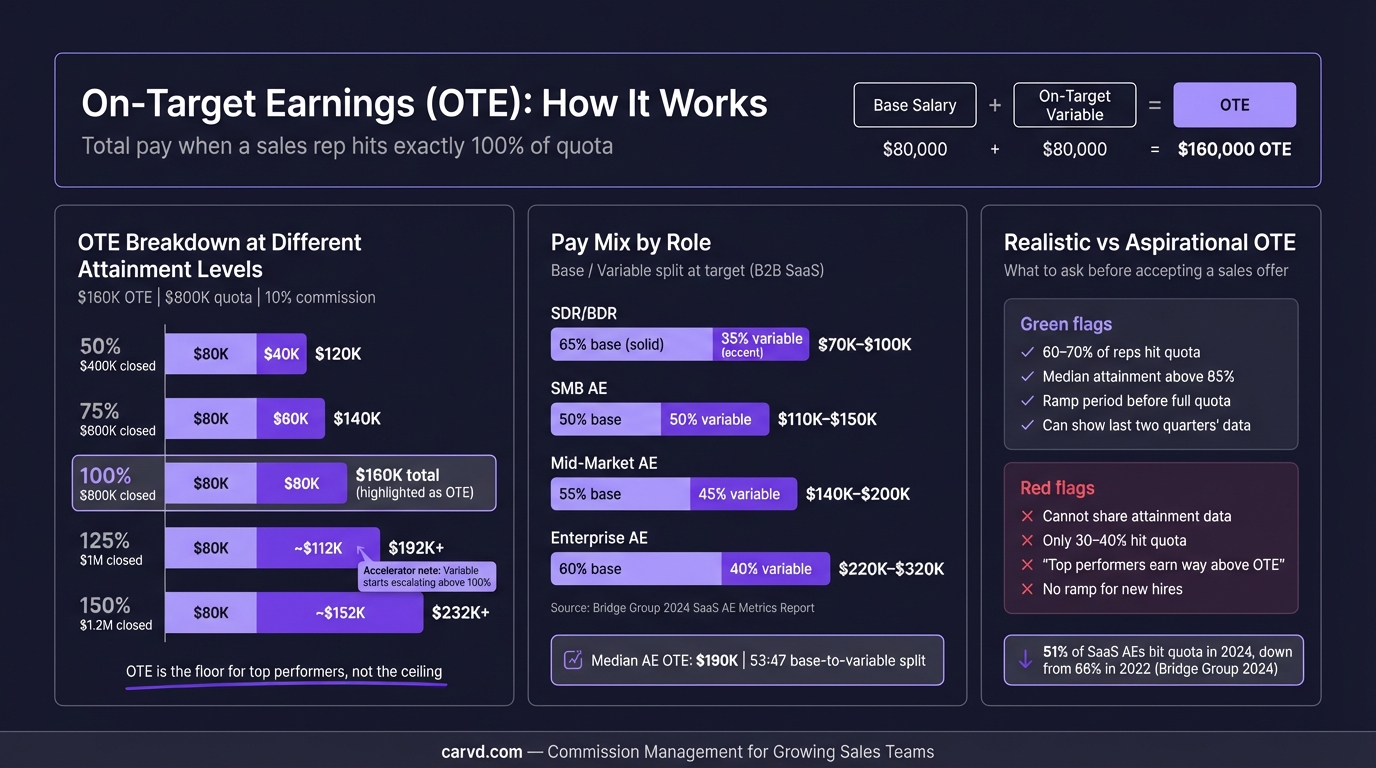
How OTE breaks down
Every OTE number has two components:
Base salary is guaranteed. You receive it regardless of how much you sell. It's your floor.
Variable compensation (sometimes called "variable target" or "at-risk pay") is what you earn by hitting quota. It's usually paid as a commission on revenue closed — a percentage of every deal.
The ratio of base to variable is called pay mix. A 50/50 mix means half your OTE is base, half is variable. A 60/40 mix pays a larger base relative to commission.
Bridge Group's 2024 benchmark of 172 B2B SaaS companies found median AE pay mix at 53% base, 47% variable — close to 50/50. SDRs typically run 65/35 or 70/30 because they're not closing full deals. Enterprise AEs sometimes run 50/50 or higher variable because deal sizes and margins support it.
The higher the variable percentage, the more your actual earnings depend on hitting quota.
OTE vs salary: what's actually guaranteed
A job posting with "$150,000–$200,000 OTE" is not offering a salary of $150,000–$200,000. It's saying:
- Your base might be $75,000–$90,000 (guaranteed)
- You earn the rest by selling
This distinction matters more than most candidates realize when evaluating an offer. The base is what you live on if pipeline dries up or you're ramping into a new territory.
When comparing two offers, compare base salaries first. Then evaluate whether the OTE is achievable — which requires asking about the quota attached to it.
What OTE actually predicts about your earnings
OTE assumes 100% quota attainment. Most reps don't hit that.
According to Bridge Group's 2024 report, only 51% of AEs hit quota — down from 66% in 2022. RepVue's Cloud Sales Index puts Q4 2024 average attainment at 43%. By segment: Enterprise AEs averaged 38% quota attainment, Mid-Market AEs averaged 40%, and SDRs averaged 53%.
At 43% attainment, a $150,000 OTE means the average rep earns closer to $100,000–$110,000. Not $150,000.
This doesn't mean OTE is a meaningless figure. It tells you the upside if you perform well and the company's territory and quota are set fairly. But it's a ceiling, not a guarantee — and the ceiling is higher than the average outcome.
To estimate realistic earnings, ask:
- What percentage of reps hit quota last year? (Request the actual figure, not a recruiting-friendly approximation)
- What was median attainment? (Gives you a real midpoint, not a best-case)
- Are accelerators uncapped? (High attainment reps can exceed OTE significantly if accelerators pay above 100%)
OTE benchmarks by role
These are 2024 figures from Bridge Group and publicly available data:
| Role | Median OTE | Pay Mix | Typical Quota |
|---|---|---|---|
| Account Executive (SaaS, SMB/Mid-Market) | $190,000 | 53/47 | $800K ACV |
| SDR/BDR | $85,000–$100,000 | 65/35 | Activity-based |
| Sales Manager | $180,000–$220,000 | 60/40 | Team quota |
| Enterprise AE | $220,000–$280,000 | 50/50 | $1.5M–$2M+ ACV |
Source: Bridge Group 2024 SaaS AE Metrics & Compensation Benchmark (172 companies).
OTE varies significantly by company stage, industry, and geography. A $190K median at Series B SaaS companies does not mean that's what a similar role pays at a pre-product-market-fit startup or a Fortune 500. Use these as anchors, not hard targets.
How companies set OTE
OTE isn't chosen arbitrarily. For well-designed plans, it follows a formula:
1. Benchmark by role and market. Companies start with what's competitive for the role in their market.
2. Set quota at 4–5x variable target. If OTE is $190K with a 47% variable portion ($89,300 at-risk), quota is typically set at $800K — which puts the commission rate around 11%. Bridge Group's 2024 data puts median quota-to-OTE ratio at 4.2x.
3. Commission rate falls out of that math. If variable target is $89,300 and quota is $800K, commission rate is 11.2%. The rate isn't chosen independently — it's the result of OTE and quota decisions. The OTE calculator runs this math in seconds from any combination of base, quota, and commission rate.
Poorly designed plans skip step two. Someone decides the commission rate should be 10%, sets a quota based on a revenue target from the board model, and announces the OTE as the sum. Those plans produce OTE numbers that look reasonable but are structurally difficult to hit because the quota-to-market-reality gap never gets validated.
For a deeper look at plan construction — including how to set accelerators, ramp periods, and clawbacks — see the sales compensation plan guide.
Evaluating an OTE offer
When you receive a job offer with an OTE figure, these are the questions worth asking before signing:
"What percentage of reps hit quota last year?" The answer reveals whether the OTE is achievable or aspirational. Less than 60% is worth probing. Less than 40% is a warning sign about quota setting, territory coverage, or product-market fit.
"What was median attainment across the team?" Median is more useful than percentage who hit quota, because a team where 70% hit exactly 100% is different from a team where 30% hit 200% and 70% hit 50%.
"Is the territory assigned or carved?" Inherited territories with existing customers are easier to ramp than greenfield territories. OTE numbers reflect the same for both on paper.
"What does year-two OTE look like?" Some companies increase quota significantly in year two without adjusting OTE. An offer that looks reasonable at hire can become a bad deal after the first renewal cycle.
"Are accelerators uncapped?" If you can close 150% of quota, does your commission scale? Capped accelerators limit upside for top performers and are a common reason strong AEs leave.
When reps earn more than OTE
OTE is defined at 100% quota attainment, but most plans pay accelerators above that threshold. A rep closing 125% of quota earns more than OTE.
How much more depends on accelerator design. A standard structure:
| Attainment | Commission rate |
|---|---|
| 0–99% | 8% (base rate) |
| 100–125% | 12% |
| Above 125% | 16% |
At $800K quota, 125% attainment is $1M in revenue. At 12% on the final $200K, that's an extra $24,000 above OTE — a meaningful bump. Plans that pay meaningfully above OTE for overperformance retain top performers. Plans that effectively cap earnings don't. The commission plan builder lets you model accelerator tiers at 80%, 100%, and 120% attainment before committing to a structure.
See uncapped commission: pros, cons, and when it makes sense for the full tradeoff analysis.
The OTE number in context
OTE tells you two things: what the company believes a strong rep can earn, and how they've structured base vs. risk. What it doesn't tell you is whether the quota is realistic, what the product's win rates actually look like, or whether the territory has enough pipeline to support the number. Once you're in the role, Carvd's rep dashboards show you exactly where you stand against OTE at any point in the quarter.
The figure on the job posting is a starting point. The conversation around it is where you learn whether the compensation is genuinely competitive.
For the full guide to how OTE is calculated, set by role, and benchmarked against market data, see On-Target Earnings: What It Means and How to Calculate It.
Related reading: How to Build a Sales Compensation Plan · Draw Against Commission: How It Works · Uncapped Commission: Pros, Cons, and When It Makes Sense
Last updated: March 21, 2026