Uncapped Commission: Pros, Cons, and When It Makes Sense
Uncapped commission can attract top sales talent—but the risks are real. Here's when it works, when it backfires, and how to structure it without blowing your comp budget.
Most job postings say "uncapped commission." Most reps know that's not always true.
The gap between "uncapped" as a recruiting claim and "uncapped" as a compensation reality is where most of the confusion lives. Some plans are genuinely unlimited. Others have soft controls — reduced rates above a threshold, governance committees that review large payouts, or bluebird policies that cap individual deals without capping the plan technically.
Here's what uncapped commission actually means, when it works as a design choice, and when it creates more problems than it solves.
What uncapped commission means
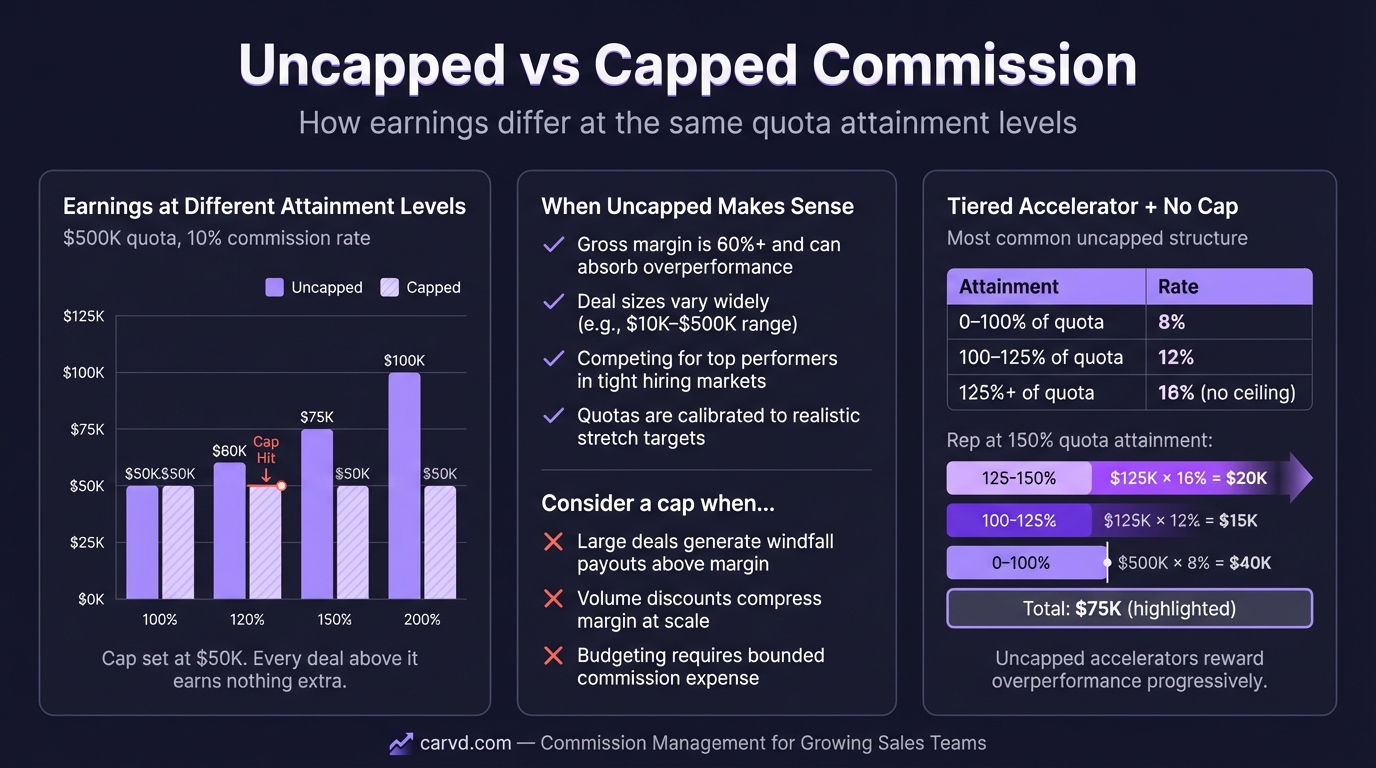
An uncapped commission plan has no ceiling on variable pay. A rep who closes $3M against a $1M quota earns commission on all $3M — not just the first $2M, or up to some fixed dollar maximum.
The alternative is a capped plan, where earnings stop at a defined limit — usually 2x or 3x the target incentive. A rep with a $50,000 target incentive and a 2x cap maxes out at $100,000 in variable pay regardless of how much more they sell.
According to the WorldatWork and SalesGlobe 2022 Sales Compensation Programs and Practices survey of over 600 companies, 35% use hard caps. That means roughly 65% technically do not — but 56% of companies use at least one form of payout governance (decelerators above a threshold, bluebird policies for windfall deals, or compensation committees that review extreme payouts). Truly unlimited plans, with no controls of any kind, are less common than job descriptions suggest.
The distinction matters when you're designing a plan or evaluating a job offer.
Why uncapped commission works for reps
The behavioral case for uncapped commission is straightforward. If a rep knows they'll stop earning above a certain number, they stop closing aggressively once they hit it. They may defer deals into the next period, reduce pipeline activity, or shift focus elsewhere.
LinkedIn data cited by Salesforce shows pay is the top reason sales reps leave their roles, and average sales rep turnover runs around 35% annually. An uncapped plan signals that the company expects reps to overperform and will pay accordingly — which is a meaningful differentiator in competitive hiring markets, particularly in SaaS.
The job posting line "uncapped earning potential" exists because it works as a recruiting signal. Whether the underlying plan delivers on it is a separate question.
Why uncapped commission creates risk for companies
The risk isn't that reps will make too much money. The risk is that commission cost of sales becomes unpredictable.
Alexander Group's benchmark database puts the cross-industry B2B compensation cost of sales (CCOS) at around 7.9% of revenue, with a healthy range of 8–15% for most B2B businesses. SaaS mid-market companies typically run 10–15%; enterprise software runs higher. When a plan is truly uncapped and a rep closes several bluebird deals — unusually large, unexpected contracts that weren't in the budget model — CCOS can spike well above those ranges.
Bluebird deals. A single enterprise deal that represents 150% of a rep's annual quota can generate a commission payout the finance team didn't model. Alexander Group guidance suggests most plans should trigger governance review when a single deal exceeds 50–66% of a rep's annual target. That review doesn't automatically cap the payout — it just brings it to a committee before the check clears.
Deal timing manipulation. When reps track their position against a quota closely, they make rational decisions about when to close deals. A rep near a tier boundary may push to close two deals in the same week to cross into a higher rate. A rep who has already hit their maximum payout ceiling has no reason to close anything else this period. Uncapped plans reduce the incentive to defer, but they introduce a different timing dynamic: reps optimizing closes around quarterly resets, plan years, or accelerator thresholds.
Excellence point calibration. Most tiered plans pay an accelerated rate above quota. If that accelerator is set too high relative to where historical overperformance actually lands, the plan produces large unplanned payouts for average-plus performance, not just exceptional performance. Alexander Group flags this as a common design error — when the "excellence point" (the rate designed for truly exceptional performance) is calibrated too conservatively.
The 35% who cap: why they do it
The WorldatWork and SalesGlobe data shows cap usage skews toward larger companies. That pattern makes sense. A 500-person sales org with a handful of reps each closing $5M+ deals has material exposure to individual payout variance. A 10-person startup does not.
Caps also appear more in lower-margin industries where variable payout isn't self-funding. A SaaS business with 70–80% gross margins can afford to pay 15% commission on a deal that generates 70% gross margin — the math works. A distribution company operating on 12% gross margins cannot pay 10% commission on every deal and survive. In those contexts, caps exist to protect margin, not to shortchange reps.
Alternatives to hard caps
Most companies that want to manage payout risk without a hard cap use one of these mechanisms:
Decelerators. Instead of a ceiling, the commission rate drops above a threshold. Model different decelerator curves with the commission plan builder to see the payout impact at various attainment levels. A plan might pay 10% on deals up to quota, 15% on deals from 100–150% of quota, and then 7% on everything above 150%. Reps continue earning — just at a lower rate. According to the WorldatWork/SalesGlobe survey, 30% of companies use decelerators.
Bluebird policies. A separate rule applies to unexpectedly large deals, typically defined as any single deal exceeding 50–66% of annual quota. The deal gets reviewed by a compensation committee (usually Sales, Finance, and HR) and may be paid at a different rate or split across periods. About 28% of companies use this approach, per the same survey.
Excellence point with a soft cap. The plan pays the highest accelerator rate only up to a defined "excellence point" — say, 200% of quota — and then applies a flat rate above that. Reps can still earn beyond the excellence point; they just don't get a further accelerator. This is different from a hard cap because the payout continues.
None of these are "truly uncapped." They're governed plans with specific rules for specific scenarios. Whether they're described as uncapped in job postings depends on the company.
When uncapped commission makes sense
High-margin businesses where commission is self-funding. SaaS, software, and services businesses with gross margins above 60% can pay out large commissions on oversized deals without losing money on those deals. The math supports it.
Small teams where plan design is transparent. At 5–10 reps, everyone knows everyone's number. There's no anonymity behind a commission dispute, and the CFO is often close enough to the process to catch anomalies before they become budget problems.
Competitive hiring markets for specific roles. Enterprise AEs with a track record of closing large deals know their market value. Uncapped plans signal you're not going to penalize them for overperforming — which matters when they're evaluating three offers simultaneously.
Newer companies that need to attract talent without topping out base salary. Uncapped commission competes with base salary as a total compensation lever. If you can't afford to pay a $200K base, an uncapped plan that realistically pays $150–200K OTE at 100% quota is an alternative signal.
When uncapped commission creates problems
Low-margin businesses. If your gross margin is 30%, paying 10% commission on every dollar of revenue leaves little room for operating costs. Uncapped plans in low-margin contexts are either unsustainable or the "uncapped" claim isn't real because the quota itself is set as a ceiling.
Large teams with diverse deal types. At 50+ reps across multiple segments, territories, and product lines, an uncapped plan creates budget exposure that's hard to model. One rep closing an unexpected $10M deal can shift your compensation line materially.
When your quota methodology is weak. Uncapped plans assume quotas are set accurately and consistently. If some reps have territory advantages that make overperformance easy — not because they're selling harder, but because their patch is better — uncapped commission rewards luck, not performance. That's a plan design problem that caps can partially mask but uncapped plans make visible.
Tracking uncapped commissions accurately
Whatever your policy — truly uncapped, soft-capped with decelerators, or a bluebird governance process — the math gets complicated at scale.
For a team of 5 reps on flat commission, a spreadsheet is fine. At 20+ reps on tiered plans with deal-level bluebird thresholds, tracking which deals triggered which rate, which reps hit which governance threshold, and what the total payout looks like before payroll closes becomes error-prone quickly.
Commission software like Carvd calculates this deal by deal through its commission calculator, showing each rep exactly how their payout was derived — which tiers applied, which deals hit which rate, and what the total looks like. That transparency reduces the dispute rate that caps sometimes create: reps who understand their number don't argue about it.
The honest version of "uncapped"
Uncapped commission is a real structural choice with real tradeoffs. It works well in high-margin businesses that can absorb variable payout costs, with reps who have clear quotas and consistent territory advantages. It creates risk in lower-margin contexts, at scale, or when the quota methodology is inconsistent.
The 65% of companies that technically don't use hard caps still mostly use governance mechanisms that limit extreme payouts. That's not dishonest — it's practical plan design. The question isn't whether to have a ceiling but whether your ceiling is a hard stop or a softer control that still lets reps earn beyond quota.
For reps evaluating an "uncapped" offer: ask about bluebird policies, decelerators, and whether the plan has been changed in the past two years. Use the commission calculator to model what your expected earnings actually look like at different attainment levels. The answers tell you more than the headline.
Related reading: Sales Commission Structure: Types, Examples & How to Choose · Tiered Commission Structure: How to Build One That Scales · Commission Clawbacks: When to Use Them
Last updated: March 21, 2026