On-Target Earnings (OTE): The Complete Guide for Reps and Managers
On-target earnings (OTE) is the total annual pay a sales rep earns at 100% quota. Learn how OTE is calculated, benchmarked by role, and evaluated in a job offer.
On-target earnings (OTE) is the total annual pay a sales rep earns when hitting exactly 100% of quota. It combines base salary and variable commission into one number — the figure that appears in job postings and offer letters.
If your base is $95,000 and you earn $95,000 in commissions at full quota attainment, your OTE is $190,000.
That's the definition. The harder questions are how that number gets built, what's realistic versus aspirational, and how managers should set it for their teams. This guide covers all of it — with calculation examples for SDRs, AEs, and sales managers.
What OTE includes (and doesn't include)
OTE has exactly two components.
Base salary is guaranteed pay — the amount you receive regardless of how much you sell. It's your floor. You receive it whether you close one deal or twenty.
Variable compensation (also called variable target, at-risk pay, or commission target) is what you earn by hitting quota. For most sales roles, this is paid as a commission rate applied to closed revenue.
OTE is the sum at 100% quota attainment. It does not include bonuses, equity, benefits, or SPIFs — those are compensation elements outside the OTE framework.
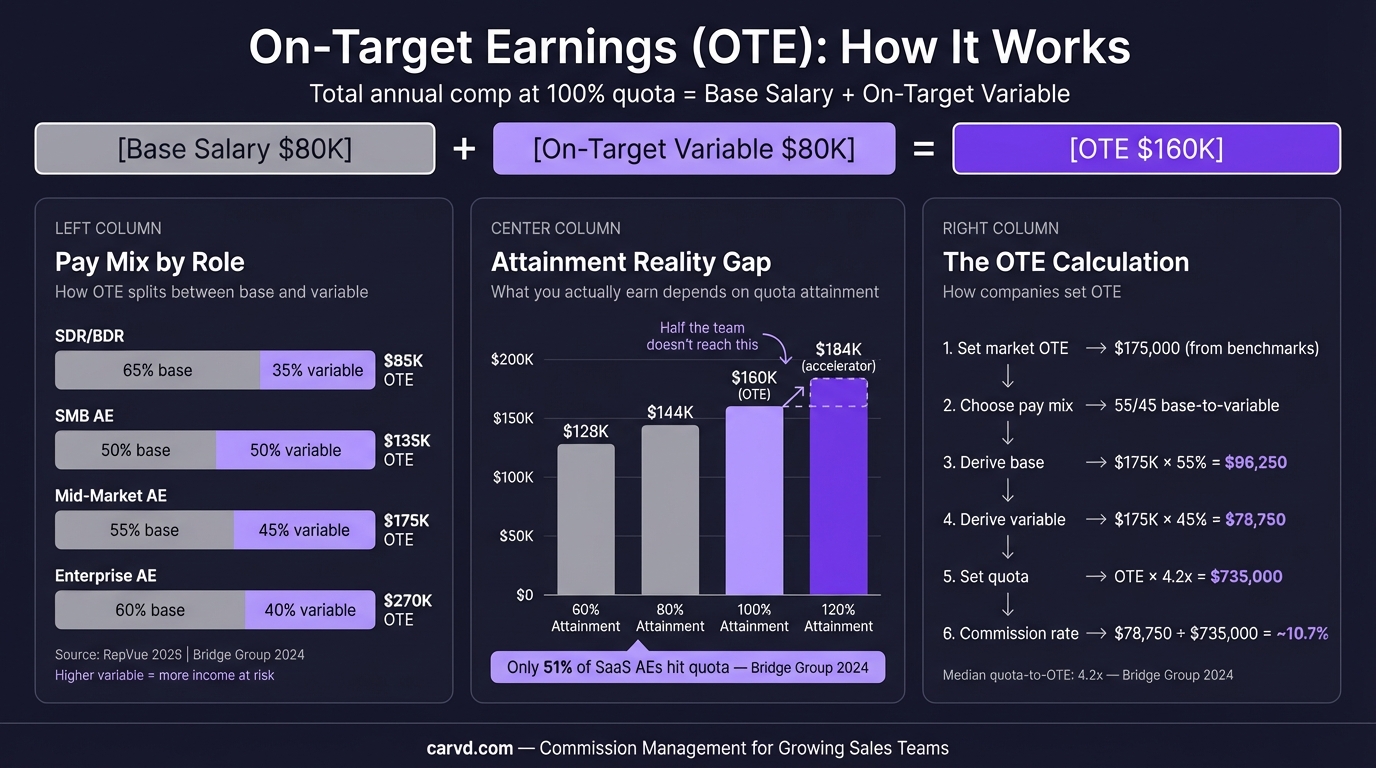
The ratio of base to variable is called pay mix. It's written as base:variable (e.g., 50:50 or 60:40) or expressed as a percentage split.
| Pay mix | Example at $190K OTE | What it means |
|---|---|---|
| 50:50 | Base $95K, variable $95K | Equal split — highest earning risk, highest upside |
| 60:40 | Base $114K, variable $76K | Higher floor, lower upside |
| 70:30 | Base $133K, variable $57K | Conservative — common for SDRs and CS roles |
Bridge Group's 2024 benchmark of 172 B2B SaaS companies puts median AE pay mix at 53% base, 47% variable. That's close to 50:50 — the industry convention for quota-carrying roles. You can model different pay mix scenarios and see the impact on OTE using the OTE calculator.
SDRs typically run 65:35 or 70:30 because they generate pipeline rather than closing full-cycle deals. Enterprise AEs sometimes run 50:50 or higher variable because deal sizes and margins support larger commission payouts per deal.
For a deeper look at how pay mix affects rep behavior and plan design, see variable compensation: how it works and when to use it.
How to calculate OTE: formulas and examples
The OTE formula is straightforward.
OTE = base salary + variable target
The variable target is how much you earn in commissions at exactly 100% quota attainment. For commission-based plans, this is: commission rate × quota.
Example 1: Account executive at a SaaS company
- Base salary: $95,000
- Annual quota: $800,000 ACV
- Commission rate: 11.5%
- Variable target: $800,000 × 11.5% = $92,000
- OTE: $95,000 + $92,000 = $187,000
This aligns with Bridge Group's 2024 median data — a slight rounding to reach the reported $190,000 figure at slightly different inputs.
Example 2: SDR / BDR
SDRs don't carry a revenue quota. Their variable pay is typically tied to meetings booked, opportunities created, or qualified pipeline generated.
- Base salary: $58,000
- Variable target (at 100% activity quota): $25,000
- OTE: $83,000
At a 70:30 pay mix, a 30% variable on $83K OTE gives roughly $25K in variable pay — achievable by consistently booking 20 qualified meetings per month (or whatever the SDR's target metric is).
Example 3: Sales manager
Sales managers typically receive a team override — a small commission on team-closed revenue — plus a flat variable bonus tied to team quota attainment.
- Base salary: $130,000
- Team override: 1.5% on team closed revenue
- Team carries $3.5M annual quota
- Variable target at 100% attainment: $3,500,000 × 1.5% = $52,500
- OTE: $130,000 + $52,500 = $182,500
Some managers also receive personal deal credit from key accounts. Others receive a lump bonus rather than an override. Pay mix for managers typically runs 60:40 to 70:30 because management stability matters more than maximum variable upside.
For a step-by-step walkthrough of how to calculate OTE across plan types, see how to calculate OTE.
The math behind OTE: quota, commission rate, and pay mix
OTE, quota, and commission rate are three variables that must be internally consistent. When they're not, plans produce OTE numbers that look competitive but are structurally impossible to hit.
The sequence that produces a coherent plan:
1. Benchmark OTE by role and market. Start with what competing employers pay for the same role in your geography. Bridge Group's 2024 data puts median AE OTE at $190,000 — up from $167,000 in 2022. Benchmarks vary significantly by company stage, city, and product segment.
2. Set pay mix by role type. A 50:50 mix at $190K OTE means $95K base and $95K variable target.
3. Set quota at 4–5x the variable target. This is the critical step most plans get wrong. If the variable portion is $95,000, the annual quota should be $380,000–$475,000. Bridge Group's 2024 data puts the median quota-to-OTE ratio at 4.2x: a $190K OTE rep carries roughly $800K in annual quota.
4. Commission rate is the result, not the input. With $95,000 variable at $800,000 quota, the commission rate is 11.9%. Bridge Group's median commission rate for SaaS AEs in 2024 is 11.5%. To calculate OTE scenarios before committing to a plan, try a Stackrows compensation template.
When companies reverse this sequence — setting a revenue target from a board model first, then announcing OTE — quota often exceeds what the territory or market supports. The OTE sounds competitive, but hitting it requires closing far more revenue than a well-calibrated plan would assign.
| Variable at $190K OTE | Quota needed (4x) | Implied commission rate |
|---|---|---|
| $95,000 (50:50 split) | $380,000 | 25.0% |
| $89,300 (47% variable) | $800,000 | 11.2% |
| $76,000 (40% variable) | $800,000 | 9.5% |
Different combinations of pay mix and quota produce very different commission rates and earning dynamics. The 53:47 split at $800K quota (median from Bridge Group) works out to about 11.2% — the figure most often cited as a standard SaaS AE commission rate.
OTE benchmarks by role (2024–2025)
These are current benchmarks from Bridge Group's 2024 SaaS AE report and Seattle Corporate Search's 2025 SaaS salary benchmarks.
| Role | Base | Variable target | OTE | Pay mix |
|---|---|---|---|---|
| SDR / BDR | $45K–$65K | $15K–$30K | $60K–$85K | 70:30 |
| SMB Account Executive | $60K–$80K | $50K–$70K | $110K–$150K | 55:45 |
| Mid-Market AE | $75K–$95K | $65K–$105K | $140K–$200K | 50:50 |
| SaaS AE (median) | ~$101K | ~$89K | $190K | 53:47 |
| Enterprise AE | $110K–$140K | $110K–$180K | $220K–$320K | 50:50 |
| Sales Manager (first-line) | $120K–$150K | $80K–$130K | $200K–$280K | 60:40 |
Sources: Bridge Group 2024 SaaS AE Metrics & Compensation Benchmark (172 B2B SaaS companies); Seattle Corporate Search 2025 SaaS Salary Benchmarks.
These are medians across a wide range. OTE varies significantly by:
- Company stage. Pre-Series B startups often pay lower base but higher equity; growth-stage companies pay market OTE with smaller equity grants.
- Geography. San Francisco and New York AE OTE runs $30K–$50K higher than remote-first or secondary markets.
- Product complexity. Longer sales cycles and more technical products typically command higher OTE.
- Vertical. Security and infrastructure products carry higher OTE than horizontal productivity tools.
Use the table above as an anchor, not a hard target. Verify against current job postings for your specific role and market.
Realistic vs aspirational OTE: what attainment data shows
OTE is defined at 100% quota attainment. Most reps don't hit that.
Bridge Group's 2024 benchmark found only 51% of SaaS AEs hit quota — down from 66% in 2022. RepVue's Cloud Sales Index tracks rolling quota attainment across thousands of reps: average attainment in 2024 was 43%. Q1 2025 was 43.3%; Q3 2025 was 43.2%.
At 43% attainment, a rep with $190,000 OTE earns roughly:
- Base: $101,000 (fixed, always paid)
- Commission at 43% of $800K quota: $800,000 × 43% × 11.2% = ~$38,600
- Actual total: approximately $139,600
That's a meaningful income — but it's $50,000 below the OTE number on the job posting.
The math changes substantially with higher attainment. A rep at 80% quota attainment earns $101,000 + ($640,000 × 11.2%) = $172,680. At 100%, they hit the full $190,000. At 125%, accelerators often kick in at a higher rate — a rep might earn $215,000–$225,000 depending on plan design.
Why attainment rates are so low
Forrester research has documented that companies intentionally over-assign quotas by 20–30% so that even if only half the team hits their number, the company still hits its board-level revenue plan. A 50% attainment rate across the team is often engineered in — not a sign of poor product or weak reps.
Declining attainment from 2022 to 2024 (66% to 51% in Bridge Group data) reflects quota inflation outpacing market conditions and deal velocity. If quota growth exceeds pipeline growth, attainment rates fall even if rep performance stays constant.
This context matters when evaluating an OTE offer. The question isn't whether OTE is achievable in theory — it's whether this company's quota-setting reflects actual territory capacity.
For more detail on attainment patterns and how reps track their own pacing, see OTE salary: what you actually earn vs what the offer says.
How to evaluate an OTE offer (rep perspective)
OTE is the starting point of negotiation, not the end. Before accepting any comp offer, these questions reveal whether the stated OTE is achievable.
"What percentage of reps hit quota last year?" This is the most important question. The honest answer tells you whether OTE is a realistic expectation or a theoretical ceiling. Anything below 60% warrants a follow-up. Below 40% means either the quota is too aggressive, the territory doesn't support the number, or there's a product or market fit issue you should investigate before joining.
"What was median attainment across the team?" Median attainment matters more than the percentage who hit quota. A team where 70% of reps hit exactly 100% is structured differently from a team where 30% hit 200% and 70% hit 50%.
"What is the quota-to-OTE ratio?" Take the annual quota and divide by OTE. At Bridge Group's median, it's 4.2x. Ratios above 5x are worth scrutinizing — they usually mean the plan requires high attainment to reach OTE or that the quota was set from a board model without validating territory capacity.
"Is the territory carved or greenfield?" Inherited territories with existing customer relationships ramp faster than greenfield. Both roles carry the same OTE on paper.
"What does year-two quota look like?" Some companies increase quota significantly at the end of year one without adjusting OTE. An offer that looks reasonable at hire can deteriorate as quota scales.
"Are accelerators uncapped?" If you close 125% of quota, does the commission rate increase? Capped accelerators limit upside for top performers and are a common reason strong AEs leave.
For a full negotiation framework — including which elements of OTE are most negotiable — see OTE in sales: how it's set, paid, and negotiated.
How to set OTE for your team (manager and founder perspective)
Setting OTE is one of the highest-leverage decisions for any sales org. Get it wrong and you either overpay (burning margin) or underpay (burning retention).
The process that produces internally consistent, market-competitive comp plans:
Step 1: Benchmark by role and geography
Pull current data for the role you're hiring. Use Bridge Group, Levels.fyi, Betts Recruiting benchmarks, or current job postings for roles with disclosed OTE. Check geographic adjustments — a $190K OTE AE in San Francisco may need a $160K offer in Austin to maintain the same lifestyle, or you may match it to attract top performers.
Step 2: Determine pay mix by role risk tolerance
Higher variable pay is appropriate for:
- Fully quota-carrying individual contributors (50:50 or 45:55 for competitive markets)
- Roles where activity directly drives revenue (outbound-heavy AEs)
- Experienced hires who can handle income variability
Higher base is appropriate for:
- SDRs and BDRs (who influence but don't close revenue)
- New reps in long ramp periods
- Roles where the sales cycle exceeds 6 months (cash flow concern for the rep)
- Managers who must maintain stability while coaching the team
Step 3: Set quota using the 4–5x rule
Variable target (at 100% OTE) × 4 to 5 = quota.
For a mid-market AE with $80,000 variable target, quota should be $320,000–$400,000. If your revenue plan requires each AE to close $600,000, either the OTE is too low, the pay mix is wrong, or the quota is too high.
The 4–5x ratio exists because it produces a commission rate in the 8–15% range — the range that's motivating without being economically unsustainable for the company.
Step 4: Check your math across plan components
Before publishing a comp plan:
- Commission rate at 100% attainment = variable target ÷ quota
- Does that rate fall in the 8–15% range for your product economics?
- Is the base competitive for the role independently, without relying on the variable?
- Can top performers earn meaningfully above OTE with accelerators? (Target: 1.5–2x OTE for 150% attainment)
Step 5: Validate with territory data
Before finalizing quota, verify that the assigned territory has enough addressable revenue to support hitting the number. A territory with $300,000 in potential ARR should not carry a $500,000 quota. If a rep cannot theoretically hit quota given their territory, the plan is structurally broken before it starts.
For a complete guide to plan design — including accelerators, clawbacks, ramp periods, and multi-product plans — see how to build a sales compensation plan. To model specific plan structures before rolling them out, use the commission plan builder.
OTE vs total compensation: what the number leaves out
OTE is a cash compensation figure. It excludes equity, benefits, retirement contributions, and bonuses. In practice, a rep evaluating a $190,000 OTE offer needs to account for the full package.
| Compensation element | Included in OTE? |
|---|---|
| Base salary | Yes |
| Variable commission | Yes |
| Signing bonus | No |
| Equity / stock options / RSUs | No |
| 401(k) match | No |
| Health insurance | No |
| SPIFs and quarterly bonuses | Sometimes* |
| President's Club / recognition rewards | No |
*SPIFs are short-term performance incentives. Some companies roll them into OTE projections when recruiting; most don't. Ask explicitly whether stated OTE includes SPIFs.
For a full breakdown of everything that goes into a sales rep's compensation, see total compensation: what it includes beyond OTE.
OTE and commission transparency: the trust problem
Once a plan is live, the ongoing challenge is making sure reps trust their commission payouts.
At companies still running commissions through spreadsheets, reps often maintain shadow tracking — a personal record of every deal and what it should pay. This is common enough that Bridge Group's 2023 survey identified it as a key indicator of low trust in the commission process.
Shadow accounting wastes selling time. If a rep spends 2–3 hours per pay period re-deriving their commission because they don't trust the number, that's pipeline-building time lost.
The underlying problem is usually opacity — reps receive a total payout without seeing how it was calculated deal by deal. When the number is wrong (or just looks wrong), there's no audit trail to investigate.
The solution is visibility at the deal level. Carvd's rep dashboards show reps a real-time breakdown of each closed deal, the commission rate applied, any accelerators triggered, and the running payout total — so the payday number is never a surprise.
For a deeper look at how commission tracking affects rep trust and dispute rates, see variable pay: how it works and why reps shadow-track it.
OTE reference: key terms
On-target earnings (OTE)
The total annual compensation a sales rep receives when hitting 100% of quota — combining guaranteed base salary and earned variable commission.
Pay mix
The ratio of base salary to variable compensation. Expressed as base:variable (e.g., 60:40). A 50:50 plan means half of OTE is guaranteed, half must be earned.
Variable target
The commission amount earned at exactly 100% quota attainment. OTE = base + variable target.
Quota-to-OTE ratio
Annual quota divided by OTE. Industry standard is 4–5x. Bridge Group's 2024 median for SaaS AEs is 4.2x.
Quota attainment
Percentage of annual quota a rep closes. Bridge Group 2024: 51% of AEs hit quota. RepVue Q3 2025: 43.2% average attainment across tracked reps.
Accelerator
A higher commission rate that kicks in above a quota threshold. A plan might pay 11% up to 100%, then 16% on revenue above quota. Accelerators let top performers earn above OTE.
Ramp period
A reduced quota period for new reps, typically 3–6 months. OTE assumes a fully ramped rep; year-one actual earnings are typically below stated OTE during ramp.
Related reading: What does OTE mean? · OTE in sales: how it's set, paid, and negotiated · How to build a sales compensation plan · Variable compensation: how it works · OTE vs base salary: what you're actually guaranteed · How to calculate OTE · Total compensation: what goes beyond OTE
Last updated: March 22, 2026