OTE vs Base Salary: What's the Difference?
OTE and base salary are not the same number. Here's what each means, how pay mix affects your floor and ceiling, and what to look for when evaluating a sales offer.
When a sales job posting lists "$160,000 OTE," that's not the same as a $160,000 salary. Understanding that distinction before signing an offer letter can make a meaningful difference in your actual take-home pay.
OTE and base salary are related but different numbers. One is guaranteed. One is a ceiling you can only hit if your quota cooperates.
What base salary means in a sales role
Base salary is the fixed, guaranteed component of a sales rep's total compensation. It's paid on a regular schedule — bi-weekly or monthly — regardless of quota performance. Whether you close three deals or thirty that period, base salary doesn't change.
For non-sales roles, base salary and total compensation are often the same thing. For sales roles, base salary is only part of the story.
What base salary is:
- Guaranteed cash, paid on schedule
- Not tied to performance in any given period
- The amount you can count on during a slow patch, a ramp period, or a deal drought
Base salary in sales is intentionally set below what reps earn at quota. That design is deliberate: it preserves upside for strong performance and keeps the company's cost-of-sales aligned with revenue results.
What OTE means in a sales role
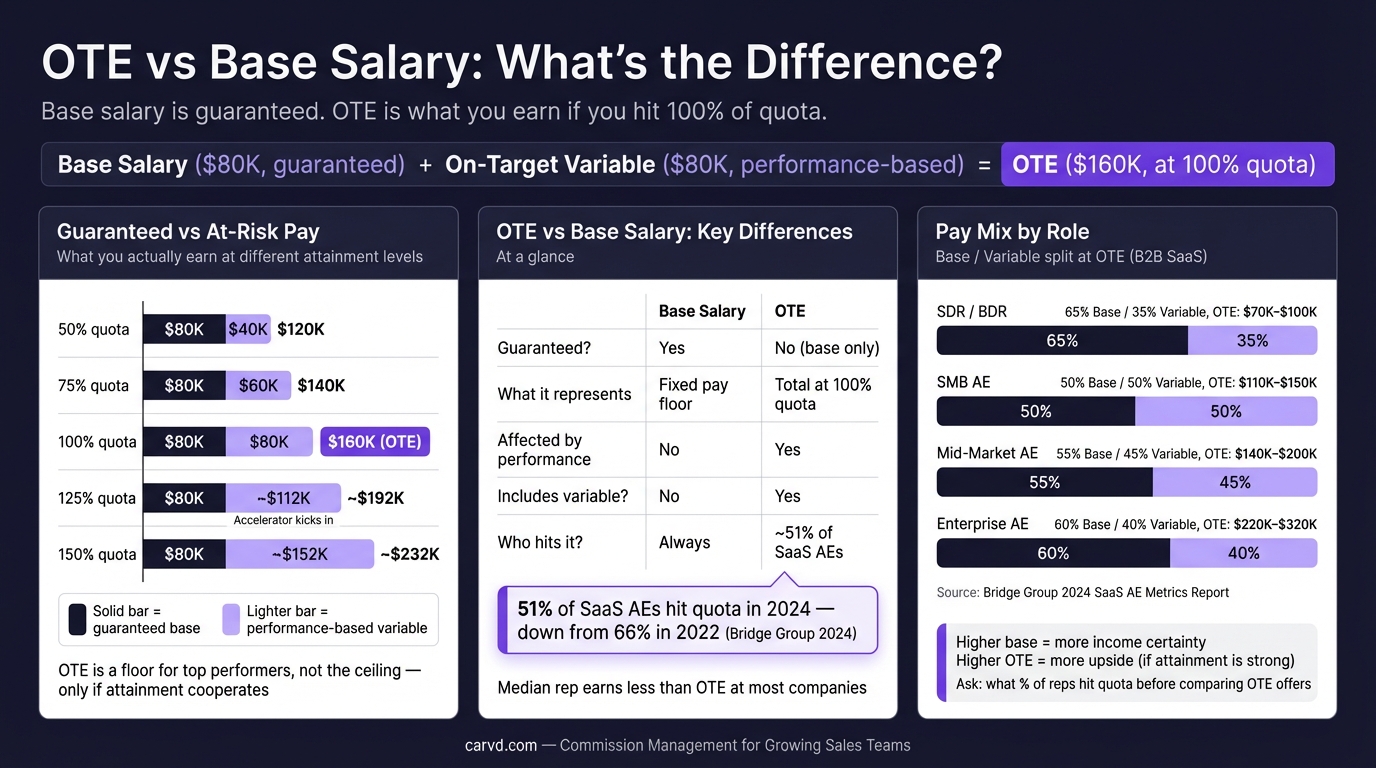
OTE — on-target earnings — is the total annual compensation a sales rep receives when hitting exactly 100% of their assigned quota. It combines base salary and the on-target variable (OTV), which is the commission or bonus earned at full quota attainment.
OTE formula:
OTE = Base salary + On-target variable
| Component | Example | Type |
|---|---|---|
| Base salary | $80,000 | Guaranteed |
| On-target variable | $80,000 | Performance-based |
| OTE | $160,000 | Total at 100% quota |
In this example, the rep has a 50/50 pay mix. Half the compensation is guaranteed; half depends on hitting quota. At 80% quota, actual earnings drop to roughly $144K. At 120% quota with accelerators, they might exceed $185K.
OTE is not a salary. It's a performance target that assumes the rep will hit 100% of their assigned quota for the full year.
The key differences
| Base salary | OTE | |
|---|---|---|
| Guaranteed? | Yes | No (only base portion) |
| What it represents | Fixed pay floor | Total pay at full quota |
| Affected by performance | No | Yes |
| Includes variable? | No | Yes |
| What most reps earn | Always | ~50% of reps, per Bridge Group 2024 |
The most important difference: only the base is guaranteed. OTE is the number on the job description, but it's also the number most reps don't reach. According to Bridge Group's 2024 SaaS AE Metrics Report, only 51% of SaaS AEs hit quota — down from 66% in 2022. For roles where fewer than half the team hits quota, the median rep earns less than OTE every year.
Pay mix: how base and variable are proportioned
The ratio of base to variable is called pay mix. It determines how much of OTE is at risk.
| Role | Typical pay mix (base/variable) | Example OTE | Guaranteed base |
|---|---|---|---|
| SDR / BDR | 65/35 | $85,000 | $55,250 |
| SMB AE | 50/50 | $135,000 | $67,500 |
| Mid-Market AE | 55/45 | $175,000 | $96,250 |
| Enterprise AE | 60/40 | $270,000 | $162,000 |
| Account Manager | 70/30 | $130,000 | $91,000 |
Source: Bridge Group 2024 SaaS AE Metrics Report; RepVue salary index, early 2026.
SDRs carry a higher base-to-variable ratio because they generate pipeline, not closed revenue. An SDR's output — booked meetings — feeds an AE's results but doesn't directly produce ARR. AEs who run the full sales cycle have more influence over deal outcomes, so more of their pay is tied to those outcomes.
Enterprise AEs trend back toward higher base (60/40) partly because enterprise deal cycles are longer. A rep with a 9-month average sales cycle needs a liveable base while deals progress. Tying too much compensation to a variable that pays out quarterly creates income volatility that pushes strong candidates toward other roles.
How to compare a base salary offer vs an OTE offer
Comparing two job offers gets complicated when one quotes base and the other quotes OTE. The right approach is to normalize both to expected annual earnings at realistic performance levels.
Step 1: Get the base on the OTE offer. Ask the hiring manager or recruiter: "What is the base salary, and what is the on-target variable?" A $160K OTE at 50/50 means $80K base + $80K variable.
Step 2: Find out the attainment rate. Ask: "What percentage of reps hit quota last quarter and last year?" If 70%+ hit quota, the OTE is a reasonably reliable earning expectation. If less than 50% do, the expected value of the OTE is much lower than the stated number.
Step 3: Calculate expected earnings at median attainment. The OTE calculator handles this math automatically — enter the OTE, pay mix, and expected attainment to see projected take-home. If the median rep closes 75% of quota on a $160K OTE (50/50 pay mix):
- Base: $80,000
- Variable at 75% attainment: $80,000 × 75% = $60,000
- Expected annual earnings: $140,000 — not $160,000
Comparing a $140,000 salaried offer to this role means comparing $140K vs $140K at median attainment, not $140K vs $160K OTE.
Step 4: Consider ramp. Most companies reduce quota during the first 2–6 months on the job. A $160K OTE with a 4-month ramp at 50% quota means first-year variable earnings are materially lower than projected. Ask for ramp terms before accepting.
When to prefer higher base vs higher OTE
Neither is universally better. The right choice depends on your situation.
Higher base makes sense when:
- Quota attainment data at the company is below 60%
- You're changing industries or segments and expect below-quota performance while ramping
- You have fixed monthly obligations (mortgage, dependents) where income variability is a real problem
- The company is early-stage with unclear quota-setting methodology — a moving quota is more variable than the salary suggests
Higher OTE (lower base) makes sense when:
- Attainment data shows 70%+ of reps hitting quota
- You're confident in the territory, product, and your own track record
- The company has predictable, well-designed accelerators that reward overperformance
- You've been in a similar role and segment recently and have reason to believe you'll outperform
At an established company with strong quota attainment, higher OTE with lower base is frequently the better financial choice. At an early-stage company that hasn't figured out its ICP and keeps changing quota, higher base is the safer bet.
Negotiating base salary vs OTE
In many offers, base salary and OTE are negotiable independently. A few dynamics worth knowing:
Negotiating base up doesn't always raise total OTE. Some companies will adjust the pay mix — raising base while lowering the variable — to keep total OTE the same. That structure gives you more income certainty but less upside. It may or may not serve your interests.
Asking for both can work. At companies with budget flexibility, asking for both higher base and higher OTE simultaneously is reasonable. Justify it with market data — RepVue, Betts Recruiting's annual guide, or the commission rate benchmarks tool for role-specific rate comparisons.
Ask about clawback provisions. Some companies include clawback clauses that let them recover variable compensation if a client churns within a set window. Understand the terms before you rely on variable earnings as income.
Consider total compensation, not just OTE. Equity, benefits, 401K match, and signing bonuses all affect take-home compensation. A $180K OTE with 4-week PTO and a $15K equity grant may be more valuable than a $195K OTE with thinner benefits at a Series A with uncertain prospects.
What OTE looks like when it fails
The most common frustration with OTE-based roles isn't missing quota — it's surprises at payout time. Reps track their own deals throughout the quarter. If the commission check doesn't match their mental math, they want to understand why.
Discrepancies happen for legitimate reasons: clawbacks, timing adjustments, quota resets, deal credits between reps, split commissions. But when these aren't communicated clearly, reps feel shorted — even when the payout is technically correct.
That gap between expected and actual is where trust in the comp plan erodes. Carvd's commission calculator gives reps real-time visibility into how their commissions are being calculated — which plan rules applied, which deals credited at which rates, and where the final payout comes from. That transparency matters most in complex plans where OTE includes multiple components: base, variable, accelerators, and bonuses.
Related reading
- On-target earnings (OTE): the complete guide — how OTE is calculated, set, and evaluated
- What does OTE mean? A plain-English explanation — OTE components and pay mix in detail
- OTE salary: base + variable explained for sales roles — benchmarks and how attainment affects actual earnings
- How to build a sales compensation plan (with templates) — the full comp design process
- Base salary plus commission: finding the right split — pay mix benchmarks and design trade-offs
Last updated: March 22, 2026