OTE Salary: What the Number in a Sales Job Offer Actually Means
OTE salary is base pay plus commission at 100% quota. Learn what OTE ranges look like by role, why most reps earn less, and how to evaluate a real offer.
OTE salary is not the same as a regular salary. It's the total pay you'd earn in a year if you hit exactly 100% of your quota — base plus commission, combined.
A job posting that says "$150,000–$200,000 OTE" is not offering a salary of $150,000–$200,000. It's saying your guaranteed base might be $75,000–$90,000, and you'd earn the rest by hitting your number.
That difference matters when you're evaluating an offer, comparing two positions, or figuring out whether an OTE figure is realistic or aspirational.
What OTE salary is made of
Every OTE salary has two parts:
Base salary is guaranteed income. You receive it regardless of whether you close a single deal. It's your floor.
Variable pay (also called the variable target or at-risk pay) is commission earned by hitting quota. At a 50/50 pay mix with $190,000 OTE, the base is $95,000 and the variable target is $95,000.
The ratio of base to variable is called pay mix. Bridge Group's 2024 benchmark of 172 B2B SaaS companies found median AE pay mix at 53% base, 47% variable — close to 50/50. Different roles run different splits:
| Role | Typical pay mix | Why |
|---|---|---|
| SDR/BDR | 65:35 to 70:30 | Generating pipeline, not closing full deals |
| SMB AE | 55:45 to 60:40 | Shorter cycles, more volume |
| Mid-Market AE | 50:50 | Industry standard |
| Enterprise AE | 50:50 to 60:40 | Longer cycles sometimes warrant more base |
| Sales Manager | 60:40 to 70:30 | Variable tied to team results, not personal quota |
The higher the variable percentage, the more your total annual earnings depend on hitting quota.
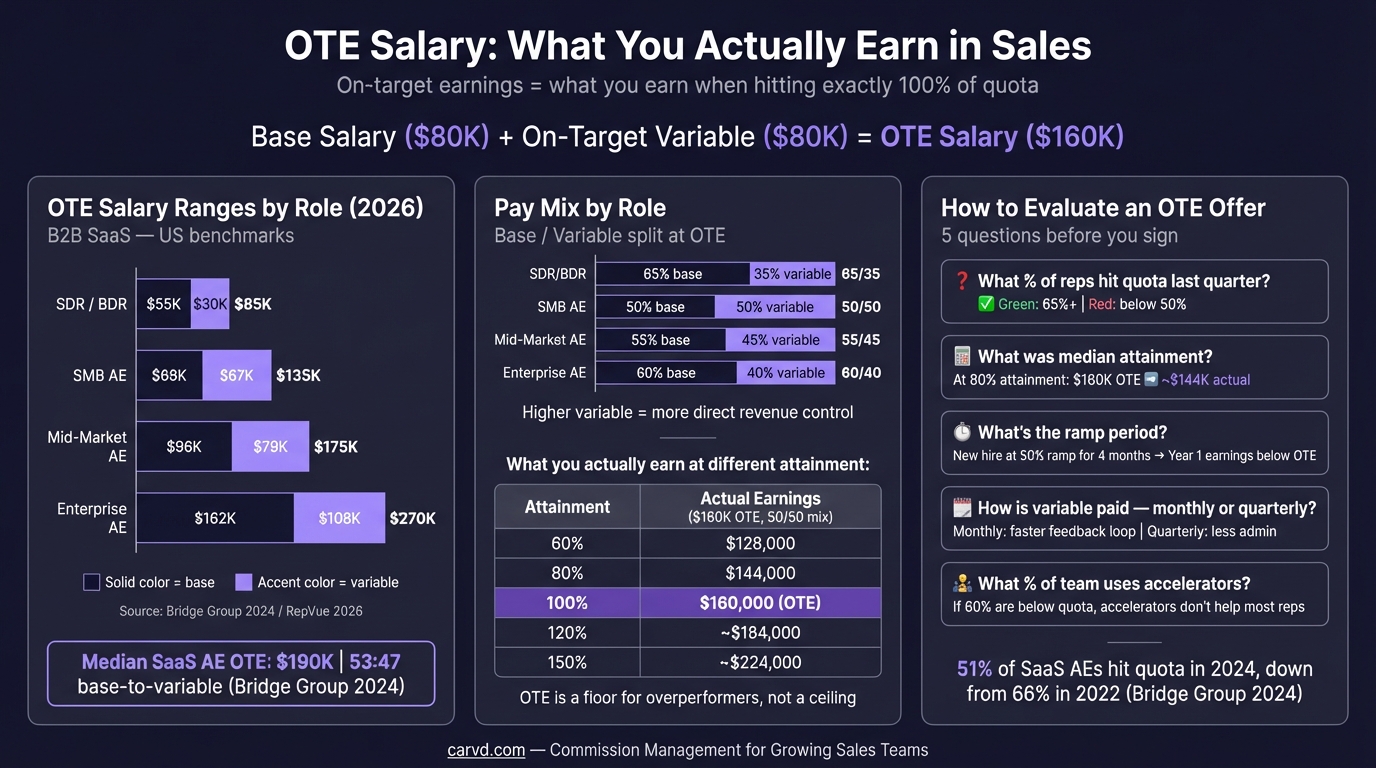
OTE salary benchmarks by role
These are 2024–2025 figures from Bridge Group, RepVue, and Betts Recruiting:
| Role | Typical base | OTE range | Pay mix |
|---|---|---|---|
| SDR/BDR | $55K–$75K | $76K–$110K | 65:35 |
| SMB AE | $65K–$85K | $120K–$160K | 55:45 |
| Mid-Market AE | $75K–$100K | $150K–$200K | 50:50 |
| SaaS AE (median) | ~$101K | $190K | 53:47 |
| Enterprise AE | $100K–$140K | $200K–$280K+ | 50:50 |
| Sales Manager | $120K–$150K | $200K–$280K | 65:35 |
| VP of Sales | $160K–$200K | $280K–$400K+ | 65:35 |
Sources: Bridge Group 2024 SaaS AE Metrics & Compensation Benchmark; RepVue Sales Salary Guide 2025; Betts Recruiting 2025 Compensation Guide.
These are medians across a wide range of companies. OTE varies significantly by stage, geography, and product complexity. To check how a specific offer stacks up, run it through the OTE calculator and compare the quota-to-OTE ratio against these benchmarks.
OTE salary by company stage
The same role pays meaningfully different OTE depending on where the company is in its growth:
| Stage | AE OTE (typical) | Key dynamic |
|---|---|---|
| Seed / Pre-Series A | $120K–$160K | Lower cash, higher equity; less structured plans |
| Series A | $150K–$180K | Plans formalizing, territory and quota being set |
| Series B / Growth | $175K–$210K | Competitive cash, structured accelerators |
| Late-stage / Enterprise | $190K–$280K+ | Full cash comp, minimal equity dependency |
Early-stage startups typically offer 15–25% below Series B+ companies for the same role, offset by larger equity. A $190,000 OTE median for a SaaS AE is anchored at companies that have reached growth stage — the same role at a Series A startup might carry $150,000–$165,000 OTE.
What OTE salary actually predicts about your earnings
OTE assumes 100% quota attainment. Most reps don't hit that.
Bridge Group's 2024 benchmark found only 51% of SaaS AEs hit quota — down from 66% in 2022 and 74% in 2012. RepVue's Q4 2024 Cloud Sales Index puts average attainment across all cloud sales roles at 43%. By segment: Enterprise AEs averaged 38%, Mid-Market AEs 40%, SDRs 53%.
At 43% attainment, the math on a $190,000 OTE looks like this:
- Base: $101,000 (guaranteed)
- Variable target: $89,000
- Realized commission at 43% attainment: ~$38,000
- Actual annual earnings: ~$139,000
That's not a bad outcome. But it's not $190,000.
This doesn't make OTE useless as a benchmark. It tells you the ceiling if you perform at 100% and the quota is achievable. It also tells you the base — which is the number you should evaluate first when comparing offers.
One reason attainment rates hover around 50%: Forrester has documented that companies intentionally over-assign quotas by 20–30% so that even if only half the team hits their number, the company still hits its revenue plan. A 50% attainment rate is often designed in, not accidental.
How to read an OTE salary in a job posting
When you see a range like "$150,000–$200,000 OTE" in a job posting, the range reflects uncertainty in the base or the plan tier, not a guarantee of earnings between those numbers.
The two questions worth asking before treating that range as your expected salary:
1. What is the base component? If the posting says "$150,000–$200,000 OTE" but doesn't specify base, ask. A 50/50 split means base is $75,000–$100,000. Some companies set base as low as 40% of OTE to maximize variable upside — which means more of your compensation depends on hitting quota.
2. What percentage of reps hit quota last year? This is the number that determines whether the stated OTE is achievable or aspirational. Less than 60% is worth probing. Less than 40% is a signal about quota calibration, territory coverage, or product-market fit.
A secondary question worth asking: what does median attainment look like? Median tells you more than the percentage who hit quota, because a team where 70% hit exactly 100% is a different environment than one where 30% hit 200% and 70% hit 50%.
OTE salary vs. base salary: which to optimize for
When comparing two offers, compare base salaries first. OTE is contingent; base is not.
A $180,000 OTE at a 40/60 base:variable split gives you a $72,000 base. A $170,000 OTE at a 60/40 split gives you a $102,000 base. The second offer has a lower stated OTE but a $30,000 higher guaranteed floor.
The right pay mix depends on how much volatility you can absorb and how confident you are in the quota's achievability. Early in a role with an uncertain territory, a higher base provides more stability. In a proven territory with a track record of reps hitting quota, a heavier variable split maximizes upside.
For high performers who consistently close above 100% of quota, the more important question is the accelerator structure: what does the commission rate become above 100%? A plan that pays a meaningful premium above 100% (say, 1.5x or 2x the base rate) is more valuable than a capped plan even if stated OTE is higher. The commission rate benchmarks tool shows typical rates and accelerator multipliers by role and industry.
The connection between OTE salary and commission calculations
OTE sets the expectation. Commission calculations determine what you actually receive.
In companies still running payroll on spreadsheets, the gap between expected OTE and received commission is a recurring source of disputes. Reps track their own deals and calculate what they should have earned; finance produces a different number; no one can explain the difference in under an hour.
The underlying problem is transparency: reps have no way to see how each deal contributed to their commission total, which accelerator tier applied, and whether the clawback for a cancelled deal was calculated correctly.
Carvd's rep dashboards show reps a deal-by-deal breakdown of every commission calculation — so the payout number at the end of the month matches what they'd calculate themselves. See what does OTE mean for a full breakdown of how OTE is defined, and OTE in sales for how companies set and structure OTE plans.
Related reading: Sales Compensation Plan: How to Build One That Works · Base Salary Plus Commission: Finding the Right Split · On-Target Earnings: The Complete Guide
Last updated: March 22, 2026