Total Compensation: What's Included Beyond Base Salary
Total compensation is more than your salary. Learn what goes into a total comp package for sales roles—base, variable, equity, and benefits—with real benchmarks.
Total compensation is not the same as your salary. It's not even the same as your OTE.
Base salary is what hits your bank account every two weeks regardless of performance. OTE adds the commission you'd earn at 100% quota. Total compensation includes both of those — plus equity, health insurance, retirement contributions, paid leave, and any other form of value an employer provides.
For most sales professionals, the difference between base salary and total compensation is significant. According to the U.S. Bureau of Labor Statistics Employer Costs for Employee Compensation report (September 2024), benefits alone make up 29.6% of total employer compensation costs in private industry. That's roughly $13 in benefits for every $31 in wages.
Understanding the full picture matters when comparing job offers, negotiating, or deciding whether a role is worth taking.
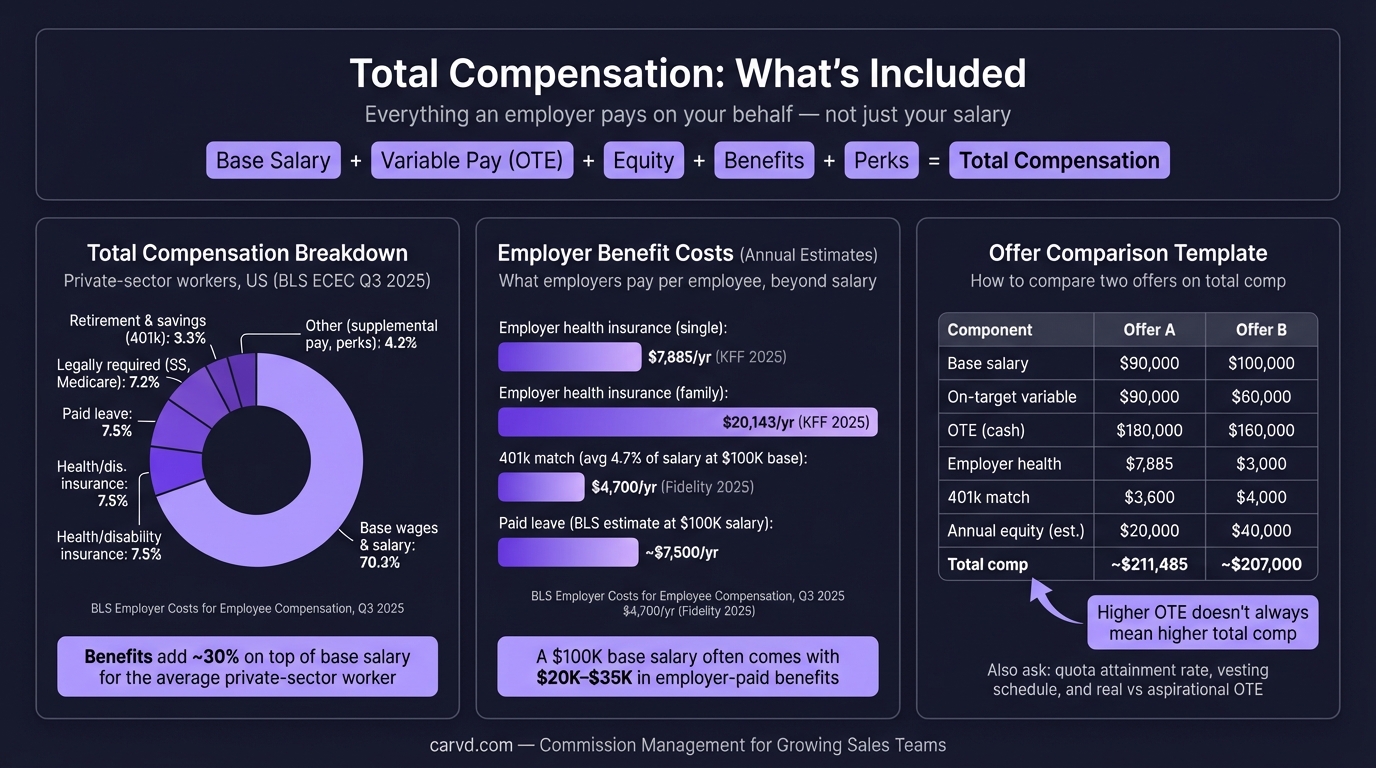
What's included in total compensation
A complete total compensation package for a sales role typically has four layers:
1. Base salary
Fixed cash paid regardless of performance. This is your guaranteed floor — the number that matters most if you're early in a role, building a new territory, or in a market where quota attainment is uncertain.
For SaaS AEs, Bridge Group's 2024 benchmark of 170+ B2B SaaS companies puts median base salary at roughly $101,000, representing 53% of OTE. SDR base typically runs $55,000–$75,000.
2. Variable pay
Commission, bonuses, or both. For most sales roles, this is the largest non-base component and the most variable by definition.
OTE (on-target earnings) is the sum of base plus variable target at 100% quota. A mid-market AE with a $190,000 OTE at 50/50 pay mix has a $95,000 base and a $95,000 variable target. Whether they earn that variable target depends on quota attainment.
Bridge Group's 2024 data found median AE quota attainment at roughly 51%, with RepVue's Q4 2024 Cloud Sales Index reporting an average of 43% across cloud sales roles. At 43% attainment, a rep with a $95,000 variable target earns about $40,850 in variable pay — not $95,000. The OTE calculator models realistic take-home at any attainment level so you can compare offers on expected earnings, not theoretical ceilings.
Variable pay also includes one-time bonuses: signing bonuses (typically 25–50% of base for competitive enterprise AE hires), quarterly performance bonuses, and SPIFFs.
3. Equity
At startups and growth-stage tech companies, equity is a real part of total compensation. At public companies, it typically comes as RSUs.
The challenge with equity is valuation uncertainty. Carta's State of Startup Compensation H2 2024 report found that equity grants for sales roles at startups were approximately 6.4% of base salary annually — compared to 8.5% for P3 software engineers. On a $100,000 base, that's roughly $6,400 per year in equity value before any assumptions about exit or vesting.
The standard structure is a 4-year vest with a 1-year cliff. Equity granted at Series A may be worth multiples of its original value at exit — or nothing. It's a real asset but an illiquid one, and most financial planners recommend not counting it toward your guaranteed income floor.
4. Benefits
Employer-paid benefits are often underweighted when comparing offers. The BLS data puts the average employer benefit cost at $13.15 per hour across private industry. Translated to annual terms, that's roughly $27,000 in employer benefit costs per full-time employee.
The main components:
| Benefit | Typical annual employer cost |
|---|---|
| Health insurance (individual coverage) | ~$9,000/year |
| Health insurance (family coverage) | ~$15,000/year |
| 401(k) match (at 6% match on $90K salary) | ~$5,400/year |
| Paid leave (vacation, sick, holidays) | Embedded in salary structure |
| Legally required (SS, Medicare, unemployment) | ~7.5% of gross wages |
A 401(k) match is one of the more concrete benefit differentials between employers. A company matching 6% of salary on a $90,000 base contributes $5,400 annually. A company with no match contributes $0. Over five years, that's a $27,000 difference in employer contributions — before investment returns.
Total compensation benchmarks for sales roles
Using Bridge Group 2024, Betts Recruiting 2025, and BLS data combined:
| Role | Base | OTE | Equity (annual, startup) | Benefits est. | Total comp range |
|---|---|---|---|---|---|
| SDR/BDR | $55K–$75K | $76K–$110K | $3.5K–$5K | $18K–$25K | $100K–$140K |
| SMB AE | $65K–$85K | $120K–$160K | $4K–$6K | $20K–$27K | $145K–$195K |
| Mid-Market AE | $75K–$100K | $150K–$200K | $5K–$8K | $22K–$30K | $180K–$240K |
| Enterprise AE | $100K–$140K | $200K–$280K | $6K–$12K | $25K–$35K | $230K–$330K |
| Sales Manager | $110K–$150K | $160K–$280K | $7K–$15K | $25K–$35K | $195K–$330K |
The equity column above reflects startup grants only — at public companies, RSU values will be higher and more predictable, but cash compensation often rises accordingly.
Note: "Total comp range" here uses OTE (not actual earnings at median attainment). Actual realized cash compensation for most sales reps runs 10–30% below OTE depending on quota calibration and attainment rates.
How employers present total compensation — and what to watch for
When companies discuss total compensation in job postings or offer letters, the definitions are not always consistent.
Some common packaging approaches:
OTE only. The posting says "$190,000 OTE" without mentioning benefits or equity. Common at startups where equity is expected to be negotiated separately.
Cash total comp. Base plus variable at target. Doesn't include equity or benefits. This is the most common framing in B2B SaaS.
Total target compensation (TTC). Base plus variable plus equity. Xactly's 2024 Sales Compensation Report uses this framing. More common at public companies where RSUs have a visible market value.
Total rewards. Everything: cash, equity, benefits, professional development stipends, and perks. More common in HR materials than in job postings.
The gap between how companies present comp and how reps experience it matters most in one place: when calculating what you'll actually take home in year one. OTE only matters if quota is achievable. Equity only matters at exit. Benefits matter every month.
How to compare two job offers on total compensation
Start with the guaranteed components and work outward:
Step 1: Compare base salaries. Base is the only number that's truly guaranteed. A $180,000 OTE at a 40/60 base:variable split gives you $72,000 guaranteed. A $160,000 OTE at 60/40 gives you $96,000 guaranteed. Larger stated OTE with a more aggressive variable split often means more risk, not more money.
Step 2: Assess variable pay realistically. Ask what percentage of reps hit quota last year, and what median attainment looks like. If only 40% of reps hit quota, your expected variable earnings are a fraction of the variable target.
Step 3: Quantify the benefits differential. A company with employer-paid family health coverage ($15,000 value), a 6% 401(k) match ($5,400 on a $90K salary), and 20 days PTO is meaningfully different from one offering individual-only coverage, no match, and 10 days PTO. The difference can easily exceed $20,000 annually.
Step 4: Weight equity appropriately. At a Series A startup, equity is real but illiquid and speculative. At a public company, RSUs vest and sell. For planning purposes, treat pre-IPO equity as a bonus scenario, not part of your expected income.
Step 5: Factor in accelerators and upside. For strong performers, the commission rate above 100% quota matters more than the base OTE. A plan that pays 1.5x or 2x commission above quota creates meaningful upside that a capped plan doesn't.
The piece that usually gets lost: commission accuracy
OTE and total compensation set the expectation. Commission calculations determine what a rep actually receives.
At companies managing commission in spreadsheets, reps frequently can't verify that the number on their pay stub matches what they earned. They know their deals, their rates, and roughly what they should have been paid — but can't see the deal-by-deal calculation that produced the final figure.
The result is shadow accounting: reps building their own trackers in parallel to verify payouts. This is common enough that it has a name. It's also a signal that the company's commission process isn't transparent enough to build trust.
Carvd's commission calculator shows reps a deal-by-deal commission breakdown — so the figure they receive matches what they'd calculate themselves, without needing a parallel spreadsheet to verify it. When the cycle closes, the payroll export generates a payroll-ready file covering every rep. See on-target earnings for the full OTE definition, and variable compensation for how variable pay structures affect total comp over time.
Related reading: OTE Salary: What the Number in a Sales Job Offer Actually Means · Variable Pay: What It Is and How to Design It · Sales Compensation Plan: How to Build One That Works
Last updated: March 22, 2026