Sales Commission Structure: Types, Examples & How to Choose
Every major sales commission structure explained with formulas and real examples. Includes a decision framework for startups, growth-stage, and enterprise teams.
Most sales teams choose a commission structure the same way they chose their CRM: something quick, familiar, and good enough for now. A flat rate that worked for 5 reps starts showing cracks at 15. A tiered structure designed for one product line gets confusing when you add three more.
According to CaptivateIQ's 2024 State of Incentive Compensation Management Report, 70% of companies still use spreadsheets to design and track commission plans — and 66% of companies have overpaid or underpaid commissions in the past year. The structure isn't the only cause, but it's where most problems start.
This guide covers every major commission structure type, how each one works with real examples, and a practical framework for choosing the right structure based on your team's stage and complexity.
What is a sales commission structure?
A sales commission structure is the set of rules that determines how much variable pay a sales rep earns and what triggers that payment. It defines:
- Commission rate — The percentage of revenue, profit, or quota paid per deal
- Pay mix — The ratio of base salary to variable pay (e.g., 50/50 or 60/40)
- Quota — The revenue target that defines 100% attainment
- Accelerators — Higher rates paid on revenue above quota
- Payment triggers — What event unlocks commission (closed-won, invoiced, cash received)
- Clawback terms — Conditions under which paid commission is recovered
Get any of these wrong and you create one of three problems: reps who don't trust their pay, margins that compress unexpectedly, or a plan so complex that 78% of revenue leaders acknowledge their reps don't understand it (QuotaPath, 2024).
Types of sales commission structures
1. Base salary + commission (most common)
A rep earns a fixed base salary plus a percentage of revenue for deals they close. The base provides income stability; the variable component ties pay to performance.
Formula:
Total earnings = Base salary + (Revenue closed × Commission rate)
Example: An AE with $95,000 base salary and a 10% commission rate closes $800,000 in the year. Total earnings: $95,000 + ($800,000 × 10%) = $175,000.
According to Bridge Group's 2024 SaaS AE Metrics & Compensation Benchmark (172 B2B SaaS companies), the median AE has $190,000 OTE with a 53% base / 47% variable split. That puts median base salary at roughly $100,700 and target variable at $89,300 — with commissions calculated on ACV.
Best for: The majority of B2B sales roles. Works from early-stage to mature teams. The base provides enough stability to attract candidates; the variable retains high performers.
Watch for: Pay mix creeping too far toward base (above 70% base / 30% variable). When reps know they'll earn their number whether or not they hit quota, the incentive effect disappears. Tools like Carvd's comp plan builder let you model different base/variable splits before committing to a structure.
For a full guide to building this type of plan, see How to Build a Sales Compensation Plan.
2. Flat rate commission
Every deal pays the same commission percentage, regardless of deal size, product, or attainment. No tiers, no accelerators, no complexity.
Formula:
Commission = Revenue × Commission rate
Example: A rep earns 8% on every deal. A $20,000 deal pays $1,600. A $200,000 deal pays $16,000. The rate never changes.
Best for: Early-stage companies with small teams (fewer than 10 reps), a single product line, and simple deals. A flat rate is easy to communicate and easy to calculate. When a spreadsheet with two columns does the job, a tiered plan adds complexity without benefit.
Watch for: At some point, flat rates don't differentiate behavior. A rep who closes $1.5M and one who closes $800K earn the same rate per dollar. If you need to retain top performers and drive overperformance, flat commission offers no mechanism to do that.
3. Tiered commission
A tiered commission structure pays increasing rates as reps hit higher performance thresholds. The first tier covers revenue up to a baseline; each subsequent tier pays more per dollar earned in that bracket.
Formula (cumulative, not retroactive):
Commission = (Revenue in Tier 1 × Rate 1) + (Revenue in Tier 2 × Rate 2) + ...
Example:
| Attainment | Revenue Range | Rate |
|---|---|---|
| 0–100% | Up to $600,000 | 8% |
| 100–125% | $600,001–$750,000 | 12% |
| Above 125% | Above $750,000 | 16% |
A rep who closes $820,000 earns: ($600,000 × 8%) + ($150,000 × 12%) + ($70,000 × 16%) = $48,000 + $18,000 + $11,200 = $77,200.
Their effective blended rate is 9.4% — above the base 8%, but well below the accelerator rate. This is deliberate: the structure rewards incremental revenue while keeping total commission cost predictable.
Best for: Teams with meaningful performance variance — some reps at 60% of quota, others at 140%. Tiered plans create a reason to keep closing after quota is hit. They're standard practice in SaaS: ICONIQ Growth's 2023 survey of 236 B2B SaaS executives found 82% of SaaS startups include accelerators in their plans.
For a deep dive on breakpoint design and rate-setting, see Tiered Commission Structure: How to Build One That Scales.
4. Straight commission (commission-only)
Reps earn nothing beyond their commissions. No base salary. All income is variable, tied entirely to what they close.
Formula:
Total earnings = Revenue closed × Commission rate
To maintain comparable income to a base + commission plan, straight commission rates need to be significantly higher — often 15–25% depending on the role and margin.
Best for: Independent contractors, 1099 sales reps, referral agents, and part-time channel partners. It keeps fixed compensation cost at zero and aligns the company's payroll entirely with revenue generated.
Watch for: Straight commission creates income instability that drives turnover. It also makes it harder to recruit experienced reps who have family obligations or mortgages. Most W-2 employees in quota-bearing roles expect a base salary.
For more on the trade-offs of commission-only structures, see Straight Commission: What It Is and When It Works.
5. Draw against commission
A draw is an advance against future commissions. The company pays a rep a guaranteed minimum payment each period; that advance is deducted from future commission earnings once the rep is generating enough revenue to cover it.
There are two types:
Recoverable draw: The advance must be paid back if commissions don't cover it. If a rep earns $4,000 in draw but generates only $2,500 in commissions, they owe the company $1,500 — carried forward as a deficit.
Non-recoverable draw: The advance is forgiven if commissions don't cover it. The company absorbs the shortfall. It functions like a conditional minimum guarantee.
Formula (recoverable draw example):
Net commission = Commission earned − Draw advanced
If negative, deficit carries forward to next period
Example: A new hire receives a $7,500/month recoverable draw during a 90-day ramp. In month 1, they close $30,000 in deals at 10% commission = $3,000 earned. The draw covers the gap: they receive $7,500, but carry a $4,500 deficit into month 2.
Best for: Ramp periods for new AEs in roles with longer sales cycles. The draw protects reps during the period before their pipeline matures, while keeping the company's cost tied to eventual commission generation.
For a detailed breakdown of how draws work in practice, see Draw Against Commission: How It Works.
6. Per-product (product-based) commission
Different products, services, or deal types carry different commission rates based on margin, strategic priority, or contract value.
Formula:
Commission = (Product A revenue × Rate A) + (Product B revenue × Rate B) + ...
Example: A software company has three product lines:
| Product | Commission Rate | Rationale |
|---|---|---|
| Core platform | 10% | High margin, strategic |
| Add-on modules | 7% | Lower margin |
| Professional services | 4% | Delivery-heavy, low margin |
A rep who closes $400,000 core platform, $80,000 add-ons, and $40,000 services earns: ($400,000 × 10%) + ($80,000 × 7%) + ($40,000 × 4%) = $40,000 + $5,600 + $1,600 = $47,200.
Best for: Multi-product companies that want to steer reps toward higher-margin deals. If professional services margin is 20% and core software is 80%, paying the same commission rate on both misaligns rep incentives with company economics.
Watch for: Too many rates and rules create calculation complexity that undermines trust. If a rep can't verify their own commission without a spreadsheet, you'll get shadow accounting — reps tracking their own comp in parallel to yours.
7. Residual commission
Reps continue to earn commissions on accounts they originally closed, for as long as those customers remain active. Common in subscription, insurance, financial services, and managed services.
Formula:
Monthly commission = Active MRR from rep's book × Residual rate
Example: An insurance agent maintains a $2M book of annual premiums at a 4% residual rate. Annual residual income: $80,000. If the agent closes $300,000 in new policies in the same year at an 8% first-year commission rate, first-year earnings: $80,000 + $24,000 = $104,000.
Best for: SaaS companies with churn accountability built into rep comp, subscription-based services, and account management roles where rep tenure correlates with retention.
For more on how residual commissions work and when they create problems, see Residual Commission: How It Works.
8. Commission split
When multiple reps contribute to the same deal — an SDR who sources a lead, an AE who runs the deal, a sales engineer who closes technical evaluation — a commission split defines how total commission is divided among contributors.
Formula:
Individual commission = Deal commission × Split allocation
Example: A $150,000 deal generates a 10% commission ($15,000). The company splits it:
- AE (deal owner): 70% = $10,500
- SDR (lead source): 10% = $1,500
- SE (technical close): 20% = $3,000
Best for: Complex deals with multiple contributors — enterprise sales with overlay specialists, channel + direct splits, or SDR/AE teams where sourcing credit matters for retention.
Watch for: Split structures that aren't documented explicitly create disagreements at close. SDRs who source deals that are re-sourced by field reps, or SEs who get pulled into deals late and expect credit — these disputes compound fast.
For the mechanics of split arrangements, see Commission Split: How to Structure It.
9. Uncapped commission
Technically a design principle rather than a stand-alone structure: reps earn their commission rate on every dollar of revenue with no maximum payout ceiling. Often combined with tiered or flat structures.
Best for: Early-stage companies trying to attract top performers who value upside, or high-velocity SMB roles where top reps can significantly exceed quota.
Watch for: Uncapped plans can create windfall situations — a rep who closes one unusually large deal may earn more than the CEO. More importantly, 70% of SaaS companies that offer uncapped commissions put an administrative review process in place for deals above 200–300% of quota. In practice, "uncapped" often comes with informal ceilings.
For the full case for and against uncapped plans, see Uncapped Commission: Pros, Cons, and How to Design It.
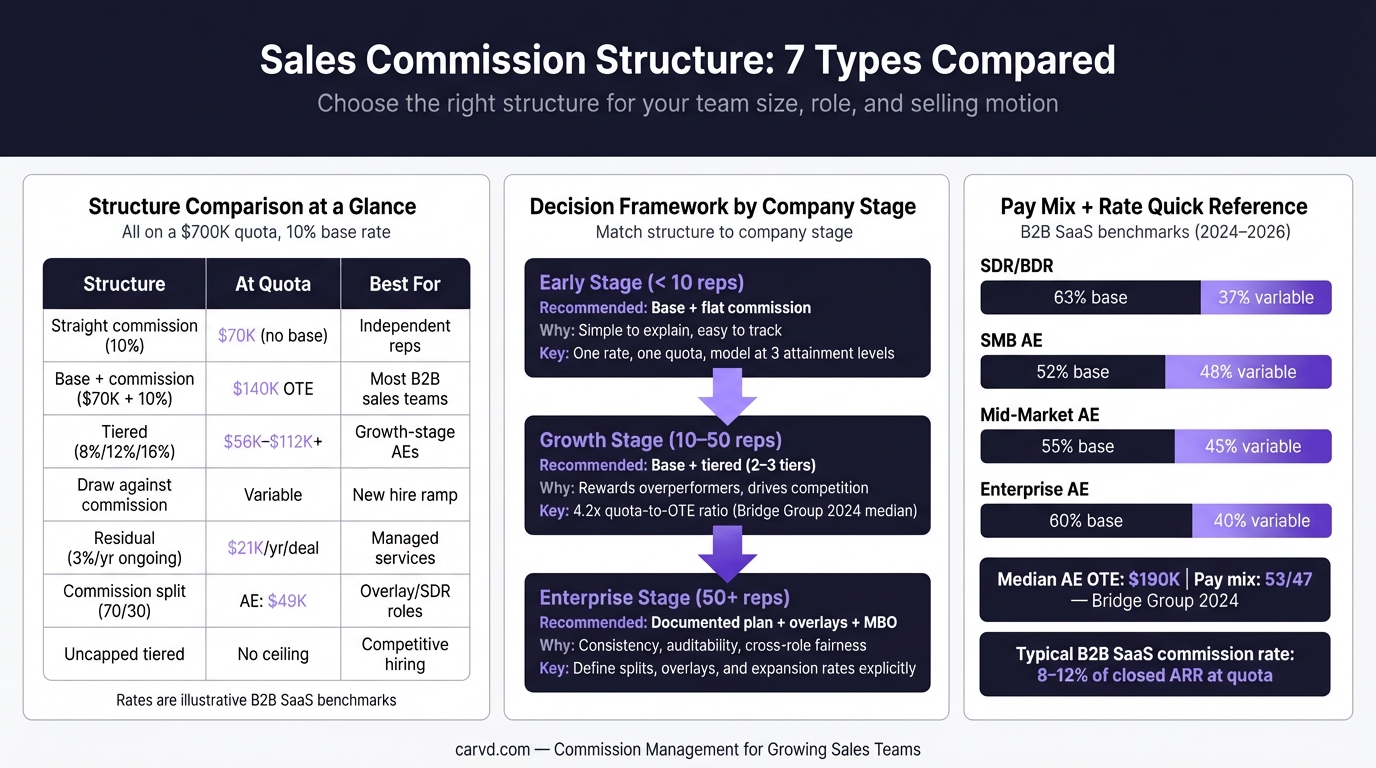
Commission structure comparison table
| Structure | Base salary | Complexity | Best for | Common in |
|---|---|---|---|---|
| Base + commission | Yes | Low–Medium | Most B2B sales roles | SaaS, tech, B2B |
| Flat rate | Yes | Low | Small teams, one product | Early-stage |
| Tiered / accelerators | Yes | Medium | Teams with performance variance | Growth-stage SaaS |
| Straight commission | No | Low–Medium | Contractors, channel | Insurance, real estate |
| Draw against commission | Draw (advance) | Medium | New hire ramp | Enterprise, long-cycle |
| Per-product | Yes | Medium–High | Multi-product orgs | SaaS, distribution |
| Residual | Yes + ongoing | Medium | Subscription accounts | SaaS, insurance, services |
| Commission split | Yes | High | Multi-contributor deals | Enterprise, channel |
| Uncapped | Yes | Low (but risky) | High performers, upside-heavy | Early-stage, SMB |
The key variables in any commission structure
Regardless of which structure you choose, five variables determine whether it works in practice.
1. Commission rate
Bridge Group's 2024 benchmark puts median SaaS AE commission rate at 11.5% of ACV at 100% quota attainment, with a typical range of 11–14%. Outside SaaS, rates vary significantly: insurance reps at 5–10% of premium, manufacturing reps at 5–8% of revenue, financial services at 25–40% of first-year product value.
The correct rate isn't a number you choose — it falls out of the OTE/quota math. If OTE variable target is $90,000 and quota is $900,000, the commission rate is 10%. Change the rate without changing quota, and you've changed OTE. They're the same equation.
2. Pay mix
The split between base salary and variable pay. Alexander Group's cross-industry benchmark puts the standard direct sales rep mix at 60% base / 40% variable. Bridge Group's SaaS-specific data is 53/47.
Higher variable works for short-cycle, high-frequency closes where reps can smooth out income volatility across the year. Lower variable (higher base) is appropriate for long-cycle enterprise deals where a single bad quarter can mean no commission earnings.
3. Quota
Set quota at 4–5x OTE. Bridge Group's 2024 data shows median quota:OTE ratio of 4.2x. If AE OTE is $190,000 with a 50/50 split, variable target is $95,000. At an 11.5% rate, quota should be roughly $826,000.
Quotas set from the top down — "we need $50M ARR this year, divide by headcount" — tend to be disconnected from rep-level attainability. Only 51% of SaaS AEs hit quota in 2024, down from 66% in 2022 (Bridge Group, 2024). When fewer than half your reps make their number, the plan is usually as much to blame as the market.
4. Accelerators and decelerators
Accelerators pay a higher commission rate above quota — typically 1.5x to 2x the base rate. A plan with 10% base commission might pay 15% above 100% quota and 20% above 125%.
Decelerators reduce the commission rate below a threshold, usually below 50–70% quota attainment. They reduce the total payout cost for low performers and signal that significant under-attainment has consequences.
5. Clawbacks
A clawback provision allows the company to recover previously paid commission when a deal cancels within a defined period — typically 30 to 180 days for SaaS. Without clawbacks, reps have no financial stake in whether the customers they closed actually stay.
For a detailed breakdown of clawback design and enforceability, see Commission Clawback: How to Design One That Works.
How to choose the right commission structure
The right structure isn't universal — it depends on company stage, team size, product complexity, and sales motion.
Early stage (under 10 reps, 1–2 products)
Use: Base + commission with a flat rate.
Keep it simple. Your plan needs to be explainable in two minutes and calculable without a spreadsheet. A flat rate is the right call until you have performance variance that justifies the complexity of tiers.
Set OTE first, then derive your commission rate from quota. Don't benchmark your rate against competitors before you know whether your quotas are comparable.
Growth stage (10–50 reps, multiple products or segments)
Use: Tiered commission with accelerators; consider per-product rates if margin varies significantly across lines.
At this stage, performance variance is real and differentiation matters. A tiered structure gives top performers a reason to keep closing after quota. Per-product rates help steer rep behavior toward deals that are strategically and economically better for the business.
Add a draw against commission for new hire ramp periods if your average sales cycle is longer than 60 days. A new AE closing enterprise deals won't generate meaningful commission in their first 90 days — without a draw, you'll lose them before they're productive.
Add clawbacks. At scale, churned customers and cancelled contracts are a meaningful financial exposure.
Mature or enterprise (50+ reps, complex territories or overlays)
Use: Tiered commission with territory/product splits; overlay quotas for SEs and specialists; commission splits for coordinated selling motions.
The complexity here is less about the commission structure itself and more about ensuring accuracy at scale. A commission calculation that involves 4 reps, 3 territory credits, 2 products, and an accelerator is the kind of plan that generates disputes when managed in spreadsheets.
CaptivateIQ's 2024 data found 53% of sales managers spend 2–3 days per pay period resolving commission disputes. That's not a calculation problem — it's a structure complexity problem that compound with scale. A formal dispute resolution workflow with an audit trail cuts resolution time significantly.
Why commission plan clarity matters as much as the structure itself
The most sophisticated commission plan fails if reps don't trust the output. QuotaPath's 2024 survey of 450+ revenue leaders found 78% say their reps find it difficult to understand their compensation plans — and 60% of reps take 3–6 months to fully understand how they're paid.
When reps can't verify their own commission, they do it manually. This is shadow accounting — reps maintaining personal spreadsheets to double-check company payouts. Shadow accounting is a tax on selling time and a signal of broken trust in the comp process.
The solution is rarely a simpler commission structure. It's transparency at the deal level: showing reps exactly which deals were included, which rate applied to each, and how the total was calculated. A tiered plan with accelerators is not too complex to understand — it's too complex to verify when the company publishes only a final number.
Tools like Carvd calculate commissions with a deal-by-deal breakdown, so reps can verify their own payout without building a parallel spreadsheet. That's what reduces disputes — not fewer tiers.
Common mistakes in commission structure design
Setting commission rate before quota. The rate is an output of the OTE/quota relationship, not an independent variable. Decide OTE first, set quota based on realistic pipeline, then derive the rate. You can use a commission plan builder to model different rate and quota combinations, or start in a spreadsheet — Stackrows has professional templates for every industry.
Changing plans mid-cycle. Alexander Group research found 89% of companies that adjusted compensation mid-cycle in 2024 did so because of misaligned quota or territory design — problems that should have been caught at plan design, not fixed mid-year. Mid-cycle changes destroy trust regardless of whether they benefit reps or hurt them.
Ignoring margin differences across products. Paying the same commission rate on a 20% margin product and an 80% margin product creates a business problem, not just an accounting one. Per-product rates exist for this reason.
Building accelerators without decelerators. If top performers earn disproportionately more above quota, consider whether below-threshold performance carries any consequence. One-sided incentive structures can create tolerance for persistent under-attainment.
Making plans too complex to verify. The 5-tier plan with 4 product rates, 2 territory overlays, and a quarterly SPIF modifier is theoretically optimal and practically unverifiable. Reps who can't track their own earnings mentally will shadow-account or disengage.
Tracking commissions across plan types
The plan type affects how much calculation work is involved at the end of each period. A flat commission on a spreadsheet is a two-column formula. A tiered, multi-product plan with splits, clawbacks, and accelerators across a 30-rep team is where errors compound.
66% of companies have made commission errors in the past year according to CaptivateIQ's 2024 data. Most aren't calculation mistakes in isolation — they're errors introduced when the plan type exceeds the capability of the system tracking it.
For more on commission operations — how to calculate, track, and audit commissions at scale — see the Commission Operations pillar and posts on commission spreadsheets, commission errors, and commission automation.
Summary
There is no single best commission structure. The right choice depends on team size, deal complexity, product margin, and what behavior you're trying to drive.
Use flat commission when simplicity matters more than differentiation. Move to tiered when you need to reward overperformance. Add per-product rates when margins diverge meaningfully across your catalog. Draw against commission for ramp periods. Residual for churn accountability. Splits for coordinated selling motions.
Whatever structure you choose, two things determine whether it works: reps understand how it was calculated, and the calculation is accurate. A plan reps don't trust is a plan that isn't working — regardless of how well it's designed on paper. For a side-by-side breakdown of how Carvd handles this differently from enterprise tools, see how Carvd compares to QuotaPath.
Last updated: March 21, 2026