Commission Splits: When and How to Split Sales Credit
Learn when commission splits make sense, how to set percentages, and how to avoid the disputes and over-crediting that erode sales team trust.
Dividing sales credit sounds simple. Two reps worked the deal — split it 50/50.
But once you have overlay specialists, inside/field rep pairings, named account managers, and channel partners, the commission split logic compounds fast. The Alexander Group documented a case at a $4 billion software company where a single deal involved 41 people receiving commission credit — and hundreds of hours were spent resolving the resulting dispute.
That's the extreme end. But the underlying problem is common. According to a WorldatWork survey conducted with the Alexander Group, 58% of companies credit two or more sellers per transaction. Most haven't designed formal split rules — which means they're managing split disputes deal by deal.
What is a commission split?
A commission split divides the credit for a deal between two or more reps. Because commission is calculated as a percentage of credit, splitting credit splits the payout.
Two distinct structures exist:
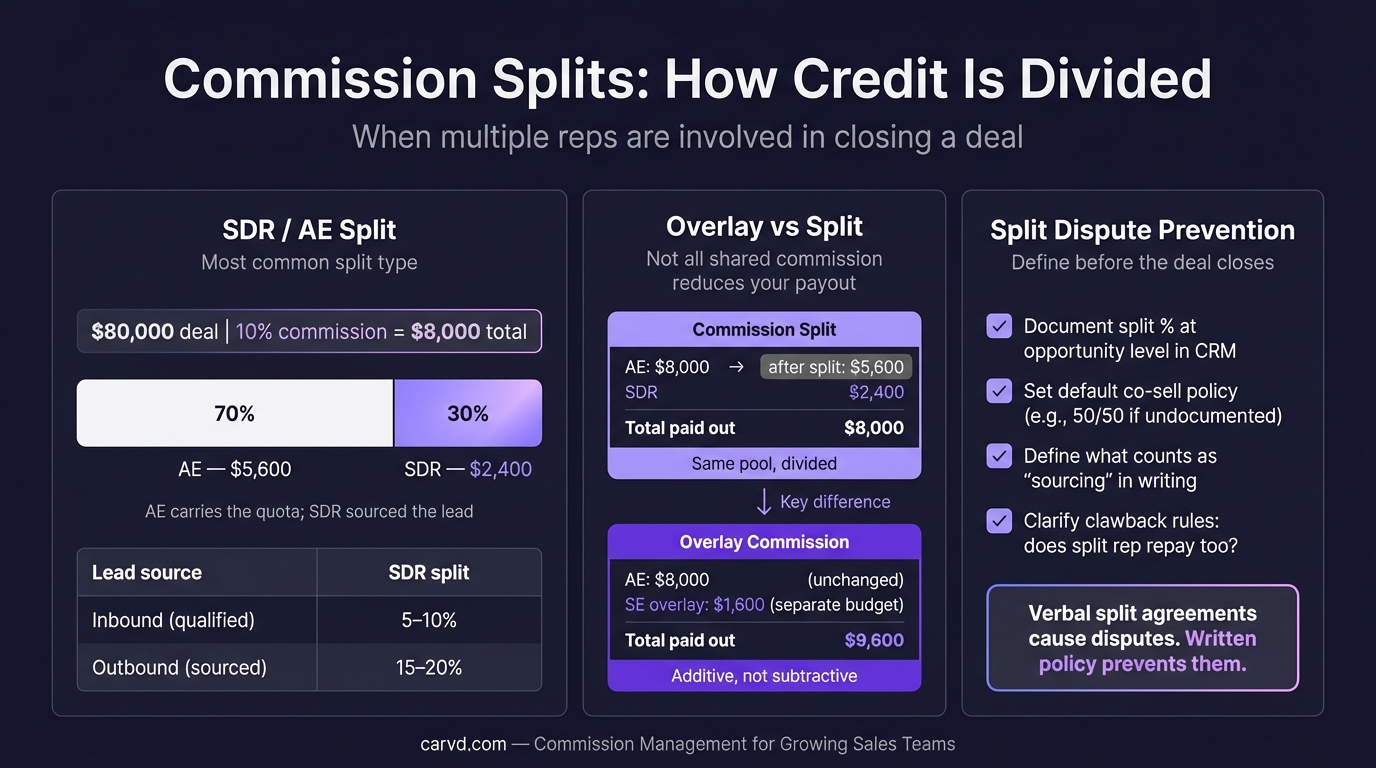
Revenue splits: The deal's credit totals exactly 100%, divided among contributors. A 60/40 split gives the primary rep 60% of the deal's commission value and the secondary rep 40%. The company pays commission on 100% of actual revenue.
Double crediting: Each contributor receives 100% credit, so total credited revenue exceeds the actual deal value. A primary AE and an overlay solutions engineer each receive full credit for a $200,000 deal — the company effectively credits $400,000 for $200,000 in actual revenue. This costs more but incentivizes collaboration without penalizing either rep for involving the other.
Most companies use revenue splits for same-role pairings (two AEs co-selling) and double crediting for overlay specialists (solutions engineers, technical specialists, industry overlays).
When commission splits make sense
Splits solve a specific problem: a deal closed because of multiple people's work, but the commission plan only accommodates one rep.
Territory overlap. A national account headquartered in New York operates in three states. The global account manager negotiated the master contract; regional reps service the local accounts. Without splits, nobody is incentivized to cooperate. A common default for this pattern is 25% to the global account manager and 75% to the primary local rep — though the right ratio depends on where the selling and relationship work actually happened.
Inside/field pairings. An inside rep qualifies and advances the deal; a field rep closes it in person. Both contributed meaningfully at different stages. A 40/60 split (more to the closer) is a reasonable starting point. The right number depends on how actively the inside rep stayed involved through late-stage negotiations.
Overlay specialists. Solutions engineers, technical specialists, and product experts who join deals to handle complex requirements. Most companies award these roles full double credit alongside the AE rather than splitting credit — any dilution reduces the specialist's willingness to engage on the next deal.
Channel and referral partners. When an external partner sourced or significantly contributed to a deal, they typically receive 10–30% of the deal's commission value, depending on the partner's role and industry norms. Partner commission arrangements usually sit outside the core rep comp plan but draw from the same commission budget.
Setting split percentages
Three approaches exist, and they're not equally reliable.
Predefined defaults by scenario. The most defensible approach. Define split percentages for each deal type in your comp plan documentation before deals happen. For example:
| Scenario | Primary rep | Secondary rep |
|---|---|---|
| Two co-equal AEs | 50% | 50% |
| Field close / inside source | 60% | 40% |
| HQ account manager + local rep | 75% | 25% |
| Overlay specialist | 100% | 100% (double credit) |
Forrester recommends predefined defaults with a formal escalation path — a compensation review board or designated approver — for edge cases that don't fit the table. Without that escalation path, every unusual deal becomes a manager negotiation, which is slow and inconsistent.
Contribution-based splits. Some companies weight splits by measurable activity: days on the deal, number of calls completed, specific milestones owned. This sounds fair but creates an incentive problem — reps log activities to claim more credit rather than to actually advance the deal. Use this only when you can define contribution criteria that are difficult to game.
Negotiated splits. Two reps agree on a percentage and a manager approves it. This offers flexibility and produces the most disputes. Deals close, memories of who did what diverge, and without documentation from the time of negotiation, you have no record to fall back on.
Predefined defaults with a review escalation for edge cases is the right model for most teams. The other two approaches require more RevOps bandwidth than most sales ops teams have.
The over-crediting problem
Double crediting is a legitimate design choice, but it has a natural expansion problem. Reps learn that looping in a specialist increases their visibility without reducing their payout. Managers approve credits to keep their teams happy. Org changes add new roles to existing deal credit lists.
The same WorldatWork/Alexander Group survey found that 16% of companies have duplicate crediting that exceeds 112% of actual revenue — meaning they're paying commission on more revenue than they closed. Over time, this compounds the commission expense line without a corresponding increase in closed business.
The fix is a defined list of credit-eligible roles for each deal type, reviewed at least annually. If overlay specialist double credit only applies to specific product categories or deal sizes above a threshold, you prevent the casual "loop in the SE to get more eyeballs" behavior that quietly expands your commission expense.
Common mistakes
Defining splits after deals close. This is the single most common cause of split disputes. Two reps worked a deal. It closes. Now they negotiate percentages. Both remember contributing more than the other. Without a predefined rule, the split becomes a negotiation — and negotiations at this stage are slow and expensive.
No rules for expansion revenue. A deal splits 60/40. The customer expands six months later. Which rep owns the expansion credit? If your comp plan doesn't answer this, you'll run the same negotiation again, with the same potential for dispute. A dispute resolution workflow with an audit trail makes these disagreements resolvable in minutes rather than days.
Informal agreements between reps. Two reps agree verbally on a split outside the comp plan. Finance doesn't know. The deal closes and pays at whatever the system default is. One rep expected 60/40; the other assumed 50/50. Your comp plan documentation — not Slack messages or verbal agreements — should be the only governing source for credit allocation.
Letting credit lists grow unchecked. Each quarter, audit which roles received credit on split deals. Credit lists tend to expand as teams grow and org structures change. An annual review keeps the list aligned with actual contribution, not historical precedent.
Tracking split commissions
Split structures add a step to commission calculations: credit allocation has to happen before the commission math runs.
In a spreadsheet, this means adding a credit percentage column to deal data, then calculating commission as deal value × credit percentage × commission rate. For five to ten reps with occasional splits, that's manageable. For teams where splits are routine — fifteen-plus reps with territory overlaps or overlay programs — the spreadsheet becomes a maintenance problem. Each deal needs a manual credit entry, and errors in the credit column cascade into incorrect payouts across the whole team.
Tools like Carvd let you define split percentages at the deal level or set defaults by plan type, so commission calculations pull the right credit allocation automatically. Reps see their credit share in the deal-by-deal breakdown on their rep dashboard — which reduces the "I got paid wrong" conversation that eats ops time every close period.
What to include in your comp plan documentation
Any compensation plan that uses splits needs these rules in writing before the first split deal closes:
- Which roles are eligible for credit on each deal type
- Default split percentages by scenario
- Whether splits are revenue splits (total credit = 100%) or double crediting (total credit exceeds 100%)
- How expansion and renewal revenue is credited
- The escalation process for deals that don't fit the predefined scenarios
This documentation won't prevent every dispute. But it converts "my interpretation vs. yours" into "here's the written rule" — which is a much faster resolution.
For more on commission plan structures, see the full Sales Commission Structure guide, or dig into specific structures: Tiered Commission Structures and Draw Against Commission. For a side-by-side look at how Carvd handles splits compared to other tools, see how Carvd compares to Everstage.
Last updated: March 21, 2026