SaaS Sales Commission Rates: What's Standard in 2026?
Bridge Group 2024 data: median SaaS AE commission rate is 11.5% of ACV. Here's how rates vary by segment, role, and quota attainment — with verified benchmarks.
The median commission rate for a SaaS AE is 11.5% of Annual Contract Value — that's the headline from Bridge Group's 2024 AE Metrics & Compensation Benchmark, which surveyed 172 B2B SaaS companies. But the median hides a lot of variance.
An SMB AE closing $30K deals earns a different rate than an enterprise AE closing $500K deals. A rep at 130% quota attainment earns more per dollar of revenue than one at 85%. And a company paying 10% in year one often pays 4% on renewals.
Here's what SaaS commission rates actually look like across segments, roles, and deal types.
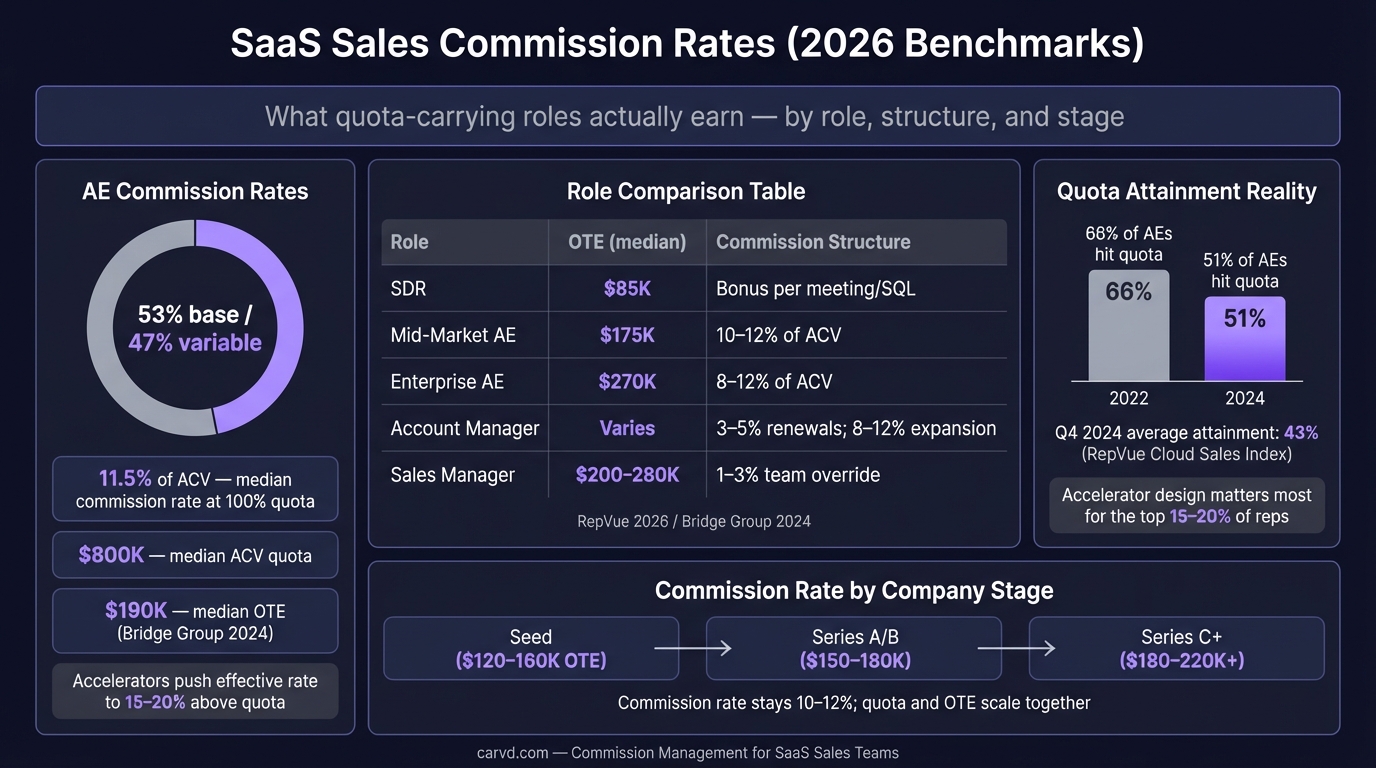
The baseline: SaaS AE commission rates in 2026
Bridge Group's 2024 survey is the most cited primary source for SaaS commission benchmarks. Key findings:
- Median commission rate at 100% quota: 11.5% of ACV
- Typical range: 11–14% of ACV
- Median AE OTE: $190,000 (up from $167,000 in 2022)
- Base-to-variable split: 53:47
- Median annual quota: $800,000 ACV
- Quota-to-OTE ratio: 4.2x median (range: 3.2x–4.8x)
The math at the median: an AE with an $800K quota hitting it exactly earns $92,000 in commission ($800K × 11.5%), plus roughly $101,000 in base salary, totaling $193,000 OTE. Close enough to the $190K median to check out.
ICONIQ's August 2025 GTM Compensation & Incentives Guide, which draws on portfolio company data for higher-growth and later-stage SaaS companies, puts the median new logo commission rate at approximately 10%, with renewal commission rates at 4–5%. The lower new logo rate in ICONIQ's data reflects that their portfolio skews toward larger deals where smaller rates generate equivalent absolute payouts.
Commission rates by segment
Deal size drives rate as much as industry does. Here's the typical range:
| Segment | Commission rate | Typical OTE |
|---|---|---|
| SMB AE (under $50K ACV) | 10–15% | $105K–$140K |
| Mid-market AE ($50K–$250K ACV) | 8–12% | $155K–$200K |
| Enterprise AE ($250K+ ACV) | 5–8% | $230K–$320K |
Sources: Bridge Group 2024, ICONIQ GTM Guide August 2025, Prowi 2026
The inverse relationship between deal size and commission rate is intentional. A 5% commission on a $300K enterprise deal is $15,000 — a strong single-deal payout. A 5% rate on a $30K SMB deal would produce only $1,500, which wouldn't be enough to motivate reps or generate reasonable income at a realistic close rate. You can model how segment-specific rates affect total earnings at different attainment levels with the commission calculator.
Pay mix: base vs. variable
The 50/50 split between base salary and variable commission is the most common structure for SaaS AEs, but it varies by role:
| Role | Base:Variable split | OTE range |
|---|---|---|
| SDR / BDR | 65:35 | $75K–$100K |
| AE (SMB) | 50:50 to 55:45 | $105K–$140K |
| AE (mid-market) | 53:47 (median) | $155K–$200K |
| AE (enterprise) | 50:50 | $230K–$320K |
| Account Manager | 60:40 to 70:30 | $130K–$190K |
Enterprise AEs earn slightly more base relative to variable in some orgs — not because the companies want to pay less variable, but because 18-month sales cycles create income volatility that makes heavy variable comp harder to sustain.
How SaaS SDRs are paid
SDRs are typically not paid a percentage of deal value because they don't own the close. Instead, their variable comp is tied to pipeline-generation activity:
- Per qualified meeting set: $20–$50 per meeting (Bridge Group / Alexander Group benchmarks via Prowi 2026)
- Per SQL accepted by AE: $100–$250 per opportunity
- Base salary: $50,000–$65,000 (Betts Recruiting 2026 data)
- Total OTE: $75,000–$100,000; enterprise-segment SDRs in Tier 1 markets approach $100K–$120K
Monthly meeting quotas typically run 12–22 meetings depending on the segment and seniority. Tenbound's 2024 SDR Market Report found only 63–68% of SDRs hit their meeting quota, which is why most plans weight on meetings held (a partially controllable metric) as well as SQLs accepted (which depends on AE feedback).
Commission rates on renewals and expansion
New logo commissions and renewal commissions are almost always different rates:
- New logo / new ARR: 10–15% (SMB) to 5–8% (enterprise)
- Renewal commission: 4–5% on the renewed ACV (ICONIQ 2025 data)
- Expansion / upsell: typically the same rate as new logo for the incremental ACV
89% of SaaS companies pay AEs commissions on new logo and new recurring revenue, according to ICONIQ's August 2025 GTM guide. Separate commission rates for renewals are most common when the same rep owns both new business and renewal — giving them full incentive to protect existing revenue.
Account managers who own a renewal book typically work on 60:40 or 70:30 base:variable splits, with commission on renewal and expansion ACV at 5–10%.
Accelerators above quota
82% of SaaS companies use commission accelerators above quota (ICONIQ 2023). The typical structure:
| Quota attainment | Commission rate multiple |
|---|---|
| 0–100% | 1x base rate |
| 100–125% | 1.5x base rate |
| 125–150% | 2x base rate |
| 150%+ | 2–5x base rate (less common) |
At an 11.5% base rate, a rep at 130% attainment earns approximately 23% commission on the revenue above quota. Everstage's analysis of commission plan data shows accelerators increase revenue per rep by 13–17% and lift rep satisfaction from 45% to 73% compared to flat plans.
Fewer than 15% of SaaS companies cap commission at quota attainment — most have moved away from caps because they demotivate top performers during high-performance periods.
Quota attainment reality check
The commission rates above assume quota attainment. In 2024, the actual number is sobering: only 51% of SaaS AEs hit quota, down from 66% in 2022 (Bridge Group 2024).
That means for roughly half the field, the 11.5% rate is applied to less than $800K in ACV — and with accelerators structured to kick in above 100%, most reps aren't earning above-rate commissions. The majority of variable comp gains flow to the top quartile of the sales team.
This has practical implications for plan design. If you're setting quota, you want at least 60–70% of reps hitting it (the Alexander Group's target range for healthy quota attainment). The current 51% attainment rate across the industry suggests many SaaS companies have pushed quotas too aggressively relative to market conditions. Importing your deal data via CSV or CRM sync and running the calculation against your actual plan reveals whether your quotas are realistic for your team.
The quota-to-OTE ratio
The quota-to-OTE ratio tells you how many dollars a rep needs to close to earn back their full OTE:
- Bridge Group 2024 median: 4.2x ($800K quota / $190K OTE)
- Bridge Group typical range: 3.2x–4.8x
- ICONIQ GTM Guide (later-stage companies): 5–8x
- SaaStr / general SaaS rule of thumb: 4–6x, with 5x cited as a sustainable steady state
The variation between Bridge Group (4.2x) and ICONIQ (5–8x) reflects the different populations. Bridge Group surveys a broader cross-section including $5M–$50M ARR companies. ICONIQ's portfolio skews toward higher-growth companies with larger quotas and deal sizes — where a 7x ratio still generates significant rep income because the ACV is large enough.
A ratio below 3x typically signals the quota is too low (expensive comp structure). Above 8x, most reps won't hit quota and churn accelerates.
How these rates compare to other industries
SaaS commission rates sit in the middle of the spectrum:
- SaaS / software: 8–15% of ACV
- Staffing / recruiting: 15–25% of first-year salary
- Insurance (new life policy): 55–120% of first-year premium
- Real estate: 2.77% per side (higher absolute payout on large assets)
- Manufacturing: 5–15% of net sales
The SaaS model works at these rates because margins are high (70–80%+) and contracts recur. A 12% commission on $100K ACV is $12,000 — worth it against $70K–$80K gross margin on that contract.
For a full breakdown across industries, see our sales commission rates by industry guide.
Designing a SaaS commission plan
If you're setting rates for a SaaS sales team:
Start with the quota-to-OTE ratio. Set quota at 4–5x OTE for SMB/mid-market AEs. For enterprise, 5–7x is workable if average deal sizes are large.
Build in accelerators. Set a threshold at 100% quota, with meaningful step-ups at 125% and 150%. Caps are optional but often signal distrust; most well-designed plans have none.
Differentiate new logo from renewal. New logo should pay more to reflect the acquisition effort. A common structure: 12% on new ACV, 5% on renewal ACV.
SDR pay should be activity-based. Per-meeting and per-SQL bonuses keep incentives tied to inputs SDRs control. A $50 per-meeting structure on a 20-meeting monthly quota creates $1,000/month variable — reasonable on a $55K base.
Tools like Carvd let you model these structures before committing, then automate calculation once you've set the plan — so reps can see exactly how their commission was derived for every deal. For a side-by-side comparison with other SaaS commission platforms, see how Carvd compares to Everstage.
For a broader benchmark, see the average sales commission percentage guide — the pillar reference for this category.
Related reading:
Last updated: March 23, 2026