How Much Commission Should You Pay Sales Reps? A Practical Framework
Don't start with the rate — start with OTE and quota. Here's the framework for setting commission rates that are competitive, sustainable, and actually motivate reps.
"What's a fair commission rate?" is the wrong question to ask first. If you start with a percentage and build the comp plan around it, you'll either overpay reps (commission expense balloons past what the business can sustain) or underpay them (turnover solves the problem for you, expensively). The rate is a result, not a starting point.
Here's how to figure out how much commission to pay — starting with the right variables.
Step 1: Decide what reps should earn at 100% quota
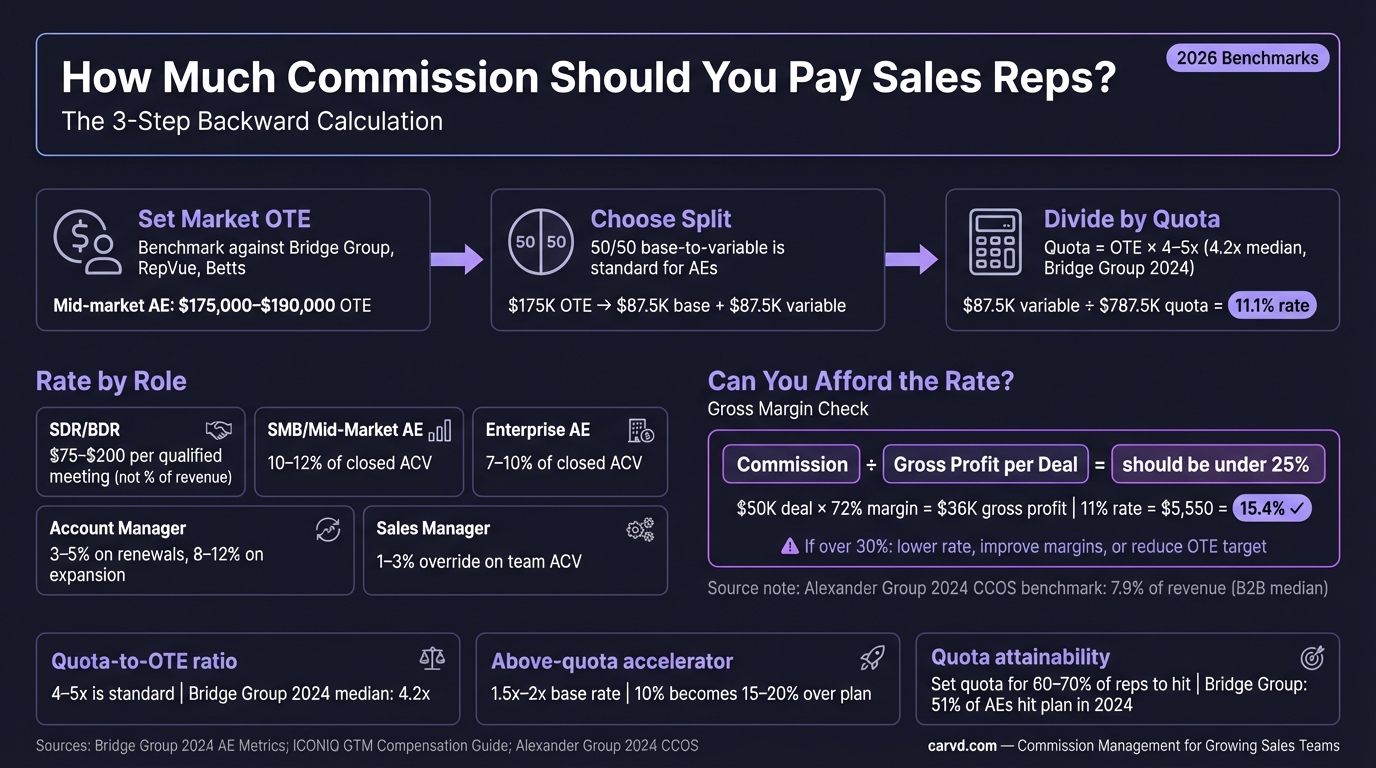
The correct sequence for setting commission rates starts with market OTE — what you need to pay to hire and retain the caliber of rep you need.
This is competitive intelligence, not math. Look at:
- Bridge Group's annual AE Metrics & Compensation Report — covers OTE, quota, base/variable split for B2B SaaS roles
- RepVue — real comp data submitted by reps, searchable by company and role
- Betts Recruiting — publishes annual sales salary guides by role, stage, and market
For B2B SaaS in 2024: Bridge Group's survey of 172 companies found median AE OTE at $190K (53% base / 47% variable). SDR OTE ran lower, typically in the $75K–$95K range depending on market.
Once you know the OTE, you know the variable component. At a 50/50 split on $180K OTE, the rep earns $90K in commission at 100% quota attainment.
Step 2: Set a realistic quota
Quota determines how much revenue a rep is responsible for generating. The commission rate then falls out of the relationship between variable OTE and quota.
Bridge Group's 2024 data shows a median quota-to-OTE ratio of 4.2x for SaaS AEs, with a healthy range of 3.2x–4.8x. At a 50/50 split and 4.2x ratio, a rep with $190K OTE carries roughly an $800K quota.
The practical formula:
Commission rate = Variable OTE ÷ Annual quota
At $95K variable OTE and an $800K quota: $95K ÷ $800K = 11.9%. That's close to Bridge Group's reported median of 11.5% of ACV — not a coincidence. The benchmarks are consistent because they all come from the same underlying logic. The commission calculator lets you plug in OTE, quota, and deal sizes to see exactly what reps will earn at different attainment levels — before you commit to a rate.
What happens when you ignore this:
- Set a 10% rate on a $1.5M quota with $95K variable OTE: a rep hitting 100% earns $150K in commission — well above their $95K variable target. You're overpaying.
- Set a 10% rate on a $1.5M quota and reduce OTE to match: the rep learns their OTE is only achievable in theory, because 100% quota attainment is unrealistic. RepVue's Q4 2024 Cloud Sales Index puts average quota attainment across the industry at 43%.
Step 3: Run the sustainability check
Before finalizing any rate, model what it costs the business if the team hits quota.
Total commission expense at 100% quota = commission rate × total team quota
If you have 10 AEs each carrying $800K quotas ($8M total) at a 10% commission rate, you're on the hook for $800K in commissions if the team hits. That's 10% of $8M revenue.
For most B2B SaaS companies, a blended commission expense of 8–12% of revenue is workable. Below 6% typically signals undermarket comp; above 15% puts pressure on gross margin, especially pre-Series B when margins are lower.
Check your numbers against SaaS benchmarks:
| Team quota attainment | What happens to commission expense |
|---|---|
| 70% | You pay 70% of your modeled cost — gives you budget breathing room |
| 100% | You pay exactly what you modeled |
| 120% | You owe the accelerators on top of base rate — budget for this |
Build the accelerator cost into your model. If 20% of your team hits 120%+ of quota at a 1.5x accelerator, that's not a rounding error — it's a planned cost that makes the plan work. The commission plan builder models accelerator costs across different attainment distributions so you can see the budget impact before you announce the plan.
What the benchmarks actually say
If you need a starting point by role before you have your own OTE and quota numbers locked in:
| Role | Typical commission structure | Rate range |
|---|---|---|
| SDR / BDR | Per qualified meeting or SQL | $20–$250 per event |
| SMB AE (under $25K ACV) | % of ACV | 10–15% |
| Mid-market AE ($25K–$100K ACV) | % of ACV | 8–12% |
| Enterprise AE ($100K+ ACV) | % of ACV | 4–8% |
| Account manager (renewals) | % of renewed ACV | 4–5% |
| Account manager (expansion) | % of expanded ACV | 7–10% |
| Sales manager | Override on team revenue | 2–3% |
These ranges come from Bridge Group's 2024 SaaS data and ICONIQ's GTM Compensation Guide. They reflect current practice, not an ideal — the right rate for your team may sit outside these bands if your sales motion or margins are atypical.
SDRs are worth calling out specifically: they generate pipeline, not closed revenue, so paying them a percentage of deals they sourced but didn't close misaligns incentives. Per-meeting or per-SQL compensation is the norm because it rewards the behavior the role actually controls.
New business vs. renewals: the rate isn't the same
If your sales org handles both acquiring and retaining customers, you'll need different rates for each motion.
ICONIQ's GTM Compensation Guide shows new business rates averaging around 10% of ACV. Renewal rates from the same dataset run 4–5% — roughly half. The logic: closing a new customer requires prospecting, discovery, competitive positioning, and negotiation. Renewing an existing customer who's happy with the product is a different (and typically shorter) sales cycle.
Expansion and upsell rates tend to fall between the two — typically 7–10% — because growing an account requires active selling, but the customer relationship lowers the selling overhead.
If you pay AMs renewal rates equivalent to new business rates, you'll overpay for low-effort renewals. If you pay no commission on renewals at all, your AMs will deprioritize retention in favor of new logo activity. Set renewal rates consciously, not by accident. For a look at how different tools handle multi-rate plan structures, see how Carvd compares to Spiff and Sales Cookie on plan complexity.
The two most common mistakes
Setting the rate before setting quota. "We'll pay 8% commission" is a budget decision masquerading as a comp design decision. 8% of what? On what timeline? For a rep covering what territory? The rate is only meaningful in relationship to quota and OTE.
Under-modeling accelerators. Many comp plans include accelerators — higher rates above quota — but budget only for the base rate. If 25% of your team hits 120%+ of quota at a 1.5x accelerator, that adds meaningful cost. Build that into your model before you announce the plan.
A practical starting point for new plans
If you're building a comp plan from scratch:
- Look up market OTE for the role on Bridge Group, Betts, or RepVue
- Set a quota-to-OTE ratio of 4x–5x (Bridge Group median is 4.2x for SaaS AEs)
- Decide your base-to-variable split (50/50 is standard for AEs; 60/40 is common for SDRs)
- Calculate the commission rate: Variable OTE ÷ Quota
- Check that it falls within the benchmark range for your segment
- Model total commission expense at 100%, 80%, and 120% quota attainment
Carvd makes it easy to model different rate scenarios before rolling out a plan — you can test flat, tiered, and accelerator structures against your deal data to see what the numbers actually look like at various attainment levels.
The goal is a rate that's competitive enough to hire and retain reps, sustainable enough to not break the business, and simple enough that reps can calculate their own payout without needing to call finance.
For broader benchmarks, see the full average sales commission percentage guide, which covers rates by industry and role. For how to evaluate whether a rate is competitive, see what is a good commission rate. For role-by-role benchmark ranges, see standard commission rates.
Last updated: March 23, 2026